


 She underscored that manufacturing decisions increasingly hinge on confidence in long‑term market access and reliable supply, rather than solely on minimising immediate costs.
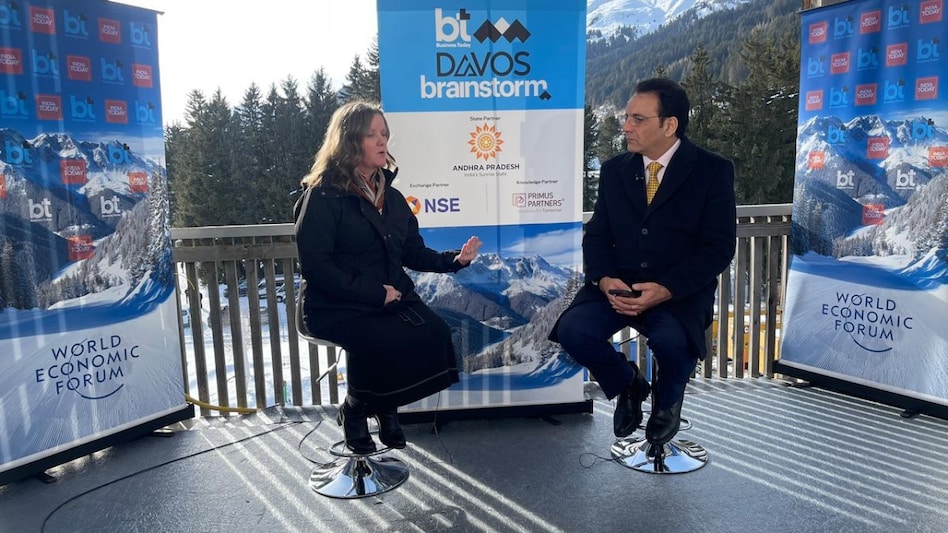
The global manufacturing landscape and supply chain networks are undergoing a fundamental shift, no longer driven by cost efficiency alone but increasingly shaped by geopolitics, risk and structural volatility, said Kiva Allgood, Managing Director of the World Economic Forum (WEF), in a conversation at the WEF Annual Meeting 2026 in Davos.
In an exclusive interaction with Business Today TV, Allgood described how traditional manufacturing paradigms such as “just‑in‑time” are evolving into models that prioritise resilience, market proximity and adaptability. She said that the stress of the COVID‑19 pandemic and subsequent geopolitical tensions have accelerated a reassessment of global supply chain logic, prompting companies and countries to rethink where and how production happens.
Catch the exclusive coverage of WEF 2026 at Davos here
“All of that seems to be now changing for companies,” Allgood noted, pointing to emerging priorities such as sustainability, infrastructure readiness, talent development and access to complete ecosystems — not just low labor costs — as decisive in attracting foreign investment.
According to a WEF report released at the Summit, global supply chains have entered an era of structural volatility, where disruption is a permanent condition rather than a temporary shock, forcing leaders to build systems capable of navigating ongoing uncertainty. Nearly three‑quarters of executives now see resilience as a critical growth driver.
Geopolitics & reconfiguration of trade
Allgood highlighted how shifting trade policies, tariffs and geopolitical fragmentation are reshaping corporate strategies. The old model — centered on low‑cost hubs and free‑trade pathways — is giving way to regionalised and resilient networks that can respond to local demand and political risk.
She underscored that manufacturing decisions increasingly hinge on confidence in long‑term market access and reliable supply, rather than solely on minimising immediate costs. Industries such as semiconductors and biomanufacturing will see continued diversification and specialisation as companies look beyond simply replicating past supply chain structures.
Policy choices & national strategies
Allgood urged policymakers to define clear objectives when designing industrial strategies, whether the focus is on job creation, food security or economic diversification. She warned against reactive measures and instead advocated for early engagement with industry to craft policies that both government and business can implement effectively.
She also rejected simplistic narratives of manufacturing as a “dirty and low‑skill” sector, emphasising that modern production involves advanced technologies, automation and skilled human oversight. While automation will replace some repetitive tasks, it also creates new, higher‑value roles in areas such as operations decision‑making and robotics management .
New playbook for supply chains
The WEF 2026 Global Value Chains Outlook emphasises that supply chains must become agile, digitally enabled and future‑ready, integrating real‑time data, scenario planning and ecosystem coordination to thrive amid global volatility. The Forum also introduced a digital Manufacturing and Supply Chain Readiness Navigator to help governments and businesses assess competitiveness and identify gaps in infrastructure and capabilities.
For CEOs, Allgood said, Davos continues to serve as a unique platform for candid dialogue and collective learning — a space where leaders can confront uncertainty, share insights and build partnerships that improve strategic decision‑making in an unpredictable world.
Watch the full interview here

 'Will discharge my responsibilities with complete humility': Pralhad Joshi after being appointed Education Minister
 'All Delhi metro stations open for passengers,' says DMRC after CJP calls off Jantar Mantar protests
 Who is Pralhad Joshi? Modi names veteran Karnataka BJP leader to lead Education Ministry after Pradhan's exit
 The 'Two-Income Trap': Why higher salaries aren't translating into wealth -- expert explains
 Corporate FDs offer up to 9.1% interest: Should you choose them over bank fixed deposits?
 FDs vs Markets: Where Should You Keep Your Short-Term Money?
 Why Term Insurance Is Essential for Every Earning Member | Sum Assured & Coverage Explained
 Pakistan's Alleged Terror-Politics Nexus: Lashkar Links Spark Questions Over Fazlur Rehman
 Think Life Insurance Is Optional? Here's Why Every Indian Family Needs It Today
 FD Vs Arbitrage Fund: Which Is Better For High Taxpayers?
 Adani Power: 45 GW target, Rs 2 lakh crore capex plan among conference call highlights
  ITC Hotels, Chalet, Ventive, IHCL, SAMHI: Hotel stocks to buy despite travel disruptions
 ITC shares: Rs 307 a key short-term level to watch; here's target price
 Mphasis shares: FY27 guidance maintained; brokerages keep 'Buy' after Q1; check target price
 Should you buy every IPO? Research suggests patience may be the smarter strategy
 Petrol, diesel prices today, July 26: Check latest rates in Delhi, Mumbai, Chennai, Kolkata and other cities
 LPG, CNG, PNG prices today, July 26: Check latest rates in Delhi, Mumbai, Chandigarh, other cities'All Delhi metro stations open for passengers,' says DMRC after CJP calls off Jantar Mantar protests
 Warren Buffett's 500-pages a day rule: Tactics to build a sharper mind through regular reading
 Quote of the Day by Narayana Murthy : ‘Entrepreneurship is all about...’









