












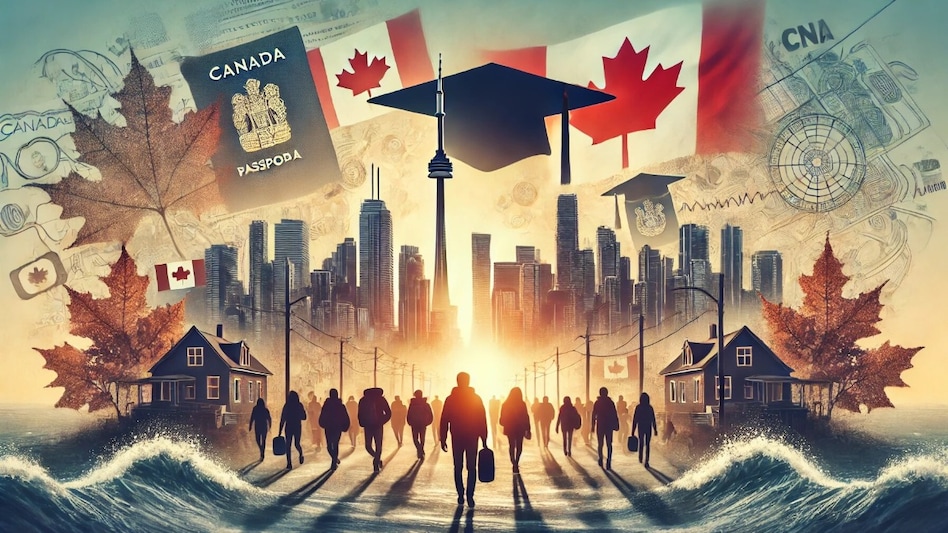
 As per the IRCC, 47,175 international students have been marked “non-compliant,” meaning they are not attending classes as required by their study permits.
 As per the IRCC, 47,175 international students have been marked “non-compliant,” meaning they are not attending classes as required by their study permits.
Canada’s stricter visa and study permit regulations are sparking growing anxiety among international students — particularly Indians — who once viewed the country as a stable gateway to education and permanent residency. Now, as costs rise and approval rates fall, many are rethinking their plans.
In a recent revelation that underscores the depth of the issue, about 47,000 foreign students may have violated their visa conditions and are living in Canada illegally, according to Aiesha Zafar, head of migration integrity at the House of Commons Committee. The data, first reported by The National Post, comes from Immigration, Refugees and Citizenship Canada (IRCC).
As per the IRCC, 47,175 international students have been marked “non-compliant,” meaning they are not attending classes as required by their study permits. Zafar noted that while several nationalities are involved, India ranks among the highest in such cases.
These numbers are based on compliance reports filed by Canadian colleges and universities, which are obligated to notify IRCC when students stop attending classes. The reports are then forwarded to the Canada Border Services Agency (CBSA) for potential investigation. However, officials admit that the tracking system has major gaps — if schools fail to report absences, missing students often go untraced.
Zafar further explained that determining the exact number of non-compliant students remains difficult since enforcement and investigations are handled by the CBSA.
Earlier this year, IRCC said that during spring 2024 alone, colleges flagged around 50,000 international students as “no-shows.” Of these, nearly 20,000 were from India, followed by over 4,200 from China.
The revelations have reignited debate over Canada’s oversight of its international education system — a sector that has become vital to both the university ecosystem and the national labour market.
Dip in Indian student permits
The controversy comes amid a steep fall in new study permits issued to Indian nationals.
According to ICEF Monitor, between January and July 2025, Canada granted only 52,765 permits to Indians — a dramatic decline from 188,255 during the same period in 2024. Current projections suggest the number may not exceed 90,000 by year-end, marking a 67% drop compared to 2023.
This downturn aligns with Canada’s 2025–2027 Immigration Levels Plan, which seeks to reduce the number of temporary residents to below 5% of the total population. During the first half of 2025, total arrivals — including students and foreign workers — fell by 57% year-on-year. The number of international students dropped by over 70%, while foreign work permits saw a 50% decline.
For Indian applicants, the situation is particularly grim: study permit rejection rates have soared to nearly 80% this year, the highest among all nationalities.
Indian students explore alternatives
With the Canadian dream fading, many Indian families are exploring other destinations for affordable, stable education and post-study opportunities. Austria, for instance, has emerged as a growing favorite thanks to its lower tuition fees, liberal post-study work options, and access to the wider European job market.
Education consultants note a similar trend toward Germany, the Netherlands, and Ireland, as students seek clarity, affordability, and a realistic path to long-term settlement — something Canada is increasingly struggling to offer.
 Banking shares gain on credit line guarantee scheme for MSMEs; how banks stand to gain
 Sensex, Nifty: Why stock market jumped sharply in afternoon trade
 All about KC Venugopal, the election strategist set to become Kerala CM
 Himanta resigns as Assam CM but new govt oath-taking ceremony likely only after May 11
 BT Explainer: What will Sebi’s new taskforce on AI do?
 China’s Night Tourism Boom: Cultural Shows, Drone Displays Draw Massive Crowds During Holiday
 Met Gala 2026: Karan Johar Debuts, Isha Ambani Shines & Ananya Birla’s Mask 'Steels' The Show!
 Bulldozer At Hogg Market: TMC Office Demolished In Kolkata Amid Post-Poll Violence Tension!
 Thalapathy Vijay’s Historic Win: The Fall Of DMK & AIADMK After 50 Years Of Dravidian Rule!
 Amit Shah’s Bengal Blueprint: How The ‘Modern Chanakya’ Cracked India’s Toughest Political Code!
 Delta Corp shares climb 15%, snap 7-session slide; book profits or hold? Analysts weigh inSensex, Nifty: Why stock market jumped sharply in afternoon trade
 Expert strategy- Jio Fin, HFCL, Paras Defence: Target prices, outlook |Daily Calls on BTTVBanking shares gain on credit line guarantee scheme for MSMEs; how banks stand to gain
 Bajaj Finance: Eight days of rally amid Q4 earnings; price targets signal record high breach?