















 The Indian Ocean is the world’s third-largest ocean, covering about 27 million square miles and accounting for roughly 20% of the world’s ocean surface.
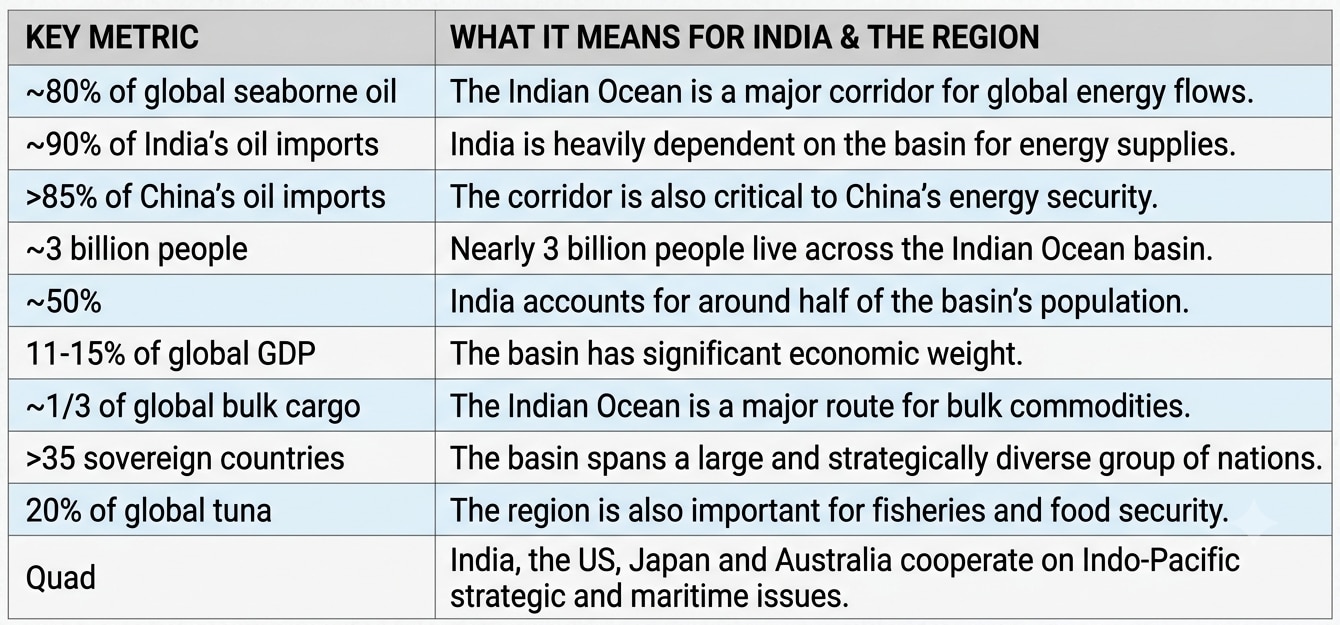
 India’s energy security is closely tied to the Indian Ocean, one of the world’s most important maritime corridors. A new MUFG report highlights the basin’s outsized role in global oil flows, noting that around 80% of global seaborne oil traverses the Indian Ocean, while the waterway is the primary transit route for more than 90% of India’s oil imports.
The Indian Ocean is the world’s third-largest ocean, covering about 27 million square miles and accounting for roughly 20% of the world’s ocean surface. It is also the only ocean bounded by land to the north, giving it a distinctive geographic position between major energy-producing regions and some of the world’s largest consumers.

 Lack of US-India deal will not have an adverse impact on India’s growth, says Panagariya
 Sebi receives 20,000 comments on proposed CAS changes; framework to follow soon
 Apple removes Jack Dorsey’s Bitchat from India App Store, cites MeitY order under IT act
 Nvidia shares approach record high as AI optimism revives investor demand
 FM Sitharaman: Need to keep building resilience, not a one time exercise
  Is Now the Best Time to Invest in Bonds? RBI Rate Hike Impact Explained
 Bond Laddering Explained: How To Manage Interest Rate Risk & Keep Your Money Flexible
 Market Correction: Which Sectors Could Hold Up as Global Risks Pressure Indian Stocks?
 5-10 Year Wealth Creation: How Should Investors Build Their Long-Term Portfolio?
 How Much Should You Invest In Bonds At Different Stages Of Life? 20/60 Investing Rule Explained
 Nvidia shares approach record high as AI optimism revives investor demandSebi receives 20,000 comments on proposed CAS changes; framework to follow soon
 Stock market sell-off: Nifty, Sensex log 8th straight weekly loss; key levels & top triggers now
 IPO boom: 69 Indian companies raise Rs 90,500 crore in Q3 despite stock market sell-off; what's next
 TCS, Infosys, HCL Tech, TechM, Wipro, LTM, Coforge, HEXT: Fresh target, Q2 previews for IT stocksNvidia shares approach record high as AI optimism revives investor demand
 Mumbai Airport to partially shut T1B from January 2027 over safety concerns
 'Highest degrees of courage': Dubai Crown Prince Sheikh Hamdan visits Smit Machchhar in hospitalApple removes Jack Dorsey’s Bitchat from India App Store, cites MeitY order under IT act
 Asian Games 2026: India end historic campaign with 85 medals, including 21 gold


