


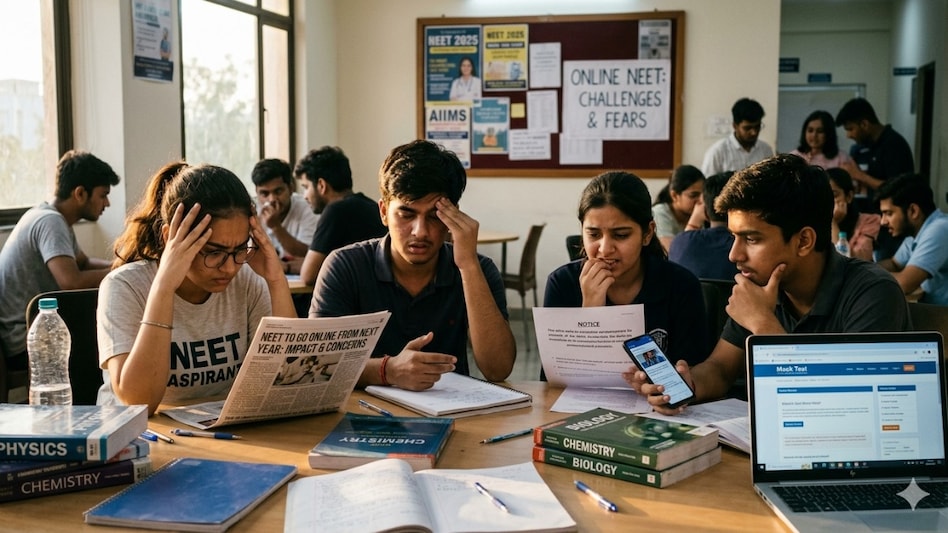
 NEET 2026: Is transitioning to CBT an easy task? Here's what you need to know
Days after the NEET-UG 2026 exam was cancelled following a "guess paper" leak, Union Education Minister Dharmendra Pradhan on Friday said that NEET should be shifted to a computer-based test system from next year as it will prevent future leaks. But will it?
Students and parents aren't convinced as moving millions of medical aspirants to a digital exam is no simple task — and history shows that online exams aren't immune to fraud either. For millions of medical aspirants already shaken by repeated NEET controversies, the big question remains: can India actually pull off a leak-proof online NEET?

 'Methodology is very robust': Former statisticians back GDP base year revision
 FCNR deposit bonanza: Economists explain why deft liquidity management will be key
 ‘Painful to hear allegations of data jugglery’: MoSPI secretary Saurabh Garg says every data is verifiable
 ₹1,800 crore Ultravolt bet: Aditya Birla Group enters wires and cables market, targets top two spot in 5 years
 $136 billion forex inflow gives rupee a lift, takes it to two-month high
 Exposing The GDP Controversy: Why Subhash Garg's Math Is Flawed
 Ajay Piramal Explains Why India Can Achieve Viksit Bharat 2047
 Auto Industry Price Hikes Remain Marginal: Hyundai India MD Tarun Garg
 EXCLUSIVE | MoSPI Secretary Saurabh Garg On 7.8% GDP | Rejects Data Manipulation Claims
 AI Is Moving To The PC: Dell’s Jacinta Quah On India’s 51% Adoption
 Coal India, Finolex Cables, Gulf Oil, Federal-Mogul Goetze among stocks to turn ex-dividend tomorrow, details here
 Fintech smallcase launches US stock, ETF portfolios for Indian investors
 Sensex plunges over 2,100 points in 3 minutes; what happened in final 5 minutes?
 Britannia, Tata Consumer, Marico: What should investors do as commodity inflation rise
 How EV-themed stocks could impact sentiment on Maruti Suzuki counter Exposing The GDP Controversy: Why Subhash Garg's Math Is FlawedAjay Piramal Explains Why India Can Achieve Viksit Bharat 2047
 'External debt could rise to $900 bn': RBI's FCNR(B) move has created five major risks, warns ISB professor
 BRICS Summit 2026: Central government offices in Delhi to remain closed on September 11
 Siliguri corridor gets major highway boost! Centre approves ₹2,077 crore NH-327 four-laning plan












