












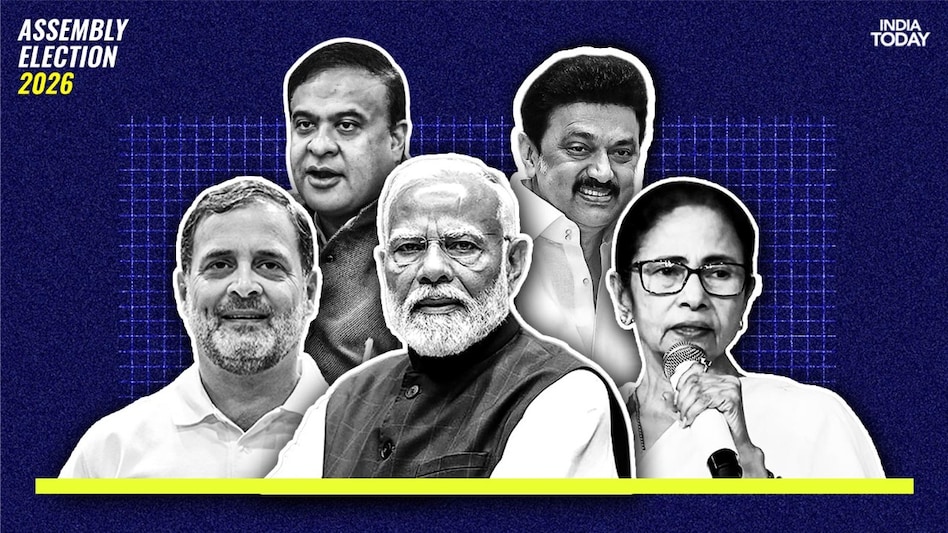
 In any election, winning by one vote and winning by a lakh produce identical results. So does losing by one or losing by a thousand. This is the namesake candidate's operating environment. In any election, winning by one vote and winning by a lakh produce identical results. So does losing by one or losing by a thousand. This is the namesake candidate's operating environment.
 Assembly elections 2026: The line moves slowly inside the polling booth. When their turn comes, the voter leans forward and scans the ballot. They know the name they are looking for — they have heard it at rallies, discussed it at home. But on the machine, the name appears multiple times.
Sometimes it is the same name. Sometimes there are minor differences: an extra initial, a father's name. Nothing that can be processed in seconds. The polling officer is watching, others waiting. The voter hesitates, then presses a button.
Outside, the ink dries on their finger. Inside, the vote may not have gone where they intended. This moment is no longer an exception. It is being engineered.
The math behind the confusion
In any election, winning by one vote and winning by a lakh produce identical results. So does losing by one or losing by a thousand. This is the namesake candidate's operating environment. You don't need to win. You don't need to campaign. You only need to exist on the ballot, wear a familiar name, and bleed a few hundred votes from the person you were deployed to mimic.
MUST READ: West Bengal turns saffron: Modi-Shah's BJP breaches Mamata's Kolkata fortress
The investment: a security deposit of just Rs.5,000, forfeited if the candidate fails to poll one-sixth of the total votes. These candidates, almost always fielded as independents, never cross this threshold. They lose the deposit, but the candidate they targeted may lose the election.
There is a word for this in Hindi: vote katua — the vote cutter. Whispered in campaign offices from Malda to Madurai, understood by every political operator, but officially denied by everyone.
When it changed outcomes
Congress veteran V.M. Sudheeran lost the Alappuzha Lok Sabha seat in 2004 by just over 1,000 votes. What tipped the balance was a namesake independent, V.S. Sudheeran, who polled more than 8,000 votes. The split of votes handed victory to the rival.
The near-miss came a decade later in a high-stakes battle. In Mahasamund, Chhattisgarh, the BJP fielded Chandu Lal Sahu against Congress veteran Ajit Jogi. On the same ballot, there were six other candidates named Chandu Lal Sahu, plus four named Chandu Ram Sahu — ten phonetically identical names in all. BJP's Sahu won, but by just 133 votes. The namesakes together polled nearly 60,000 votes, most of them intended for the primary candidate. A few hundred more confused voters and a Lok Sabha seat would have again changed hands.
Must Read: Election Result 2026 LIVE Updates: End of Mamata era? BJP storms past halfway mark
The tactic has been spread across elections and states. It has followed candidates from small assembly segments to high-profile national contests — no seat, no profile, no party considered beyond reach.
Even high-profile candidates like Hema Malini in the 2014 Lok Sabha election and Rahul Gandhi in 2019 have faced name-sake candidates contesting against them.
The principle is simple: these candidates don't need scale, organisation, or campaigning. In tight contests, they only need enough similarity to siphon off a thin slice of votes, which can possibly be the difference between victory and defeat.
How it looks in the 2026 Assembly Elections
Across five states — Tamil Nadu, Kerala, West Bengal, Assam, and Puducherry — the tactic is being deployed with notable precision.
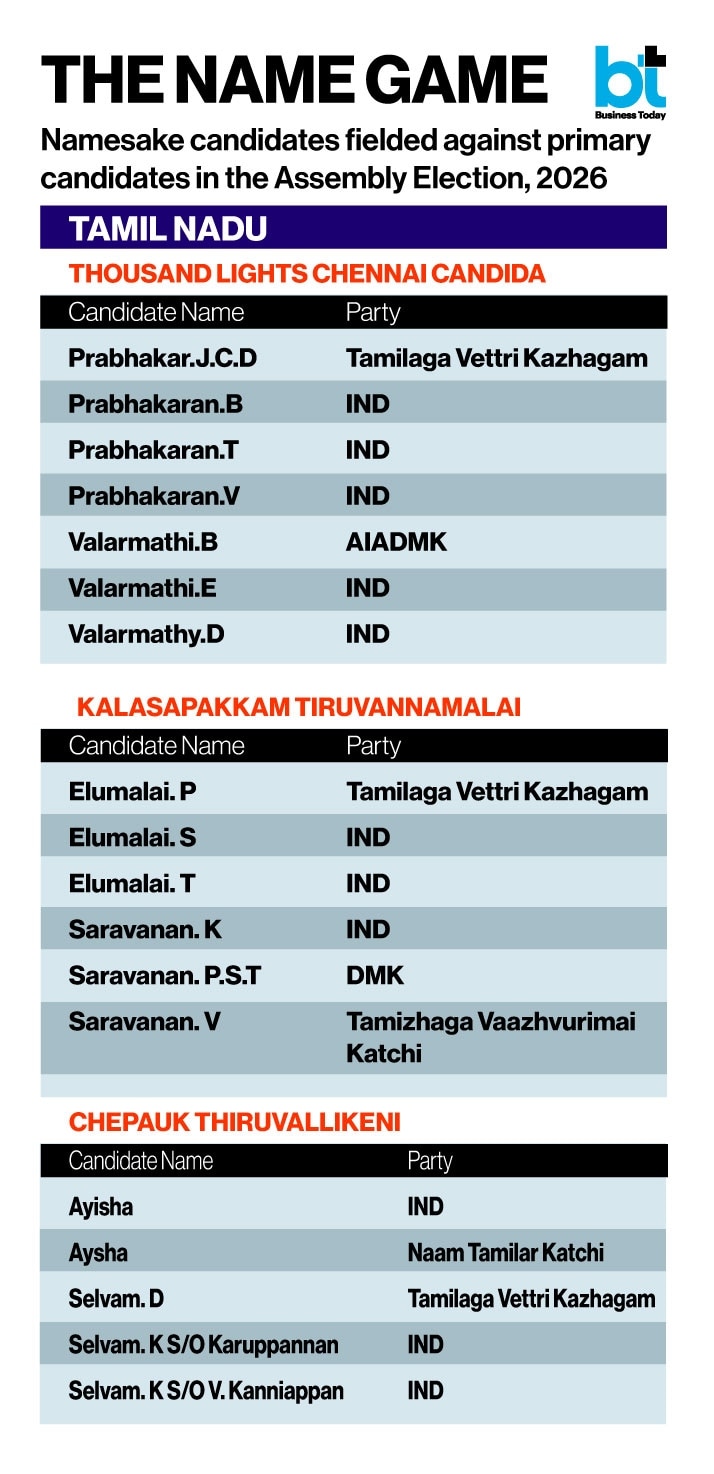
Start with the most elaborate operation: Thousand Lights, Chennai. AIADMK's Valarmathi B is shadowed by two other Valarmathis. TVK's Prabhakar JCD contends with three Independent Prabhakarans. One constituency, two targets simultaneously, it is the tactic at its most systematic.
MUST READ: Tamil Nadu Election Results: Full list of winners from DMK, TVK, AIADMK, BJP
In Tamil Nadu more broadly, the confusion is engineered at the name level. In Kalasapakkam, DMK's Saravanan P.S.T. must be located among three other men sharing his first name. In Chepauk-Thiruvallikeni, TVK's Selvam faces four independent namesakes differentiated only by aliases and fathers' names. A voter has seconds to decide. The fine print is not readable in a busy booth.
Kerala adds a new dimension: repetition across cycles. In Peravoor, former state minister K.K. Shailaja faces two phonetic near-twins — C. Shylaja and Sailaja A.V. — both Independent. This is not new for her. In the Assembly election 2016 too, she faced two namesake candidates, one allegedly even used a suspiciously similar election symbol.
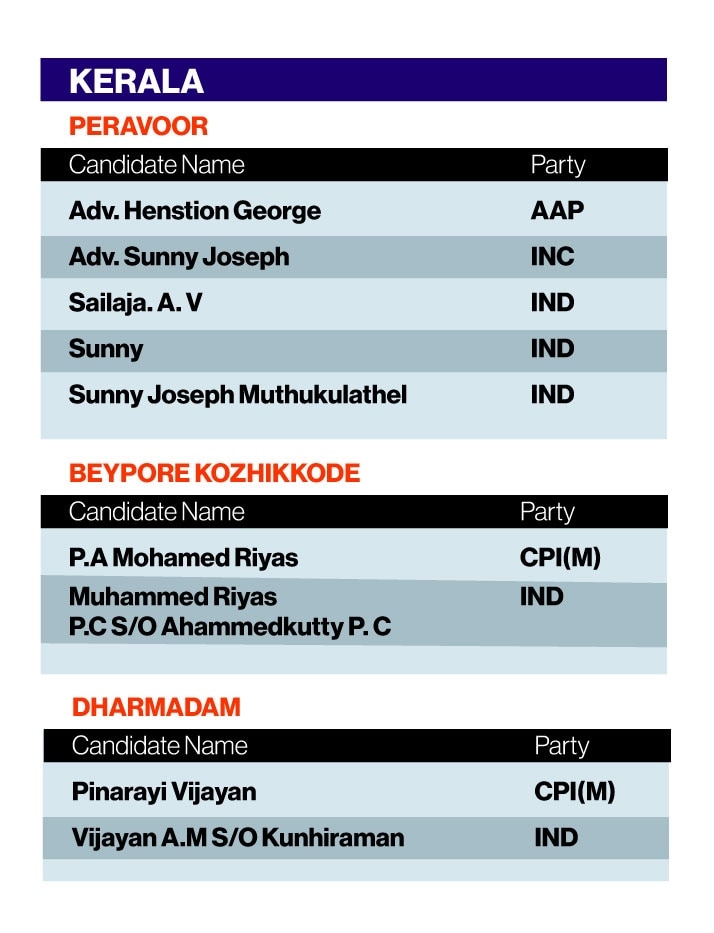
In Beypore, Minister P.A. Mohamed Riyas faces an Independent named Muhammed Riyas P.C., a direct mirror of his own first two names. In Dharmadam, the Chief Minister's own seat, an Independent named Vijayan A.M. has filed a nomination. No constituency, not even the CM's, is considered off-limits.
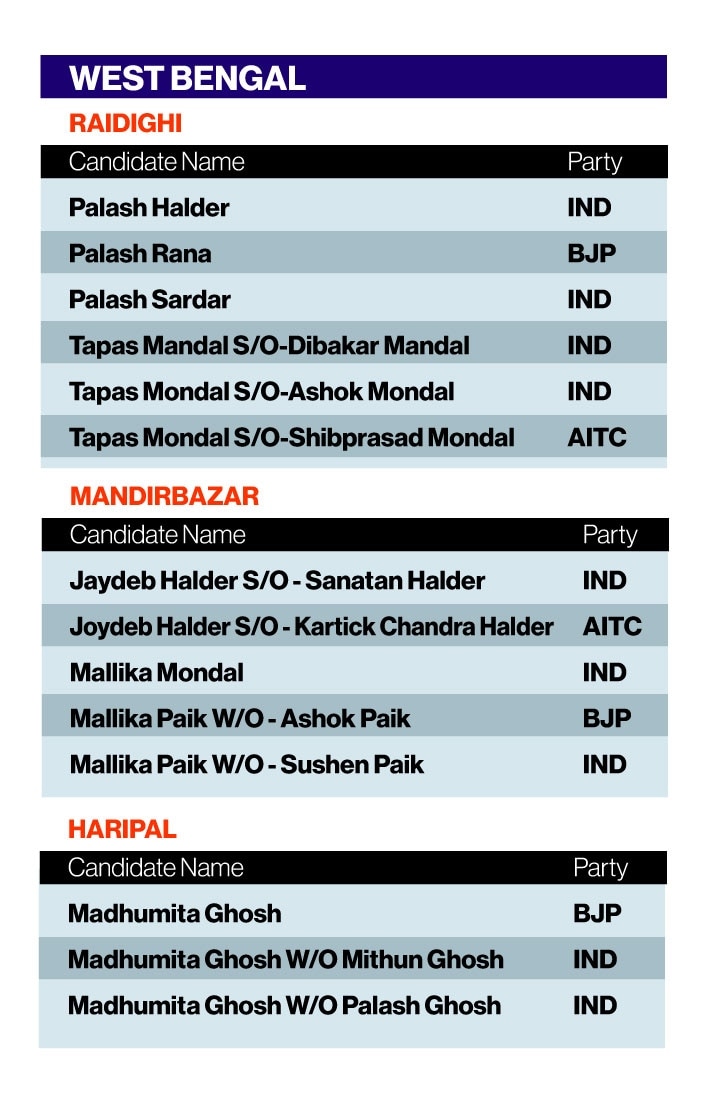
In West Bengal's Raidighi, TMC's Tapas Mondal faces two Independent Tapas Mondals. His declared assets: Rs. 32 lakh. His namesakes declare mere Rs.14,000 and Rs.7,000, not the typical profile of a serious candidate.
On the ballot, that difference is limited to the father's name in fine print. In the same constituency, BJP’s Palash Rana is also up against two independents with the same first name.
In Mandirbazar too, two primary candidates, TMC’s Joydeb Halder and BJP’s Mallika Paik, have a namesake each. In Haripal, BJP's Madhumita Ghosh faces three namesakes, two of them women sharing her exact name, differentiated only by their husbands' names.
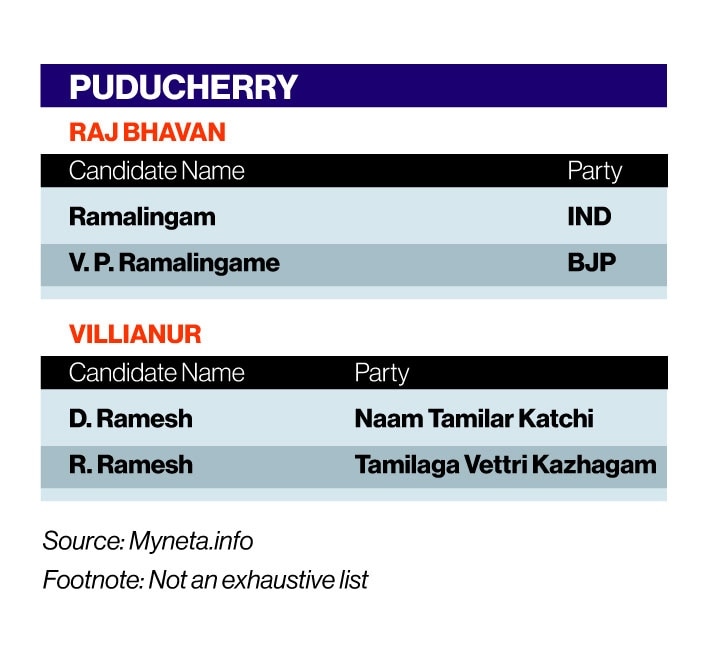
Puducherry, where constituencies are compact and margins already thin, shows how little it takes. In Raj Bhavan, BJP's V.P. Ramalingame faces an Independent named simply Ramalingam — a similar name, minus the prefix. In Villianur, two candidates are both named Ramesh, one declaring assets of just Rs. 36,500.
No party is exempt. In Tamil Nadu, DMK candidates are shadowed as frequently as AIADMK or TVK candidates. In Kerala, CPI(M) faces this tactic as readily as INC or IUML. In West Bengal, TMC and BJP are both hunter and hunted.
Candidate photographs on EVMs were introduced after the Mahasamund incident. It does help, but only partially. They require literacy, adequate lighting, and a patient booth official. In constituencies with first-time voters or lower literacy, they are a partial remedy at best.
Every nomination affidavit declares assets, criminal history, and political antecedents. When multiple candidates share a name with a party nominee and declare negligible assets, no political history, and no apparent constituency base, the pattern is not ambiguous. A scrutiny regime backed by affidavit analysis could flag these filings before they reach the ballot.
The Election Commission has never disqualified any candidate on these grounds. No political party has been formally linked to commissioning the tactic, despite it being common knowledge in campaign offices across the country.
In the five states in assembly elections 2026, over 3,800 Independents are on ballots across 824 constituencies, many of them fielded beside candidates whose names they share or mimic. Most will lose their deposits and be forgotten by evening on counting day.
But in a handful of constituencies where the margin is thin, the booth is crowded, and two names blur together on a screen, the Rs.5,000 will have been well spent.
Research inputs by Ujjwal Thakur
 Election Result 2026 LIVE Updates: Violence breaks out in Bengal after voters choose Dada over Didi
 West Bengal stocks: BJP lead gives RPSG group, textile, railway shares a lift
 West Bengal turns saffron: Modi-Shah's BJP breaches Mamata's Kolkata fortress
 Tata Trusts: Battle lines drawn, upcoming meeting will determine composition
 Adani Ports, Gujarat Fluorochemicals, Ramkrishna Forgings: Axis Direct shares target prices, outlook
 DMK In Retreat? Shocking Scenes As HQ Shuts Down Celebrations Amid TVK Vijay’s Early Lead!
 Think Electrolyte Drinks Are Healthy? Watch This Before Your Next Sip
 Upgrade To Downgrade: Why World Bank Sees India At 6.6% | Aurélien Kruse Explains
 Hormuz Crisis Explained | Oil Hits $126, UAE OPEC Tensions Rise, Global Economy On Edge
 Inflation Outlook: Why India Starts Strong Despite Oil Shock | World Bank
 Q4 profit boost for Jindal Steel but Nuvama retains 'Reduce' call; here's why
 Sensex slips over 650 points from day's high, Nifty tests 24,100; what analysts say
 Federal Bank stock gets 53% price target hike; Nomura says this
  Multibagger Adani group stock: India's 12th most valued firm - Should you buy or sell?West Bengal stocks: BJP lead gives RPSG group, textile, railway shares a lift