Today, BrahMos has emerged as the backbone of India's armed forces, demonstrated its combat capabilities during Operation Sindoor, and is being exported to friendly nations under India's "Make for the World" push.
Don't Miss | PM Modi's Indonesia Visit: BrahMos, EVMs, UPI & 16 Strategic Deals Explained
Born Out Of A Gulf War Lesson
The idea for BrahMos was born not in a laboratory, but in a classroom at Harvard during the 1991 Gulf War.
BrahMos Aerospace founder and former CEO Dr A Sivathanu Pillai, in an interview with CNN-News 18 in June 2025, credited former President APJ Abdul Kalam with planting the seed for India's cruise missile programme.
Recalling their conversations, Pillai said Kalam often challenged his team to think beyond merely joining the ranks of advanced missile powers.
"Dr Abdul Kalam once said, 'We launched Agni as the sixth nation, PSLV as the seventh, and when we did the nuclear test again, we were the sixth nation. When will we be first?'"
Kalam then encouraged Pillai to pursue advanced studies at Harvard. It was there, as the Gulf War unfolded, that Pillai closely tracked the US military's use of Tomahawk cruise missiles against Iraq.
"My attention turned towards the Gulf War. And finally, I found out the Tomahawk played a very crucial role there. To destroy the assets of the enemy, to disable them, you need a cruise missile," Pillai recalled.
He immediately contacted Kalam from the US. "We need a cruise missile," he told him. Kalam's response was simple: "When you complete your course, let us discuss."
Must Watch | UAE Eyes India’s BrahMos Missile: Why Abu Dhabi Is Shifting Away From Chinese Defence Tech
Russia Partnership And MTCR Hurdle
Those discussions eventually led India to Russia.
Following Kalam's advice, Pillai approached Russian missile experts, who revealed they had developed the world's only supersonic cruise missile engine. "The Director General said, 'If you use that engine, your missile will become a supersonic cruise missile.' I was attracted by that," Pillai said.
But the team soon realised importing just an engine would not be enough. "We needed a complete system—including the booster, guidance, and launch configurations. There was no point in taking one piece," he said.
A joint Indo-Russian design team subsequently developed a complete missile system capable of operating from both land and sea platforms. Initially conceived as an anti-ship missile, it was christened BrahMos, combining the names of the Brahmaputra and Moskva rivers.
According to a Deccan Herald report, the biggest obstacle remained the Missile Technology Control Regime (MTCR), which prevented Russia from assisting India in developing missiles with a range beyond 300 km. To comply with the restrictions, the two countries capped BrahMos' initial range at 290 km.
An intergovernmental agreement was signed in 1998, followed by the creation of BrahMos Aerospace, with India and Russia jointly investing $250 million in a 50.5:49.5 ratio.
The missile completed its maiden test from Odisha on June 12, 2001.
Four years later, a BrahMos launched from INS Rajput sank the decommissioned INS Sindhudurg while travelling at nearly Mach 2.8—almost three times the speed of sound—marking the beginning of what would become one of India's most successful defence programmes.
Operation Sindoor Boosted Global Profile
BrahMos' international profile received another major boost after Operation Sindoor, where it was used against Pakistan.
Pakistan Prime Minister Shehbaz Sharif later acknowledged that BrahMos strikes penetrated Pakistan's air-defence network, hitting targets including the Nur Khan Airbase, Rawalpindi airport area, Sargodha, Skardu, Sukkur and Muridke.
The report also cited Sharif's aide Rana Sanaullah as saying Pakistan's military had only 30 to 40 seconds to respond because of the missile's speed and precision.
From the Philippines To Indonesia
The missile has steadily become India's flagship defence export.
BrahMos Aerospace secured its first export order in January 2022, when the Philippines signed a landmark agreement for the BrahMos Shore-Based Anti-Ship Missile System.
The company says several countries across Southeast Asia, Latin America, and the Middle East have also shown interest in acquiring the missile.
Days ago, India announced another export agreement with Indonesia during Prime Minister Narendra Modi's visit. Vietnam has also signed a deal to acquire BrahMos. In West Asia, the UAE, Saudi Arabia, and Egypt have expressed interest in buying India's cruise missiles.
'Backbone Of Our Armed Forces'
Following Operation Sindoor, Defence Minister Rajnath Singh described BrahMos as "not just a missile, but a symbol of the growing indigenous capabilities of the nation."
"The missile features a traditional warhead and an advanced guided system and possesses the capability to strike long distances at supersonic speeds. This combination of speed, accuracy, and power makes BrahMos one of the best systems in the world. It has become the backbone of our Armed Forces," he said while flagging off the first batch of BrahMos missiles manufactured at the Lucknow Integration and Testing Facility in October 2025.
Calling Operation Sindoor proof of the missile's battlefield effectiveness, Singh said it had moved "far beyond a trial and has become the greatest practical proof of national security."
"Operation Sindoor is proof that victory has become a habit for us... The operation was just a trailer. It has made Pakistan realise what might follow," he added.
The Defence Minister also revealed that BrahMos had signed export contracts worth about Rs 4,000 crore with two countries within a month, while the Lucknow facility is expected to manufacture around 100 missile systems annually, generating a turnover of Rs 3,000 crore and approximately Rs 500 crore in GST collections.
'Make For The World'
The 200-acre BrahMos Integration and Testing Facility in Lucknow is one of the flagship projects under the Uttar Pradesh Defence Industrial Corridor and carries out assembly, integration, and testing entirely within India.
The BrahMos website describes the missile as a flagbearer of "Make in India" that is now moving towards "Make for the World."
Uttar Pradesh Chief Minister Yogi Adityanath called BrahMos "a missile of Aatmanirbharta," saying the Lucknow facility had created thousands of jobs while strengthening India's defence manufacturing ecosystem.
Future Beyond Mach 3
India's entry into the MTCR in 2016 enabled scientists to develop longer-range variants of BrahMos.
The missile now has versions capable of striking targets 450-500 km away and another with a range of over 800 km. Research is also reportedly underway on a hypersonic reusable cruise missile capable of flying at Mach 6 or above.
Most recently, Rajnath Singh said the BrahMos surface-to-surface missile can be deployed on INS Mahendragiri.



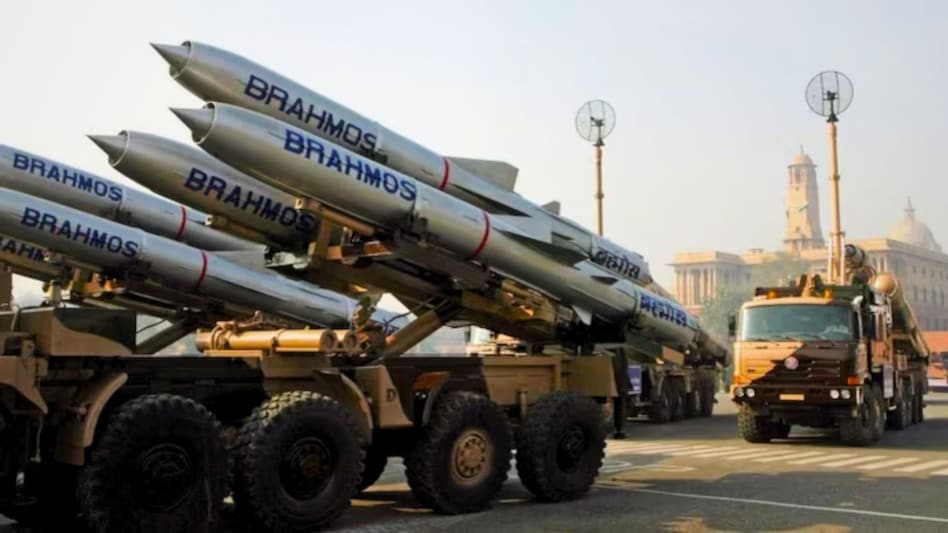 How BrahMos Became India's Most Feared Missile In 25 Years
 India’s energy lifeline runs through the Indian Ocean: Why this maritime corridor matters
 20 Asia-Pacific stocks with up to 145% upside: Full ‘Going For Glory’ list, no Indian stock included
 Govt won't step into Singapore Airlines' Air India call, says Singapore minister
  Tax filing 2026: Missed crypto income in ITR? Why investors could receive an Income Tax notice
 CNG, hybrids and EVs reshape India's car market: What August sales reveal
 Travel Insurance Mistakes: Sub-Limits, Pre-Existing Conditions & Medical Evacuation Explained
 Home Loans & Insurance: How Couples Can Structure Them For Tax Efficiency
 Money & Marriage: How Couples Can Divide Household Expenses, Track Spending And Stay On Budget
 Parag Parikh Flexi Cap Fund Underperformance: Is Fund Size Becoming A Major Challenge For Investors?
 Midcap, Smallcap Funds: Strong Profit Growth Could Keep Investor Flows Robust, But Valuations Matter
 FCNR(B) windfall lifts NBFCs, small private banks: Why these stocks may be the bigger winners
 Tata Technologies: Former CEO Patrick McGoldrick sells shares worth nearly Rs 165 crore
 Tata Power stock: Choice Broking expects recovery, assigns two price targets
  IPO rush next week: 11 issues eye to raise Rs 7,055 crore; 6 IPOs to open on same day, check details
 'Which medicine did he take?' Purnia MP Pappu Yadav's striking look fuels Ozempic rumours. Watch
 $1 trillion, 500+ investors: India to host landmark BRICS sovereign capital summit in New Delhi
 LPG, CNG, PNG prices today (September 6): Check latest rates in Delhi, Mumbai, Kolkata, other cities












