












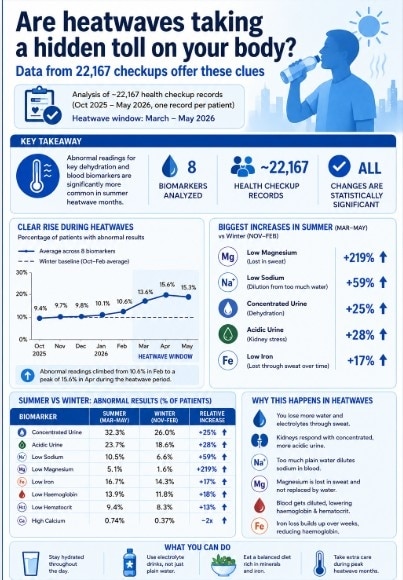



 The average proportion of patients with abnormal results across the eight biomarkers rose from 9.4% in October 2025 to 10.6% in February 2026.
Heatwaves may be doing more than causing discomfort and increasing the risk of heatstroke. New data suggest that rising temperatures could be silently altering key health markers, with signs of dehydration and mineral imbalance becoming significantly more common during the summer months.
An analysis by Plum of around 22,167 health checkup records between October 2025 and May 2026 found that abnormal readings for several dehydration- and blood-related biomarkers increased sharply during the heatwave period from March to May compared with the winter months of November to February.

 ₹1.50 lakh gold tests Indian consumers: Lightweight jewellery gains traction
 Small-cap funds under pressure in September: Only 4 schemes deliver positive returns
 'No amount of money can ever...': Mankind Pharma honours flydubai pilot Smit Machchhar with ₹1 crore
 Saudi plans military push in Yemen to wrest Bab el-Mandeb from Houthi control
  Flydubai mid-air attack: Co-pilot who attacked Indian pilot had been flagged as security risk, says report
 5-10 Year Wealth Creation: How Should Investors Build Their Long-Term Portfolio?
 How Much Should You Invest In Bonds At Different Stages Of Life? 20/60 Investing Rule Explained
 Bond Investing For Beginners: How To Choose, Check Ratings, Returns & Manage Risk
 Flexi-Cap Funds: How Much Does the Fund Manager’s Strategy Really Matter?
 Diwali 2026 Gold Price Outlook | Expert Price Targets Revealed | Massive Gold Price Prediction
 Stock market sell-off: Nifty, Sensex log 8th straight weekly loss; key levels & top triggers now
 IPO boom: 69 Indian companies raise Rs 90,500 crore in Q3 despite stock market sell-off; what's next
 TCS, Infosys, HCL Tech, TechM, Wipro, LTM, Coforge, HEXT: Fresh target, Q2 previews for IT stocks
 Carlsberg India IPO: SEBI approves confidential filing; beer maker moves closer to listing
 Suzlon, KPIT Tech, RIL, IRFC, HDFC Bank, Infy: 56% Nifty500 stocks in bear grip amid market sell-off
 Asian Games 2026: Pranavi Sharath Urs becomes first Indian woman golfer to win gold
 Beyond chatbots: Tavus's Griffin model passes video Turing test with 48% human success rate
 Amazon, Flipkart Festive Sale: 7 best phones to watch under ₹30,000 from Samsung, Motorola, and others'No amount of money can ever...': Mankind Pharma honours flydubai pilot Smit Machchhar with ₹1 crore
 India's next strategic asset: Sovereign intelligence


