









 Among the cities studied, Al Basrah in Iraq ranked as the world's most heat-vulnerable city, followed by Ahmedabad, Bamako, Nagpur, Quezon City, Baghdad, Madurai, Faisalabad, Lagos and Hyderabad.

 Among the cities studied, Al Basrah in Iraq ranked as the world's most heat-vulnerable city, followed by Ahmedabad, Bamako, Nagpur, Quezon City, Baghdad, Madurai, Faisalabad, Lagos and Hyderabad.
India has emerged as one of the countries most exposed to rising urban heat risks, with Ahmedabad, Nagpur and Madurai featuring among the world's 10 most heat-vulnerable cities in a new Oxford University study. The research highlights how extreme temperatures, socioeconomic vulnerability and limited coping capacity are combining to amplify heat-related risks across developing economies.
Ahmedabad heat risk, world's most heat-vulnerable cities, Oxford University heat study, India heatwave risk, Nagpur extreme heat, Madurai climate vulnerability, urban heat risk ranking, global warming impact on cities, heat-resilient cities, climate change and extreme heat.
India's heat risk
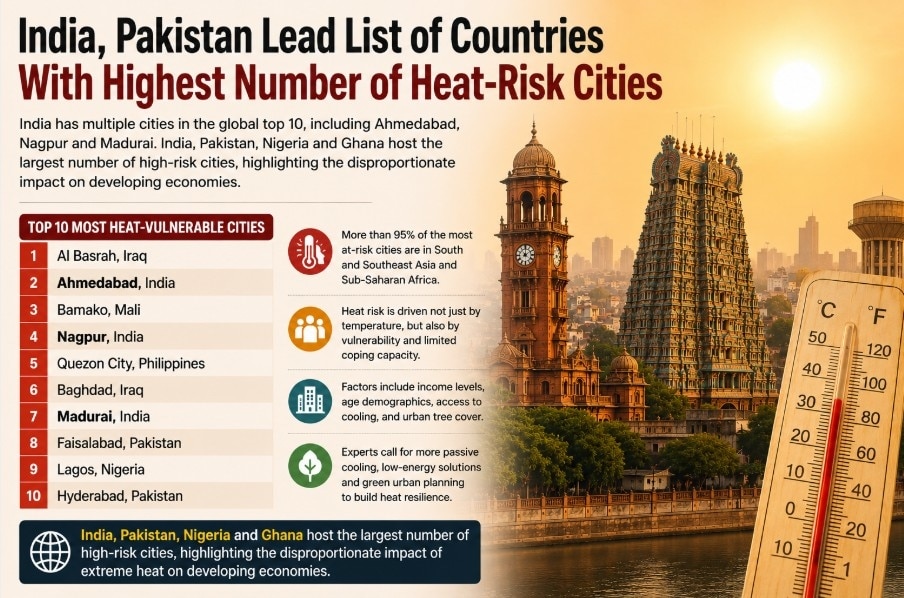
India has multiple cities in the global top 10 for heat risk, including Ahmedabad, Nagpur and Madurai, according to a new study by researchers at the University of Oxford. The study also found that India, Pakistan, Nigeria and Ghana host the largest number of high-risk cities, highlighting the disproportionate impact of extreme heat on developing economies.
The research, published in the journal Sustainable Cities and Societies, assessed 205 cities with populations exceeding one million to identify where residents face the greatest risks from rising temperatures. The analysis examined not only exposure to extreme heat but also factors such as socioeconomic vulnerability and the ability of cities to cope with heat-related challenges.
Among the cities studied, Al Basrah in Iraq ranked as the world's most heat-vulnerable city, followed by Ahmedabad, Bamako, Nagpur, Quezon City, Baghdad, Madurai, Faisalabad, Lagos and Hyderabad.
The findings underscore how heat risk is concentrated in emerging economies. More than 95% of the most at-risk cities are located in South and Southeast Asia and Sub-Saharan Africa, regions that often face rapid urbanisation, infrastructure deficits and limited adaptive capacity.
Not just high temperature
Researchers stressed that heat risk cannot be understood through temperature levels alone. According to lead author Nethmi Jayaratne Kariyawasam, a DPhil researcher at Oxford's Smith School of Enterprise and the Environment, extreme heat becomes particularly dangerous when it coincides with high levels of social vulnerability and inadequate coping mechanisms.
The study evaluated a range of indicators, including age demographics, income levels, access to cooling technologies such as air conditioning, and ecological buffers like urban tree cover. Cities with limited access to these resources tend to experience higher risks of heat-related illness and mortality.
The report also highlights the growing challenge of providing thermal comfort in a warming world. Radhika Khosla, Associate Professor at the University of Oxford, noted that while demand for air conditioning is rising globally, many people cannot afford it. She warned that excessive reliance on energy-intensive cooling systems could further accelerate climate change, creating a self-reinforcing cycle of higher temperatures and increased energy consumption.
Reduce heat exposure
Instead, researchers advocate a broader adaptation strategy that prioritises passive cooling measures, low-energy technologies such as fans and coolers, and urban planning interventions designed to reduce heat exposure. These measures can help improve resilience while limiting additional greenhouse gas emissions.
The study is being described as the first globally harmonised assessment that allows direct comparison of urban heat risk across cities worldwide. Researchers say the framework can help governments identify where adaptation investments are most urgently needed and track progress in strengthening urban heat resilience over time.
With extreme heat events becoming more frequent and intense due to climate change, the findings provide a stark reminder that developing economies are likely to remain on the front line of the global heat crisis unless significant adaptation measures are implemented.
 Mandatory PF capped at ₹1800! Will Your in hand salary increase?
 OpenAI proposes giving Trump Administration a 5% stake
 July IPO rush: SBI MF, Zepto, Manipal Health & others lined-up in Rs 45,000 cr fundraising
  Why e-rickshaws are suddenly stopping on the road? The Chinese BAT-BMS app behind it
 Henley Passport Index: India slips to 80th in July, down from 78th in May; 56 nations still visa free
 EPF Rules Changed: Should You Choose Higher Salary Or Build A Bigger Retirement Corpus?
 No Staff, Just AI! Inside South Korea's Fully Automated Cafes
 EPF Overhaul: Voluntary Contributions Above ₹1,800, New Withdrawal Rules Explained
 Raipur Demolition Row: 90+ Families Homeless For MLA Colony, Villagers Protest Amid Tears!
 Market Volatility Ahead? Fund Manager Sunil Shah Reveals His Portfolio Strategy & Top Investment Bet
 Wall Street holiday: Is the US stock market closed on July 3? Here's what investors should know
 Marico shares hit record high for two days: Trigger behind the rally and price target
  BSE index options market share falls in June, Groww MTF book grows: Jefferies
 Knack Packaging IPO subscribed over 18x on day 3 as GMP rises, issue concludes today
 Vedanta Oil and Gas share price: Stock surges nearly 34% in 5 days — what's fuelling the rally?