


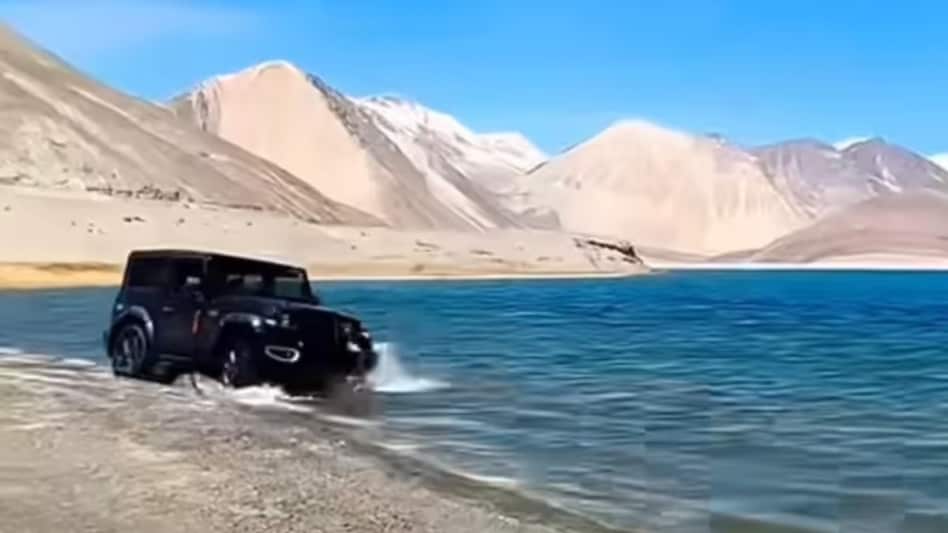
 Officials said these activities damage fragile alpine ecosystems, pollute water bodies, destroy vegetation and disturb endangered wildlife species that inhabit the region.
 For the first time, Ladakh begins prosecuting illegal off-roading as authorities warn reckless tourism will no longer be tolerated
The days of tourists treating Ladakh's fragile landscapes as an off-road playground may be coming to an end. In a first-of-its-kind crackdown, the Ladakh Administration has imposed hefty penalties on tourists caught driving through Pangong Lake and other ecologically sensitive wildlife habitats, signalling a tougher stance against activities that threaten one of India's most fragile mountain ecosystems.
Acting on the directions of Lieutenant Governor VK Saxena, the administration has begun prosecuting offenders under the Wildlife (Protection) Act, marking a significant shift from warnings to strict enforcement.
₹50,000 fine per vehicle, total penalty reaches ₹2 lakh
The Wildlife Department of Ladakh imposed a penalty of ₹50,000 each on four vehicles, taking the total fine to ₹2 lakh.
According to the Lieutenant Governor's Secretariat, the offending vehicles belonged to tourists from Himachal Pradesh, Chandigarh, Punjab and Uttar Pradesh, who were found illegally driving into Pangong Lake and protected wildlife zones across Changthang and Nubra over the past few days.
Officials said all four vehicles were impounded following investigations and released only after the penalties were paid.
Why the administration acted
Authorities say illegal off-roading has emerged as a growing problem in Ladakh, with visitors increasingly driving into lake shores, river streams and protected habitats for adventure videos, photographs and social media content.
Routine wildlife patrols, combined with social media surveillance, uncovered multiple violations across sensitive locations, including:
Officials said these activities damage fragile alpine ecosystems, pollute water bodies, destroy vegetation and disturb endangered wildlife species that inhabit the region.
Four incidents that triggered the crackdown
The latest enforcement followed a series of widely reported violations:
Each offender was subsequently fined ₹50,000 before being allowed to reclaim their vehicle.
Why off-roading is a serious ecological threat
Unlike many tourist destinations, Ladakh's cold desert ecosystem is exceptionally fragile. Vegetation takes years to regenerate, wetlands support migratory birds, and alpine habitats provide refuge to rare wildlife such as the snow leopard, Tibetan gazelle, black-necked crane and kiang.
Driving through lakes, streams and grasslands can:
Environmentalists have repeatedly warned that the growing popularity of adventure tourism and social media-driven off-roading is placing unprecedented pressure on Ladakh's protected landscapes.
LG VK Saxena issues warning to tourists
Lieutenant Governor VK Saxena reiterated that while Ladakh welcomes visitors from across the country, tourism must be responsible and environmentally conscious.
He urged tourists, adventure enthusiasts and vehicle owners to stay away from protected wildlife habitats, warning that such activities not only violate the Wildlife (Protection) Act, 1972, but also harm endangered species, damage fragile ecosystems and undermine the sanctity of Ladakh's iconic tourist destinations.
The administration has made it clear that stringent action against illegal off-roading will continue, signalling that reckless driving inside protected landscapes will now invite prosecution, vehicle seizure and substantial financial penalties rather than mere warnings.

 Third round of talks: CJP ends 49-day-long protest, says govt accepted 'key demands'
 Dharmendra Pradhan resigns, says decision taken to protect students' future amid NEET row
 All about Dharmendra Pradhan's educational qualification, wealth, assets and more
 India's first REIT mutual fund is here. Can it change how Indians invest in real estate?
  1997 paper leak protest to Education Minister: The extraordinary political journey of Dharmendra Pradhan
 FDs vs Markets: Where Should You Keep Your Short-Term Money?
 Why Term Insurance Is Essential for Every Earning Member | Sum Assured & Coverage Explained
 Pakistan's Alleged Terror-Politics Nexus: Lashkar Links Spark Questions Over Fazlur Rehman
 Think Life Insurance Is Optional? Here's Why Every Indian Family Needs It Today
 FD Vs Arbitrage Fund: Which Is Better For High Taxpayers?
 Adani Power: 45 GW target, Rs 2 lakh crore capex plan among conference call highlights
  ITC Hotels, Chalet, Ventive, IHCL, SAMHI: Hotel stocks to buy despite travel disruptions
 ITC shares: Rs 307 a key short-term level to watch; here's target price
 Mphasis shares: FY27 guidance maintained; brokerages keep 'Buy' after Q1; check target price
 Should you buy every IPO? Research suggests patience may be the smarter strategy
 Houthis target Saudi Aramco sites in Jizan and Yanbu as Red Sea tensions take a new turn
  Lifestyle inflation, delayed investing, high-interest debt: 3 biggest money mistakes young professionals makeThird round of talks: CJP ends 49-day-long protest, says govt accepted 'key demands'FDs vs Markets: Where Should You Keep Your Short-Term Money?
 ED targets gangster Atiq Ahmed’s Noida syndicate as henchmen push secret sale of benami assets









