

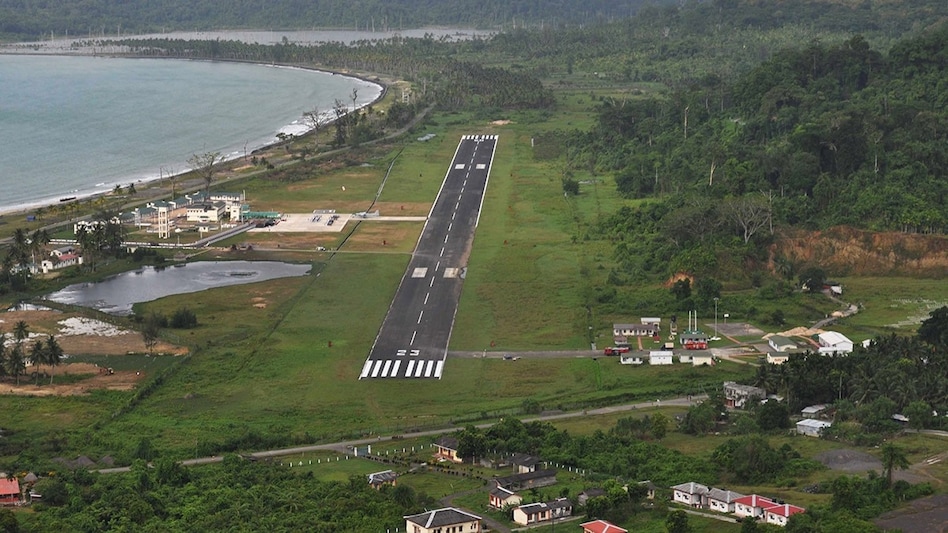
 The govt will build a new airport instead of expanding naval airfield at INS Baaz
The government has decided to build a new ₹13,000-crore greenfield civil-military airport as part of the Great Nicobar project, instead of expanding the existing naval airfield at INS Baaz. This move comes amid a growing political debate over the ₹81,000-crore mega development plan for the ecologically sensitive island.
Sources from the government and defence have said the proposed dual-use airport will be located at Chingen, near Galathea Bay on Great Nicobar's south-eastern coast. The airport will serve both civilian and military aviation needs. The site is close to the western approaches of the Malacca Strait, a key maritime chokepoint linking the Indian Ocean and the South China Sea. Officials believe the airport will enhance India's ability to monitor and respond to activities along this important trade route.
 90% EVs exported out of India are from Maruti Suzuki: MD & CEO Hisashi Takeuchi
 India's $30 trillion goal needs 8-10% growth, $400 billion more annual investment: Jayant Sinha
 1.1 billion barrels gone: IMF warns that global oil market is running out of safety cushions
 From Devbhoomi to industrial destination: Uttarakhand’s manufacturing moment
 India’s deep-tech startups face a new test: Crossing the valley of death
 #IndiaAt100 : Adipen Bose Nandhiji On Conscious Capitalism- Can Profit & Purpose Coexist?
 #IndiaAt100 : Hisashi Takeuchi On Driving India’s Manufacturing Revolution
 #IndiaAt100 : Manufacturing For Viksit Bharat | Can Industry Power India’s $30-Trillion Dream?
 #IndiaAt100 : Tarun Garg On Hyundai & India’s Manufacturing Powerhouse Ambition
 #IndiaAt100 : CM Pushkar Singh Dhami On Uttarakhand’s Industrial Growth & India’s Next Leap
 Cupid, NTPC Green, NTPC, Raymond Realty, HAL shares: Key technical levels to watch
 Defence stock with Rs 2,654-crore order book hits record high; here's why
  GACM Technologies: FII holding jumps to 29%; penny stock in focus
 Puravankara shares rise 5% on fresh order win
  20 high-conviction ideas for up to 95% upside | stocks to buy
  Form 16 delay led to ITR non-filing and ₹3.74 lakh penalty: How a salaried employee won his case
 Ahmedabad–Bhagalpur Amrit Bharat Express begins service on August 26: timings, route and coaches explained
 More homes to get piped gas? Centre unveils incentive scheme to boost domestic PNG connections
 Planning a weekend with children in Delhi? These five destinations combine nature, heritage and practical learning
 Cabinet clears four railway projects worth ₹9,450 crore that will add approximately 410 km of new track












