

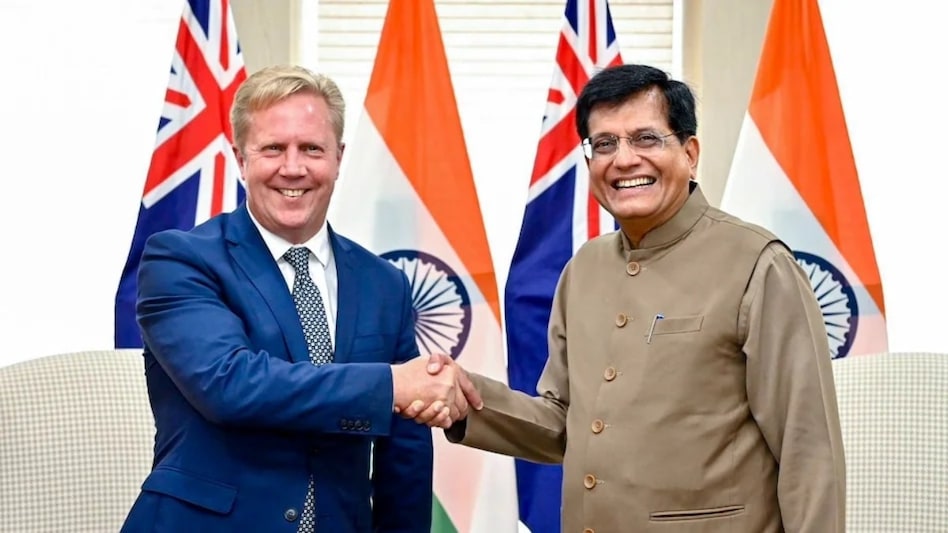
 The pact was signed in the presence of Commerce Minister Piyush Goyal and his New Zealand counterpart Todd McClay.
India and New Zealand on April 27 sealed a long-pending free trade agreement (FTA), with Prime Minister Christopher Luxon calling it a “once-in-a-generation” deal that unlocks fresh opportunities across goods, services, investment, and labour mobility.
The pact was signed in the presence of Commerce Minister Piyush Goyal and his New Zealand counterpart Todd McClay.
The agreement caps a prolonged negotiation journey that began in 2010, paused in 2015 after nine rounds, and was revived in March 2025 before being concluded in December last year — making it one of India’s quickest FTAs to be finalised.
Must read | India-New Zealand FTA opens 5,000 work visas for Indian professionals across IT, healthcare
Union Minister Piyush Goyal said, "...India today works with the rest of the world from a position of strength, full of confidence to engage, expand the relationship..."
Fastest trade deals
The agreement, concluded in December 2025 after negotiations that began in March the same year, is being described as one of India’s fastest trade deals to move from negotiation to signing.
Strategic pivot beyond trade
At its core, the India-New Zealand FTA is not just about tariffs — it is about positioning. For India, New Zealand offers a relatively small but high-income market, and more importantly, a gateway into the wider Pacific and Oceania region.
Don't miss | India-New Zealand FTA: Agra meet ahead of signing highlights $50 bn leather export ambition
The deal builds on steadily improving trade ties. Bilateral merchandise trade has already climbed to about $1.3 billion in 2024-25, while services trade — particularly in IT and travel — continues to grow.
This effectively removes tariffs across thousands of product categories, making Indian goods significantly more competitive. Sectors expected to benefit the most include textiles, leather, engineering goods, pharmaceuticals, and processed foods — many of which are labour-intensive and export-driven.
At the same time, India has been careful not to fully open its own market across the board. Roughly 30% of tariff lines have been kept out of the agreement, particularly in sensitive areas like dairy and key agricultural products.
Investment and jobs angle
One of the most significant aspects of the agreement is New Zealand’s commitment to invest $20 billion in India over the next 15 years.
This long-term capital flow is expected to support infrastructure, agriculture, and technology partnerships, while also strengthening supply chains.
For India’s domestic economy, the biggest gains are expected in employment-heavy sectors. Zero-duty access for industries such as textiles, footwear, and gems and jewellery could translate into higher export volumes and job creation, especially for MSMEs.
 Exam reforms: Tech titan Nandan Nilekani picked by PM Modi to fix national public examination system
  'Tax officers struggled for own land': Nirmala Sitharaman slams laidback attitude of govt depts
 CBDT issues new crypto reporting guidance: No new tax, but exchanges must track and report all transactions
 Did Cockroach Janta Party's 'Chalo Sansad' 2.0 threat trigger Dharmendra Pradhan's resignation? What we know so far
 'Will discharge my responsibilities with complete humility': Pralhad Joshi after being appointed Education Minister
 AI Data Centers, Aerospace & Gas Turbines: What's Powering Indo-MIM's Future Growth?
 Best Healthcare Stocks: Gaurang Shah's Outlook On Apollo Hospitals, Fortis & The Manipal Health IPO
 Is Indo-MIM's IPO Valuation Justified? Here's Why The Company Sees Strong Growth Ahead
 Treasury Bills Explained: Why T-Bills Are One Of The Safest Short-Term Investment Options
 FDs vs Markets: Where Should You Keep Your Short-Term Money?
 Gland Pharma stock: Price target of Rs 3,250 likely in medium term, says analyst
  Metal recycling stocks to buy: Gravita, Pondy Oxides, Jain Resource among top picks
 TRIL shares: Should you average the falling stock? Here's 'fixed and final' stop loss
 Adani Power: 45 GW target, Rs 2 lakh crore capex plan among conference call highlights
  ITC Hotels, Chalet, Ventive, IHCL, SAMHI: Hotel stocks to buy despite travel disruptions
 Beyond mutual funds: Why analysts see SBI Funds' alternative asset business as a long-term growth engine
 'Ashamed of it...': Manoj Muntashir calls Adipurush his biggest mistake, seeks country's forgiveness Exam reforms: Tech titan Nandan Nilekani picked by PM Modi to fix national public examination system 'Tax officers struggled for own land': Nirmala Sitharaman slams laidback attitude of govt depts
 Delhi targets traffic bottlenecks on Aruna Asaf Ali Marg with ₹1.97 crore elevated road study









