








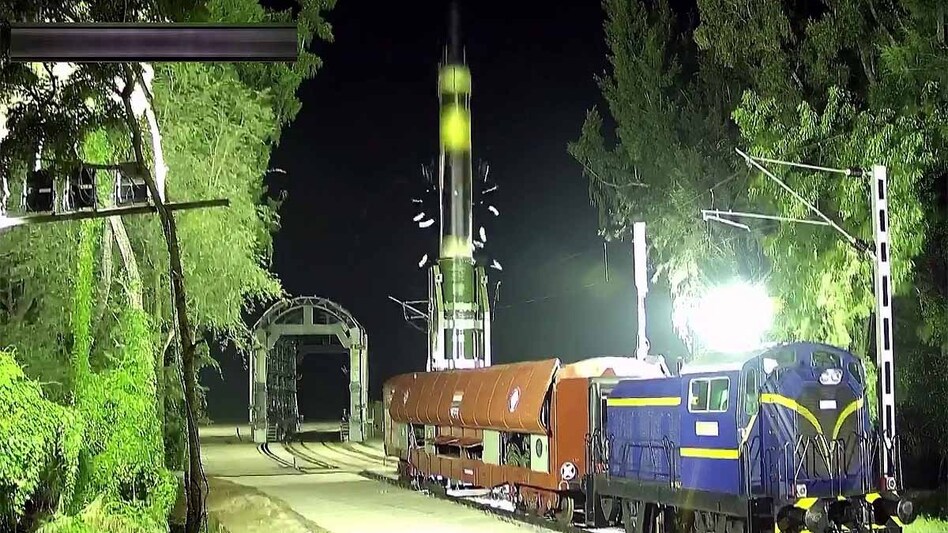
 The rail-mobile platform not only increases the survivability of India’s nuclear deterrent but also complicates enemy targeting strategies.
 The rail-mobile platform not only increases the survivability of India’s nuclear deterrent but also complicates enemy targeting strategies.
India’s Agni Prime ballistic missile, a next-generation system in the country’s Agni series, represents a significant leap in indigenous defense technology. Tested multiple times since its first trial in 2021, Agni Prime has a range of 1,000-2,000 kilometers and is designed with advanced composite materials, better navigation systems, and reduced weight compared to earlier Agni models. It is seen as a reliable medium-range ballistic missile that strengthens India’s nuclear deterrence posture, particularly in the Indo-Pacific security environment.
Countries with similar capabilities
India joins a select group of nations that have developed and deployed medium-range ballistic missiles (MRBMs). Countries with comparable capacities include:
China: The DF-21 series, often dubbed the “carrier killer,” has been in service since the 1990s with ranges between 1,500–2,000 km.
United States: The Pershing II MRBM, deployed in the 1980s, was one of the most advanced systems of its time, though later dismantled under arms control treaties.
France: The M51 and earlier M45 missiles, sea-based systems, provide ranges of up to 6,000 km, with France having mastered MRBM-class weapons decades ago.
Israel: The Jericho-II and Jericho-III programs demonstrate indigenous MRBM capacity, with ranges extending from 1,500 km upwards.
North Korea and Iran: Both nations have fielded indigenous medium-range systems like the Hwasong-7 (Nodong) and Shahab-3, respectively.
Soviet Union’s pioneering role
The Soviet Union was the first to master and widely deploy medium-range ballistic missiles. In the 1950s, the R-5M (SS-3 Shyster) became the world’s first nuclear-capable MRBM, with a range of about 1,200 km. Later systems like the R-12 (SS-4 Sandal) and R-14 (SS-5 Skean) cemented the USSR’s dominance in this class. These missiles were central to Cold War confrontations, most famously the Cuban Missile Crisis of 1962, when Soviet MRBMs stationed in Cuba brought the world to the brink of nuclear conflict.
Strategic implications for India
By developing Agni Prime, India has joined the lineage of nations that began with Soviet-era breakthroughs and evolved into modern precision systems. Unlike Cold War MRBMs, Agni Prime integrates digital guidance, canisterised storage, and rapid mobility for quick deployment. Strategically, it fills the gap between short-range systems like Prithvi and long-range intercontinental-class Agni-V, giving India flexible options for deterrence in both South Asian and wider Indo-Pacific theaters.
Rail-based mobile missile system: A key game-changer
One of the unique features of India’s missile program is the development of a rail-based mobile missile system, further enhancing the strategic value of the Agni Prime. The Indian Railways is a key partner in this strategy, enabling the Agni Prime and its predecessors to be launched from mobile platforms disguised as ordinary trains. This allows for greater mobility and flexibility, making it harder for adversaries to track and neutralize India’s missile assets.
Rail-based systems like the Agni-I and Agni-II have already demonstrated the country’s ability to launch ballistic missiles from railway platforms, a tactic reminiscent of Cold War-era Soviet rail-mobile systems. The Soviet Union, in its heyday, was a pioneer of such systems with the RT-23 UTTH (SS-24 Scalpel), which was developed during the 1980s. The SS-24, a road and rail-mobile system, offered the Soviet Union significant advantages in terms of nuclear deterrence, preventing any fixed-target vulnerabilities. While the US and European nations largely phased out rail-based missile systems, they remain a potent symbol of the strategic flexibility in Russia and now India’s defense doctrines.
The rail-mobile platform not only increases the survivability of India’s nuclear deterrent but also complicates enemy targeting strategies. India’s success in combining Agni Prime with these mobile platforms places it among an exclusive list of nations capable of such a sophisticated deterrence system, which includes Russia, China, and North Korea.
Positioning among global powers
While the Soviet Union pioneered the technology and countries like the US and China advanced it further, India’s Agni Prime marks the consolidation of self-reliant missile capability. It positions India alongside established nuclear powers that use MRBMs as both a deterrent and a balancing tool in regional geopolitics. The introduction of rail-mobile launchers adds a layer of resilience, allowing India’s strategic forces to be less predictable and more survivable in the face of first-strike threats.
 India in discussions with Iran for safe passage of 20 oil tankers through Hormuz: Report
 PM Modi speaks to Iranian President, raises unhindered transit of goods and energy
 Iran denies laying mines in Hormuz, warns nations backing 'aggression' won't get safe passage
 Iran's new Ayatollah says Hormuz must remain closed
 'It can't happen now': US Navy not ready to escort oil tankers through Hormuz
 Rahul Gandhi Vs Hardeep Puri In Lok Sabha Over India’s Oil Security
 Induction Cooktop Sales Jump 300% In Delhi-NCR Amid LPG Supply Concerns
 Market Fall Deepens | Oil Hovers Near $100, Nifty Slips - Sanjay Sinha Explains What Next
 Market Crash Amid Oil Surge? Devang Shah Decodes | Live Market Commentary
 #Podcast | #Episode09 | From Bollywood Icon To Entrepreneur: Malaika Arora On Food, Fashion & Fitness
 Brent oil prices above $100 again after Khamenei signals Hormuz will stay shut
 NSE IPO: Leading exchange appoints 20 merchant bankers for its mega issue; check full list
 Sensex tumbles 2,171 pts, Nifty falls over 2% in 2 days; will stock market extend losses?
 Adani Power, Tata Power, Coal India shares jump up to 7%: Jainam Broking's Kiran Jani weighs in
 Iran war, oil-gas crisis: BHEL, Suzlon, Adani Power, Tata Power, AGEL among JM's top picks