


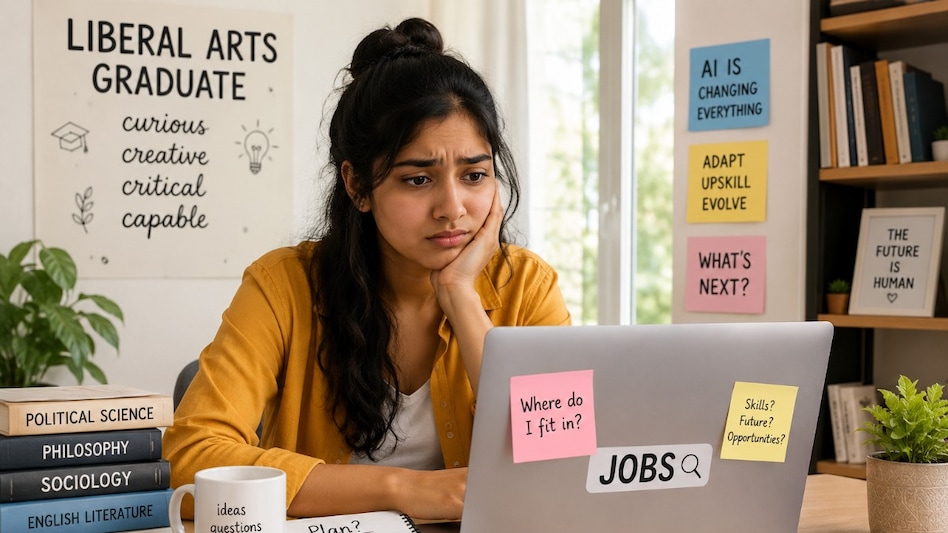
 Graduates who can connect ideas across disciplines, navigate ambiguity and recognise when a technically correct answer isn't necessarily the right business answer bring a different kind of value.
What if the biggest winner in the AI race isn't an engineer, but a philosophy graduate?
For years, the career equation seemed settled. STEM degrees promised stronger job prospects, while humanities graduates often had to justify the value of their education. Technical expertise was rewarded, specialisation was encouraged, and employers looked for people who could solve increasingly complex problems.
Artificial intelligence is beginning to rewrite that equation. A recent study by Cognizant and Pearson suggests employers are rethinking what makes someone employable.
MUST READ | AI is changing who becomes CEO — and the skills needed to get there
AI is becoming increasingly capable of writing code, analysing data and automating routine knowledge work, prompting employers to place greater value on qualities machines still struggle to replicate: judgement, critical thinking, communication and the ability to connect ideas across disciplines, according to the report, The AI Workforce Pulse.
Nearly seven in ten (69%) HR professionals say broad, interdisciplinary academic backgrounds are now more valuable for entry-level hiring than deep specialisation. Two in three (67%) say they value liberal arts graduates more than they did before AI, while an overwhelming 97% believe soft skills have become even more important in the age of AI.
The findings suggest employers increasingly value qualities often associated with liberal arts education, including critical thinking, communication, ethical reasoning and the ability to evaluate multiple perspectives skills seen as complementing AI rather than competing with it.
DO CHECKOUT | More than 9 in 10 job seekers encounter fake job offers
Graduates who can connect ideas across disciplines, navigate ambiguity and recognise when a technically correct answer isn't necessarily the right business answer bring a different kind of value.
The 64% of organisations that report valuing problem-finding over problem-solving illustrates this shift. When AI handles execution, the advantage shifts to framing problems, asking better questions and recognising challenges before they become crises.
These are strengths broad-based education often develops. As jobs evolve faster than ever, expertise built for today's way of working may not always translate to tomorrow's roles. A broader skill set offers greater flexibility and HR leaders appear to recognise that. That has implications for how organisations hire entry-level talent and invest in learning and development.
"AI is reshaping the talent landscape and exposing the limits of traditional talent and learning models," says Kathy Diaz, Chief People Officer at Cognizant. "With the fundamental shift in entry-level tasks and skill requirements changing rapidly, organisations must rethink how they hire and develop talent at pace."
Ali Bebo, Chief Human Resources Officer at Pearson, believes the future belongs to organisations that combine AI innovation with a deeper understanding of how people learn, develop and apply new skills in the real world.
The AI revolution may not make liberal arts graduates the biggest winners overnight, nor does it diminish the need for technical talent. But it is changing what employers value. The competitive advantage may increasingly lie with those who can ask better questions, connect ideas across disciplines and apply human judgement where machines cannot.

 India, New Zealand seal major strategic partnership: Why India's latest global deal is worth watching
 E20 fuel price: Why E20 petrol is not cheaper than pure petrol despite 20% ethanol blending
 'We made a mistake': Here's what Iran told US privately amid Strait of Hormuz crisis
 DMart Q1 earnings preview: Net profit, EBITDA may grow in double digits; demand outlook among key things to track
  'I've been on their list for a long time': Trump says Iran to face unprecedented bombing if he's assassinated
 The Tech Gear Show #10 | Tech News, ALT Buds Open Review, Nothing Phone (4b), Noise Rep Hands-on
 #Podcast Ep15: BMW India President Hardeep Singh Brar On EVs, Luxury Cars, Ethanol & Mobility Future
 Banks, Techs Rally On Dalal Street As Nifty Jumps
 PM Modi Arrives in Auckland For First State Visit To New Zealand In 40 Years; Focus On Trade & Ties
 "They Prioritise Graveyards", Says CM Yogi, Slamming Opposition For Disrespecting Sanatan Traditions
 4 Nifty FMCG stocks to buy after 32% selloff: What past 4 big falls since 2004 hint at
 Persistent Systems fixes record date for Rs 18 final dividend; check detailsDMart Q1 earnings preview: Net profit, EBITDA may grow in double digits; demand outlook among key things to track
  Sensex, Nifty extend gains; Rs 5.8 lakh crore investor wealth added; what's ahead?
 Swiggy says FSSAI prohibition order on Toing was linked to licence update; stock slips 3%









