


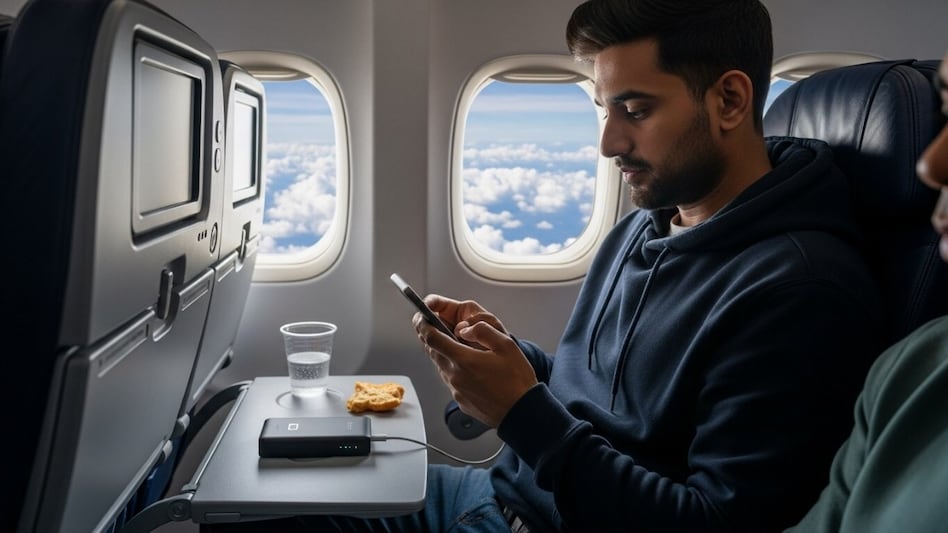
 The review comes days after an IndiGo flight at Chandigarh Airport was evacuated after a power bank reportedly caught fire inside the aircraft shortly after landing.
India’s aviation regulator is reviewing global practices on carrying and using power banks onboard flights, amid growing concerns over lithium battery-related fire incidents and increasing restrictions by airlines and regulators worldwide, sources told Business Today TV.
“DGCA is reviewing global aviation practices. No decision has been taken yet on prohibiting passengers from carrying power banks,” a person familiar with the matter said.
FAQs
Why is the DGCA reviewing rules on carrying power banks on flights in India?
The DGCA is reviewing global aviation practices after growing concerns over lithium battery-related fire incidents. The move also follows a recent IndiGo incident at Chandigarh Airport where a power bank reportedly caught fire after landing.
Has India banned passengers from carrying power banks on flights?
No, there is no ban yet on carrying power banks onboard. Sources said the DGCA is still reviewing global norms, and no final decision has been taken on prohibiting passengers from bringing them on flights.
What are the current DGCA rules for power banks and lithium batteries on flights?
Under the DGCA’s January advisory, passengers cannot use power banks to charge phones or other devices during the flight. Power banks and spare lithium batteries must be carried only in hand baggage and must not be stored in overhead compartments.
Why are power banks considered a safety risk inside aircraft?
Power banks contain lithium-ion batteries, which can overheat, catch fire, and act as ignition sources. Such fires can be intense, self-sustaining, and difficult to detect or control quickly, especially inside the cabin or overhead storage areas.
What are airlines and global regulators doing about portable chargers onboard flights?
Globally, rules are becoming stricter. ICAO has advised that portable chargers should stay within passengers’ reach and should not be charged onboard. The FAA does not allow them in checked baggage, while some airlines in the US, Japan, and South Korea have imposed tighter storage or usage restrictions.

 Anthropic says Claude now leads 26% of its AI R&D work: How fast is AI development accelerating?
 100% tariffs immediately? What Trump’s new Russia sanctions law means for India
 Russian oil & gas purchase: Trump signs Bill into Act targeting 100% tariffs on India, China
 'Tatas today are the face of India...': Former Solicitor General Harish Salve backs Tata Sons public listing
  Trump’s announces Greenland deal with Denmark: What it means for US military presence
 Gold Price Outlook: Why Gold Could Rise Despite Global Interest Rate Hikes | Silver Market Update
 Health Insurance: Why Claim Settlement Ratio Is Not Enough When Choosing The Right Insurer
 “Unacceptable And Unprofessional”: MEA Rejects Pakistan’s Claims Over INS Kolkata Collision
  Commodity Trading For Beginners: How MCX & NCDEX Work | Trading Basics | Money Today
 US Fed Rate Hikes A Headwind For Foreign Flows? | Jibi Jacob | Jefferies
 Jindal Supreme, SS Retail, Hero Motors IPOs subscribed up to 181 times on final day; details here
 Sensex, Nifty post sixth weekly loss; TCS, Titan among top laggards, slip up to 4%
 How AI collapse could benefit Indian equity market; Jefferies' Christopher Wood explains
  Banks are no more secular growth story, prefer NBFCs: Chris Wood
 Jefferies' Christopher Wood sees gold at $10,000 'sooner or later'; likes India's small, midcapsAnthropic says Claude now leads 26% of its AI R&D work: How fast is AI development accelerating?Gold Price Outlook: Why Gold Could Rise Despite Global Interest Rate Hikes | Silver Market Update
 Ghosts in the machine: How a false AI intel almost triggered a US-China clash in West Asia
 Fujifilm X Half review: The not-so-retro digital camera for Gen-Z
 Now, Google Gemini becomes latest AI model to break out & hack real companies












