


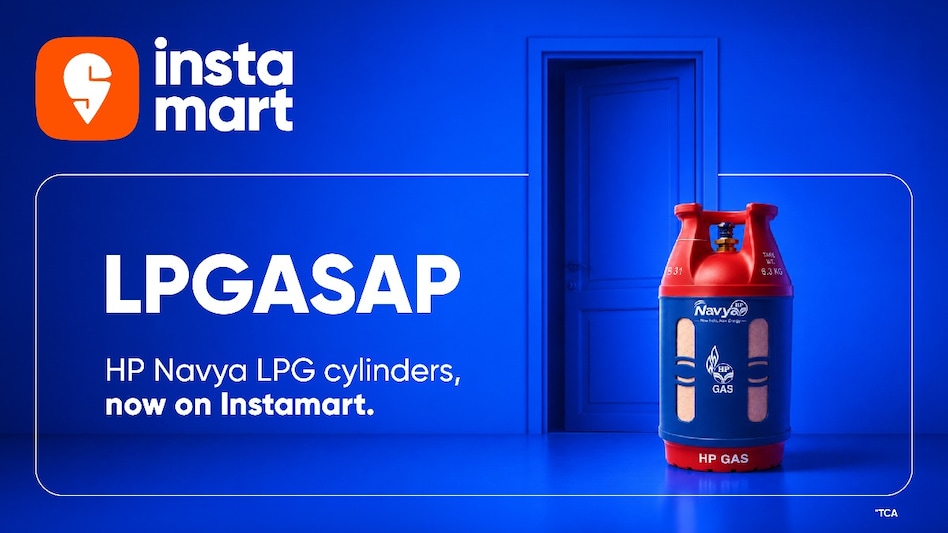
 Swiggy Instamart has partnered with HPCL to deliver LPG cylinders in minutes
Quick-commerce company Swiggy Instamart's partnership with Hindustan Petroleum Corporation Ltd. (HPCL) to deliver LPG cylinders in minutes may be a milestone for the sector, but it is also raising questions about how a tightly regulated commodity will be sold through an on-demand platform.
What the pilot offers
The pilot, launched in Bengaluru, allows customers to order 5 kg and 10 kg HP Gas cylinders through Instamart without requiring a traditional LPG connection. That marks a departure from the conventional model, where households are linked to a distributor and a registered connection.
The move promises convenience, particularly for tenants, students, and consumers who may not have a permanent LPG connection. However, it has also prompted questions around customer verification, purchase limits, safety, traceability, and the possibility of diversion or black marketing.
Must Watch: War In West Asia: What It Means For India's Oil Supply, Fuel Prices & Economy
Why verification matters
"Since LPG is a regulated commodity, this is unlikely to be an open system," said Satish Meena, founder of Datum Intelligence, an independent market research and intelligence firm. "I expect it will follow a model similar to IRCTC ticket bookings, where you can use a third-party platform, but the transaction is integrated with the government's backend systems."
According to Meena, customers are likely to undergo KYC during their first purchase, with address details captured as part of the onboarding process. "I don't have the exact implementation details, but this will need KYC and all the necessary information. I'm also sure there will be limits on how much a customer can order," he said.
The questions are significant because LPG distribution in India has historically been tightly regulated. Domestic connections have long required customer verification and address proof, while authorities have periodically cracked down on the diversion of subsidised cylinders and other forms of misuse. Industry observers say any digital distribution model will need robust safeguards to ensure traceability.
What about prices
Pricing, however, is unlikely to become a point of differentiation.
Responding to queries from Business Today, Swiggy Instamart said the LPG cylinders will be sold at government-regulated prices, making them comparable to offline retail prices.
What Instamart gains
For Instamart, the pilot is about more than adding another product category.
Meena believes the initiative reflects quick-commerce companies' efforts to become indispensable household platforms rather than just grocery delivery apps.
"It is still a pilot, but it is in the direction of increasing platform stickiness and solving more household problems," he said.
The partnership also comes at a time when competition in India's quick-commerce market has intensified. Platforms including Blinkit, Zepto, Flipkart Minutes and Amazon Now are expanding beyond groceries into higher-frequency and higher-value categories to improve customer engagement and order frequency.
What could decide wider rollout
Whether LPG deliveries become a mainstream category will likely depend on how effectively HPCL and Swiggy address regulatory and operational concerns. As the pilot evolves, industry watchers will closely monitor the KYC process, delivery protocols, purchase restrictions and other safeguards that determine whether convenience can coexist with the regulatory requirements of selling a controlled commodity.

 West Asia war: Oil could have become cripplingly expensive but three factors contained the disruption
 ITR filing: 8 costly mistakes salaried employees should avoid to prevent tax notices and refund delays
 Raghuram Rajan picked for US Fed review panel: Here's the role he'll play
 Before Elon Musk's takeover changed everything, Parag Agrawal had a leadership role model in mind for Twitter — here's who inspired him
 CAFE-III norms propose tighter fuel-efficiency targets; EVs, hybrids, flex-fuel vehicles get major compliance edge
 BHEL Q1 Results: Reports Profit At ₹382 Crore, Stock Jumps 5%; Analyst Bets On Long-Term Growth
 ITC Hotels Q1 Results: Why Have ITC Hotel Shares Fallen Despite Strong Earnings? | ITC Share Price
 Why Abakkus Is Betting On Large & Mid Caps Now?
 ‘Strong Infrastructure Builds A Strong Future’: Rajnath Singh On India’s Transformation
 Himadri CMD Anurag Choudhary On Record Q1, ₹170 Crore Expansion & Speciality Chemicals Bet
 Adani Power, Bharat Dynamics, Astra Microwave: Expert strategy for trading these stocks
  BDL share price: Should you buy, sell or hold? Key resistance and support levels
 Tech Mahindra Q1 results: PAT jumps 28%, revenue rises; deal wins cross $1 billion
 Wipro Q1 earnings: Net profit at Rs 3,352 crore, board clears interim dividend
  Sensex, Nifty close flat; IndiGo, HCL Tech, Bajaj Finance top gainers









