India records roughly 2.7–2.8 crore births annually. While fertility rates in southern states have steadily declined, several northern states continue to report higher birth rates, creating sustained demand for neonatal and paediatric infrastructure.
Demand moves north
Rainbow’s expansion thesis is built on replicating its hub-and-spoke model, large 250-plus bed tertiary children’s hospitals supported by 50-70 bed micro-market units, with a focus on accessibility in emergencies, particularly for neonatal and paediatric critical care.
“In children, the golden hour is crucial,” Kancharla said. “A critically ill newborn or a child with seizures cannot travel long distances. Accessibility drives outcomes, and outcomes drive trust.”
From a 50-bed hospital in Hyderabad in 2000, Rainbow has evolved into a specialist network offering neonatal and paediatric intensive care, ECMO, complex neurosurgery, cardiac surgery, liver transplants and bone marrow transplants. Its flagship Hyderabad facility now operates as a high-acuity tertiary centre comparable to mid-sized Western children’s hospitals, according to management.
The group also runs an integrated neonatal and paediatric retrieval network across Telangana, Andhra Pradesh and parts of neighbouring states, including air transport for critical cases.
Unlike multispeciality chains that house paediatric departments within broader hospital formats, Rainbow operates a child-exclusive ecosystem with consultant-led 24x7 care, influenced by structured NHS-style paediatric systems where Kancharla trained.
“There was primary and some secondary care available,” he said. “But when a child became critically unwell, structured tertiary and quaternary support was limited. That gap created the opportunity.”
Reflecting on the network’s evolution, Kancharla added, “What took Western paediatric systems nearly 100 years to build, we have been able to build in about 25 years because we adopted structured systems from the beginning.”
The northern push comes as private hospital infrastructure in cities such as Delhi-NCR and Lucknow expands rapidly. Kancharla believes the region today mirrors Hyderabad in the early 2000s, with rising incomes, nuclear families and increasing willingness to spend on specialised child healthcare.
“South India moved earlier because of literacy, medical colleges and early private investment,” he said. “Now North India is building capacity aggressively. In the next 10–15 years, that is where the larger paediatric opportunity lies.”
As part of its Delhi NCR expansion, the organisation is establishing two new facilities in Gurugram, with a planned capacity of approximately 325 beds in Sector 44 and around 125 beds in Sector 56. Together, these additions will significantly strengthen its presence in the NCR region and enhance access to quality healthcare for families across Delhi and Gurugram.
The model it wants to replicate
Financially, Rainbow has demonstrated steady scale-up in recent years, expanding bed capacity and deepening super-speciality services. In its filings, the company has reported growth in revenue and operating performance, supported by improving occupancy and a rising contribution from tertiary and quaternary services.
The group trains nearly 200 doctors annually through DNB and fellowship programmes, building internal pipelines in neonatology, paediatric intensive care, neurology, nephrology and gastroenterology. Kancharla noted that reverse migration of doctors trained in the UK, Canada and Australia is strengthening specialist availability.
He also pointed to broader improvements in India’s child health ecosystem. Institutional deliveries have increased sharply in several states, neonatal mortality has declined and vaccination coverage has expanded over the past decade.
“It is not private sector alone,” he said. “Government initiatives, literacy, hygiene and women’s empowerment have all contributed. Growth has to happen at both primary and tertiary levels simultaneously.”
Scaling, step by step
Data from CMIE Prowess shows a sustained rise in Rainbow Children’s Medicare Ltd’s revenue and profit over the past decade, interrupted only briefly during the pandemic period. Sales increased from ₹233 crore in FY16 to ₹1,524.9 crore in FY25, reflecting steady expansion in capacity and case mix.
Profit after tax rose from ₹16.9 crore in FY16 to ₹244.2 crore in FY25. The pandemic year marked a temporary setback, with revenue at ₹650.1 crore and profit at ₹39.6 crore in FY21. The recovery thereafter was sharp and sustained.
From FY22 onwards, profitability strengthened materially. Profit stood at ₹138.7 crore in FY22, rose to ₹212.4 crore in FY23, improved to ₹218.3 crore in FY24, and reached ₹244.2 crore in FY25. Over this three-year period, profits expanded by nearly 75%, underlining operating leverage as new capacities matured.
Brokerages remain constructive as the company enters a new expansion phase. ICICI Direct has reiterated a “Buy” rating with a target price of ₹1,650, implying a potential upside of around 43% from current levels.
In its January 30, 2026 update, the brokerage said Rainbow is preparing to enter newer territories leveraging its expertise in paediatric and perinatal care.
Rainbow operates 23 hospitals and five clinics across nine cities. Analysts expect nearly 790 additional beds over the next two to three years, with projects underway in Bengaluru, Coimbatore, Gurugram and Pune.
For Q3FY26, revenue rose 12% year-on-year to ₹445 crore, supported by a 9% increase in average revenue per occupied bed. EBITDA increased 9% to around ₹147 crore, with margins at 33%, reflecting costs associated with new hospital additions.
ICICI Direct noted that operating leverage strengthens once occupancy crosses roughly 55%. The brokerage expects revenue to grow at a 15.3% CAGR between FY25 and FY28, with EBITDA projected to expand at 14.5% CAGR. FY28 EBITDA is estimated at ₹735.6 crore. At current levels, the stock trades at about 22 times FY28 estimated EBITDA.
With capacity addition underway and a focused paediatric model, the next phase will depend on execution discipline, occupancy ramp-up and margin stability as Rainbow attempts to scale nationally.
“The need is much larger now,” Kancharla said. “The opportunity is national.”
Returns follow results
Shares of Rainbow Children’s Medicare Ltd have generated substantial gains since listing. Issued at ₹542 and listed at ₹510 on May 10, 2022, the stock closed near ₹450 on its first day amid broader market volatility.
Nearly four years later, the stock was trading at around ₹1,192 as of February 27, 2026, marking a gain of about 134% from the listing price. The gains have not been linear, with intermittent corrections amid broader market swings, but the longer-term trend has remained upward.
The re-rating reflects a strengthening financial profile, supported by steady revenue growth and improving operating metrics.
Investors who initially focused on the muted debut have gradually shifted attention to occupancy levels, bed additions and margin stability. Unlike diversified hospital chains chasing multiple specialties, Rainbow has remained focused on paediatrics, neonatal intensive care and women’s health. That operating clarity has supported earnings visibility.
While short-term movements reflect sectoral cycles and liquidity flows, the medium-term appreciation suggests a market response anchored in improving profitability rather than speculative triggers.
(With inputs from Prince Tyagi)



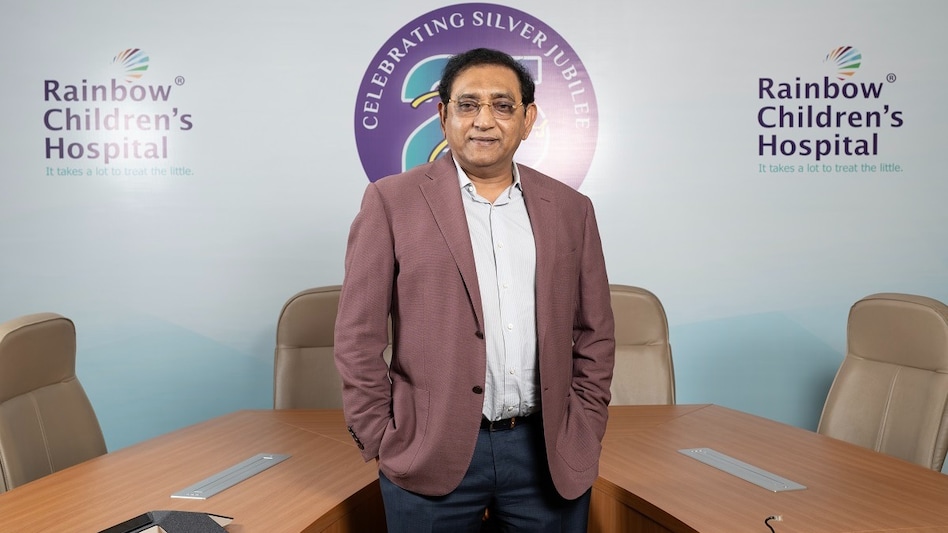 Dr Ramesh Kancharla, Founder and Chairman of Rainbow Children’s Hospital, said, “If you look at where the children are, that is where the healthcare need will be.” (Photo: Hardik Chabbra)
 Will RBI raise interest rates in October? Here’s what experts have to say
 Bitter Friday for Nestlé: Russia seizes assets as Moscow targets Western firms over Ukraine support
 West Asia impact: Saudi Aramco halts European crude allocations after East-West pipeline attack
 Tata Electronics partners with Japanese, Malaysian firms to boost semiconductor manufacturing in India
 From selling gold to spending ₹3.5 lakh: iPhone 18 Pro fever hits India as fans queue up on sale day
 “Unacceptable And Unprofessional”: MEA Rejects Pakistan’s Claims Over INS Kolkata Collision
  Commodity Trading For Beginners: How MCX & NCDEX Work | Trading Basics | Money Today
 US Fed Rate Hikes A Headwind For Foreign Flows? | Jibi Jacob | Jefferies
 ₹25 Billion FII Outflow: What Could Bring Foreign Investors Back? | Jefferies' Jibi Jacob
 India’s Private CapEx Picks Up: Christopher Wood On The Market Outlook
 Jindal Supreme, SS Retail, Hero Motors IPOs subscribed up to 181 times on final day; details here
 Sensex, Nifty post sixth weekly loss; TCS, Titan among top laggards, slip up to 4%
 How AI collapse could benefit Indian equity market; Jefferies' Christopher Wood explains
  Banks are no more secular growth story, prefer NBFCs: Chris Wood
 Jefferies' Christopher Wood sees gold at $10,000 'sooner or later'; likes India's small, midcaps
 Canada visa processing: Indians get faster visitor visas, Super Visa wait hits 70 days
 Countries with the highest take-home pay: Switzerland tops global ranking, Check full list here
 Fueling India’s tech surge: NaBFID lines up ₹3,000 crore loans for data hubs
 Panic button: California governor issue order for mandatory kill switch on advanced rogue AI












