








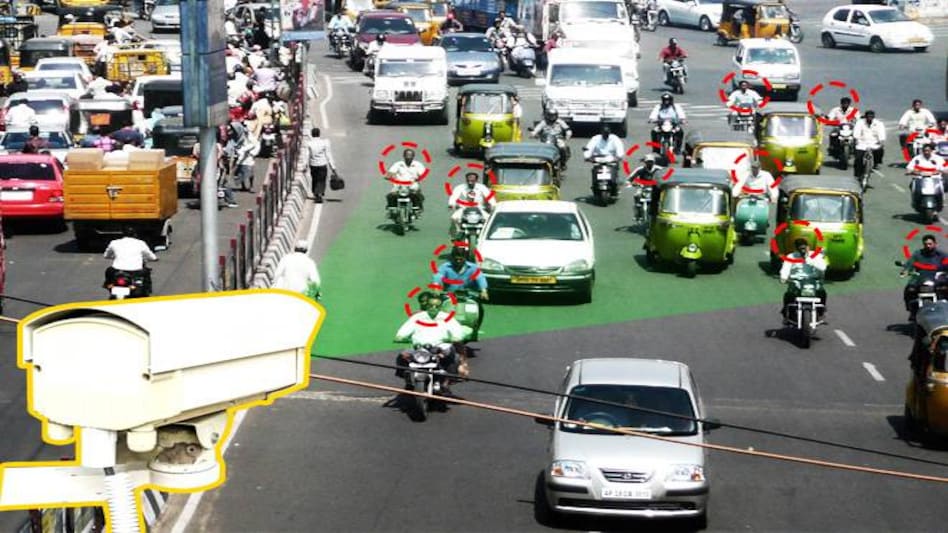
How often have you seen bikers zip past you with their helmets being used as an arm accessory? This despite every third accident in 2016 involved a two-wheeler and about 28 riders died daily on Indian roads the same year for not wearing helmets.
IIT-Hyderabad (IITH) may have a path-breaking solution to this problem. Researchers at this premier engineering institute have developed a solution using Artificial Intelligence (AI) for automatic detection of motorcyclists driving without helmets in surveillance videos, and the institute has already filed a patent application for the technology, the Economic Times reported.
The technology is in the ready-to-be-deployed stage so IITH recently signed a memorandum of understanding (MoU) with Hyderabad City Police to gain access to video data from the city's CCTV network.
"We have done significant lab experiments on sparse traffic at the IITH campus as well as dense traffic from Hyderabad city CCTV network. The results are motivating us to develop the complete software to deploy the system for real-world use," C. Krishna Mohan, associate professor, IITH, told the daily. He worked on this potentially life-saving technology along with research scholars Dinesh Singh and C. Vishnu.
The report added that the solution leverages convolutional neural network (CNN) technology. This popular deep learning architecture, which primarily mimics the human brain using AI, is most commonly applied to analysing visual imagery. Here's how it works: The solution is partially installed in cameras and partially on the servers of the central police control room. A software is also installed on an embedded card attached to CCTV cameras, which helps detect motorcyclists without helmets by sending out an alert to the central alert database.
"It will be fully automatic along with a web interface to verify the alerts by the operators [traffic police, etc.]. From there, it will be connected to the existing RTO website to generate challans [fines] and send a notification to the riders through SMS," explained Singh.
The solution can be deployed at the entrances of cities like toll bridges or on the selected checkpoints, especially road intersections. The next step for the researchers is to get an industry partner on board for making the technology commercially available.
Significantly, the team believes that the proposed system can easily be extended to other kinds of traffic applications, including detection of tripling on a bike, zigzag bike driving and traffic violations by other kinds of vehicles.
"Recent studies show that human surveillance proves ineffective, as the duration of monitoring of videos increases, the errors made by humans also increases," said Mohan, adding that the team has also developed a novel framework for automatic detection of road accidents in the surveillance videos.
That's not all. The trio has further proposed a framework for 'Snatch Theft Detection' in city-wide surveillance. Gold, silver stabilise post sell-off; UBS sees gold at $6,200/oz by June, July 2026
 IREDA shares climb 2%, snapping 4-session fall; trend still cautious or reversal sign?
 Sensex, Nifty roar back with 2.5% surge as India-US trade deal brightens outlook for markets, rupee
 World Governments Summit: Technology is becoming as important as defence and finance, says IBM's Arvind Krishna
 'Left, right switches checked, found satisfactory': DGCA rejects fuel switch malfunction claims on Air India Boeing 787
 India–US Trade Deal After Tariff War: Trump Slashes Tariffs, Modi Welcomes Trade Reset
 India-US Deal: Not A Blanket Cut, But A Big Boost | Fine Print Matters
 Adani Group Partners Italian Major Leonardo For Helicopter Manufacturing In India
 BTS | India’s IT & Start-Up Reset: AI Disruption, IPO Profits And The Big Reality Check
 SC Slams Meta, WhatsApp On Data Privacy: ‘You Can’t Play With Data Of Indians’
 IREDA shares climb 2%, snapping 4-session fall; trend still cautious or reversal sign?Sensex, Nifty roar back with 2.5% surge as India-US trade deal brightens outlook for markets, rupee
 Solar Industries Q3 earnings: Defence firm logs highest revenue, EBITDA; stock ends higher
  Adani Enterprises Q3 earnings: Net profit surges 97 times; stock zooms 12%
 India-US trade deal: Why UBS is still underweight on Indian stock market