












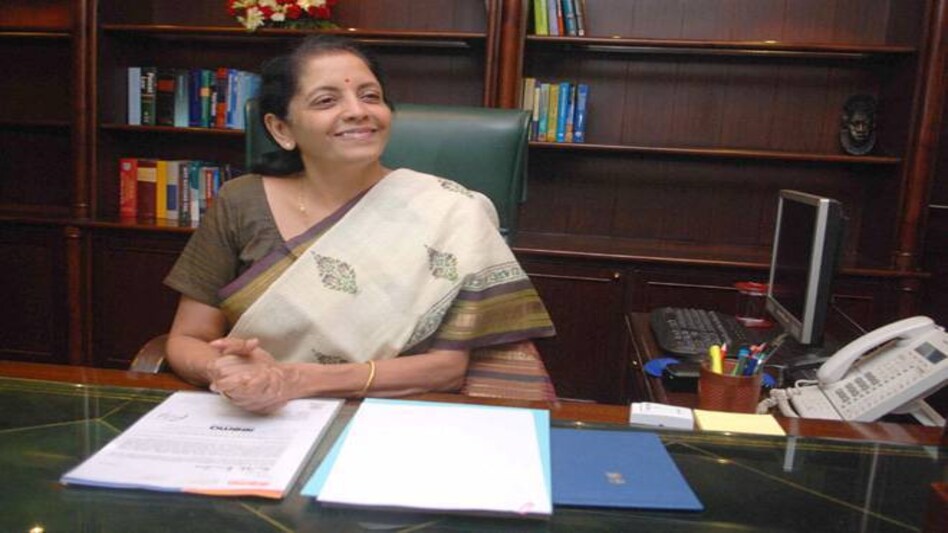
India's cardiac stent market was certainly the last thing on Commerce Minister Nirmala Sitharaman's mind when she said that the restrictive visa regime being planned by the US can have an (adverse) impact on US companies operating in India.
The minister's comment was in response to US President Donald Trump's move to restrict temporary job (H-1B) visas - a decision seen as impacting Indian software firms that use this route to send professionals to handle US assignments. If the minister's comment can be seen as a response to a restrictive regulation that harmed the interests of Indian firms, India may have to brace itself for similar complaints from the US and other developed countries soon as it has made life difficult for foreign multinational medical device makers in the country.
At least three leading global medical device makers - Abbott, Medtronics and Boston Scientific - are known to have sought permission to pull out their top end cardiac stents from the Indian market due to a price cap imposed by the government. The companies allege that government price control has made sale of latest generation drug eluting stents unviable in India.
Though not comparable, a crisis borne out of Indian regulation has irked foreign multinational cardiac stent makers. And that is what the companies are trying to highlight by deciding to pull out their high-end products from Indian markets.
Thanks to the increasing number of heart diseases and its population, India has been one of the fastest growing cardiac stent markets globally. While a bare metal stent was available at less than Rs 10,000, high end drug eluting stents (DES) like the Bioresorbable Vascular Scaffold (BVS) stents was costing over Rs 100,000 until the government decided in February 2017 to cap the prices of both the categories. While the maximum price of bare metal stent was fixed at Rs 7260, DES had to be sold at Rs 29,600 or less. A minor inflation linked increase saw this price move to Rs 7400 and Rs 30,180 a month later.
Global stent manufacturers, who enjoy over 60 percent domestic market share had a reason to worry as the price cap disrupted their future launch plans for India. The prices of their existing products came down. Since the difference between the price realised by the companies and the MRP was huge, in most cases, the lowering of retail price had only impacted the trade margins, but not the companies' profitability. Still, it curtailed the freedom of the companies to launch new products in this category as such products, unless categorised separately, cannot be priced differently.
Trump's problem was with low cost skilled labour. India's problem is high costs of stents. Restrictive regulation has turned out to be the solution in both cases.
 'Not at the expense of alliance with India': Marco Rubio clarifies on US ties with Pakistan
 'Good news on Hormuz in next few hours': Marco Rubio hints at US-Iran deal breakthrough
 Iran signals Hormuz reopening: 'Shipping traffic will return to pre-war levels within...'
 'AI is the biggest investment bubble yet': Zoho's Sridhar Vembu on spending boom
  'Not targeted at India': Marco Rubio defends US visa changes amid concerns over H-1B, student visas
 WHO Sounds Ebola Alarm | India Today’s Sneha Mordani Explains The Threat
 Why Britain Keeps Changing Prime Ministers | Brexit, Chaos & UK Political Crisis Explained
 No Water In 45°C Heat! Why Raipur's Rewa Village Is Facing A Brutal Water Crisis
 Honda City launched, ZR-V e:HEV Coming Soon • Double Digit Growth Target • New SUVs Incoming
 U.S. Tightens H-1B Rules As Visa Applications See Sharp 38% Decline
 Suzlon Energy Q4 results on Monday: Stock up 35% in two months | Preview
 Varun Beverages shares rebound 42% from March low: Is the rally sustainable?
 Vedanta Demerger: Systematix sees 186% upside? Target price explained for all 5 companies
 Suzlon Energy, IEX, Reliance Power, ZEEL: How stocks with up to 35% retail stakes fared in 2026
 IndusInd Bank shares climb 8% in a month; what investors can do?