








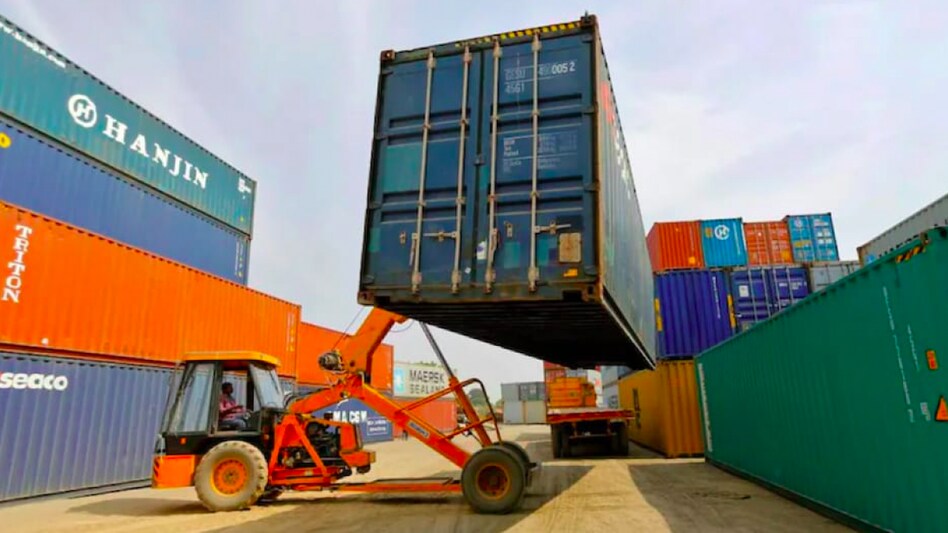
 India’s exports grew by 27.16 per cent in November to touch $30.04 billion compared to a 43.5 per cent year on year growth in October,
 India’s exports grew by 27.16 per cent in November to touch $30.04 billion compared to a 43.5 per cent year on year growth in October,
The gap between India’s merchandise exports and imports widened to a record high in November, as the outbound shipments slowed to a 9-month low level and inbound shipments remained elevated, albeit easing to a three month low level, official data showed.
While weakening global demand on account of supply bottlenecks and rising covid-19 cases in the West have impacted India’s exports, depreciating rupee coupled with high international commodity prices are keeping imports elevated.
India’s exports grew by 27.16 per cent in November to touch $30.04 billion compared to a 43.5 per cent year on year growth in October, data released by the ministry of commerce and industry showed on Tuesday. The outbound shipments were led by petroleum products, engineering goods, chemicals and electronic goods.
Imports grew by 56.58 per cent during the month to $52.94 bn, leaving a trade deficit of US$22.9 bn, which is more than twice the levels in the corresponding month last year.
Economists expect India’s current account deficit to widen to over 1 per cent of GDP in FY22, compared to 0.9 per cent surplus in FY21.
“The festive season holidays appear to have dampened the merchandise exports to a nine month low in November 2021…The merchandise trade deficit for November 2021 is not only twice as high as November 2020, but also significantly higher than the level in November 2019, which is a cause for concern regarding the implications for the size of the current account deficit in H2 FY2022,” said Aditi Nayar, chief economist, ICRA Ratings. We expect the current account deficit to widen to US$25-30 billion in Q3 FY2022 itself, exceeding the full year deficit seen in FY2020, added Nayar.
Key export items like iron ore, ready-made garments, gems and jewelry reported a decline in exports during the month amid weakness in overseas orders amid Omicron fears. Petroleum product exports jumped by 154 per cent during the month in value terms, possibly due to high international crude oil prices.
Meanwhile, non-oil non gold imports slowed to $31.82 bn in November, down 11 per cent compared to October, indicating slowing domestic demand.
Petroleum and crude oil imports were up 132 per cent during the month at $14.6 bn, while silver imports grew by 2538.19 per cent in November to $244mn. Gold imports grew by 40 per cent to $4.2 bn.
Brent crude has started rising again with Omicron fears receding and touched $74.4 per barrel on Monday.
Besides, a weaker rupee will only make imports more expensive. Rupee depreciated to nearly 76 level against the US dollar on Tuesday. The Indian currency has been depreciating on expectations of the US Fed Reserve hiking interest rates and quickening bond tapering with inflation in the world’s largest economy at a near four-decade high. Higher US interest rates may lead to capital outflows from riskier emerging market currencies.
“Though the government has announced a slew of measures to support exports, the need of the hour is to soon announce extension of the interest equalization scheme and allow transfer of MEIS,” said A Sakthivel, president, Federation of Indian Export Organisations (FIEO). Some of the other major issues, which require the attention of the government are necessary steps with an option to support the sector in case of spread of a new variant, Omicron of Covid-19 pandemic, he added. “Additionally augmenting the flow of liquidity and empty containers and establishing a regulatory authority to seek justification of imposition of various charges by the shipping lines also needs urgent intervention of the government,” said Sakthivel.
 Adani Group has capex plan of Rs 2 lakh crore annually for next five years: Karan Adani
 West Asia conflict: Record India outflows, GEM flows negative as markets enter ‘no-buyer phase’, says report
 IndiGo to levy fuel charge from March 14 as aviation turbine fuel prices surge
 India’s transparent insolvency resolution process has taken a hit: Vedanta chairman on Jaiprakash Associates
 Helium shortage: Dixon Tech, Lal PathLabs, Vedanta, HAL, MTAR shares take a hit; here's why
  Karan Adani Reveals The Only People Who Can Interrupt Gautam Adani Anytime
 India Needs To Use Its Coal Reserves: Vedanta’s Anil Agarwal
 Hormuz Closed, Oil At $100? Prashant Ruia Answers | Siddharth Zarabi | India Today Conclave 2026
 Golf Builds Patience And Focus
 Gold Vs Other Assets: Where Should Investors Bet In 2026? | India Today Conclave 2026
 Helium shortage: Dixon Tech, Lal PathLabs, Vedanta, HAL, MTAR shares take a hit; here's why
  RIL stock falls 14% from January high; what lies ahead for the index heavyweight?
 Rs 2,000 crore daily loss! OMCs take Rs 20 per litre hit on petrol, Rs 45 on diesel
 Sensex, Nifty plunge over 5% this week; investors lose Rs 19 lakh crore — will markets fall further next week?
 NSE unlisted share hold firm as IPO preps intensify; valuations near Rs 5 lakh crore