

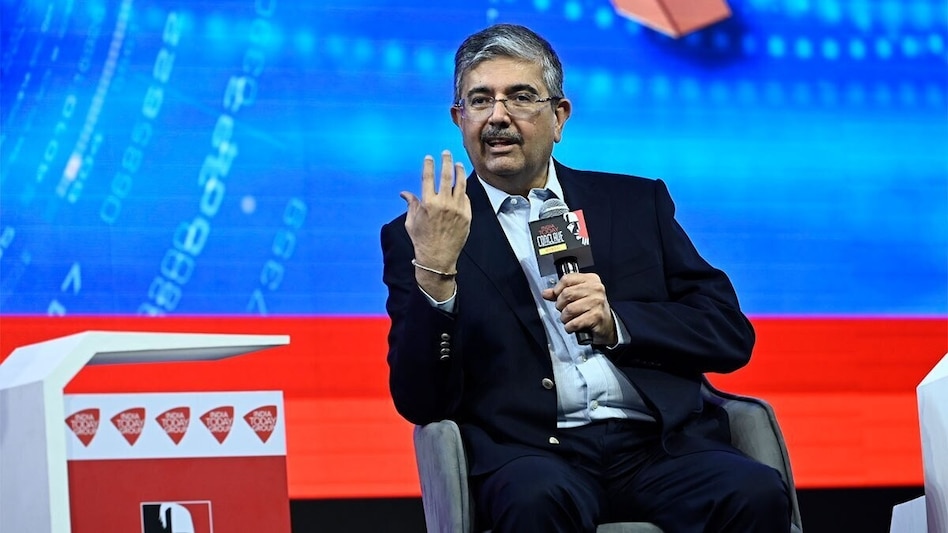
 In an earlier post, Kotak had argued that the US would increasingly leverage its dominance under a Trump administration.
 Kotak Mahindra Bank chairman Uday Kotak on Thursday said his 2024 warning about how a Donald Trump-led United States would wield its global dominance was now “playing out as anticipated,” as Washington moves towards imposing sweeping punitive tariffs on countries buying Russian oil.
“My tweet on US absolute power, in November 2024. Playing out as anticipated,” Kotak wrote on X (formally twitter), reposting his earlier message.
In that November post, Kotak had argued that the United States, as the world’s pre-eminent military, financial and technological power, would increasingly leverage its dominance under a Trump administration.
“The US is the absolute power on planet earth: military, finance, technology. Under Donald Trump it will leverage dominance. Every country has to recognise and prepare. In finance, geopolitics, trade and elsewhere. Is US fiscal deficit a chink in its armour?” he had wrote.
500% tariffs on Russian oil buyers
Kotak’s remarks come amid escalating pressure from Washington on major economies, including India, following the Trump administration’s backing of a Bill that could impose tariffs of up to 500% on countries importing Russian-origin oil and energy products.
The proposed ‘Sanctioning Russia Act of 2025’ would be triggered if Russia or entities acting on its behalf refuse to negotiate peace with Ukraine, violate a peace agreement, reinvade Ukraine, or attempt to undermine the Ukrainian government.
A key clause mandates that “the President must increase the rate of duty on all goods and services imported into the United States from countries that knowingly engage in the exchange of Russian-origin uranium and petroleum products to at least 500% relative to the value of such goods and services.”
India faces pressure
India faced a double whammy on January 8 after President Trump both backed the Russia sanctions Bill and announced the US withdrawal from the India-led International Solar Alliance (ISA), as part of a broader exit from several international organisations.
The developments came just ahead of the arrival of US Ambassador-designate Sergio Gor in New Delhi this weekend. Gor, who will formally assume office on January 12 as Ambassador to India and “Special Envoy to South and Central Asia,” had said during his Senate confirmation hearings in September that ending India’s imports of Russian oil was a “top priority” for the Trump administration.
Meanwhile, in Paris, Polish Foreign Minister Radoslaw Sikorski said he was “satisfied” with India’s recent reduction in Russian oil imports, during a joint press appearance with External Affairs Minister S Jaishankar and the foreign ministers of France and Germany.
Russia sanctions Bill gains momentum
In Washington, US Senator Lindsey Graham, a close ally of President Trump, said on January 7 that the President had “greenlit” the Russia sanctions legislation, with a possible vote in Congress “as early as next week.”
“This Bill would give President Trump tremendous leverage against countries such as China, India and Brazil to incentivise them to stop buying the cheap Russian oil that provides the financing for Putin’s bloodbath against Ukraine,” Graham said.
The bipartisan Bill, introduced in April, has already secured 84 co-sponsors in the 100-member Senate and 151 co-sponsors in the US House of Representatives, indicating smooth passage once it is brought to a vote. Trump has described it as “great legislation,” while Graham said the law would allow the President discretion to set tariff levels beyond the existing 25% penalty tariffs on Indian goods.
 Exam reforms: Tech titan Nandan Nilekani picked by PM Modi to fix national public examination system
  'Tax officers struggled for own land': Nirmala Sitharaman slams laidback attitude of govt depts
 CBDT issues new crypto reporting guidance: No new tax, but exchanges must track and report all transactions
 Did Cockroach Janta Party's 'Chalo Sansad' 2.0 threat trigger Dharmendra Pradhan's resignation? What we know so far
 'Will discharge my responsibilities with complete humility': Pralhad Joshi after being appointed Education Minister
 AI Data Centers, Aerospace & Gas Turbines: What's Powering Indo-MIM's Future Growth?
 Best Healthcare Stocks: Gaurang Shah's Outlook On Apollo Hospitals, Fortis & The Manipal Health IPO
 Is Indo-MIM's IPO Valuation Justified? Here's Why The Company Sees Strong Growth Ahead
 Treasury Bills Explained: Why T-Bills Are One Of The Safest Short-Term Investment Options
 FDs vs Markets: Where Should You Keep Your Short-Term Money?
 Gland Pharma stock: Price target of Rs 3,250 likely in medium term, says analyst
  Metal recycling stocks to buy: Gravita, Pondy Oxides, Jain Resource among top picks
 TRIL shares: Should you average the falling stock? Here's 'fixed and final' stop loss
 Adani Power: 45 GW target, Rs 2 lakh crore capex plan among conference call highlights
  ITC Hotels, Chalet, Ventive, IHCL, SAMHI: Hotel stocks to buy despite travel disruptions
 Beyond mutual funds: Why analysts see SBI Funds' alternative asset business as a long-term growth engine
 'Ashamed of it...': Manoj Muntashir calls Adipurush his biggest mistake, seeks country's forgiveness Exam reforms: Tech titan Nandan Nilekani picked by PM Modi to fix national public examination system 'Tax officers struggled for own land': Nirmala Sitharaman slams laidback attitude of govt depts
 Delhi targets traffic bottlenecks on Aruna Asaf Ali Marg with ₹1.97 crore elevated road study









