

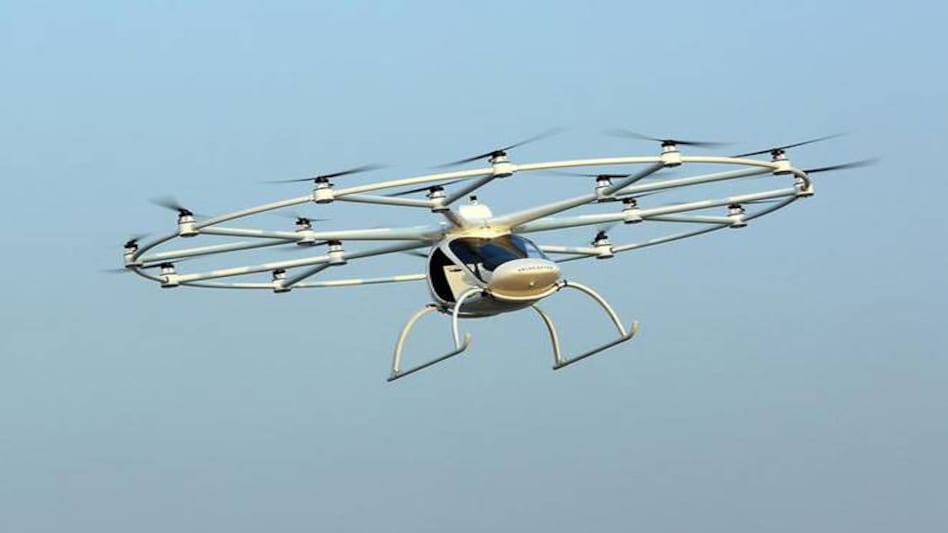
 Flying taxis can change the country's ever growing traffic problem. Photo: Reuters (For representation purpose only)
As the developed countries advance towards devising better ways of transportation, India could also join the race soon. While tech giants like Google, Airbus, Uber, Volvo, and dozens others are working on driverless cars, a few among them, like UberAIR and Elon Musk's Boring Company and Hyperloop One, are taking the race to air or underground. In what can be good news for India, IIT-Kanpur this month signed an MoU (Memorandum of Understanding) worth Rs 15 crore with VTOL Aviation India Pvt Ltd, an Indian private aviation company, to build operational prototypes, which would be used as flying taxis. Over 100 researchers from IIT-Kanpur would work on making a fully-functional prototype and the project would be completed by 2023. Though in India the technology is at early stage, it definitely has the potential to change the country's ever growing traffic problem, especially in major cities like Delhi, Mumbai and Kolkata.
Project to be Completed in 5 Years
 'I'll be here for 2.5 years': Trump warns Iran against waiting for midterms for a deal
 India could raise ₹2 lakh crore through IPOs; 55% of FY27 proceeds already fresh capital: SEBI Chairman
 No prescription, no pills: Govt cracks whip on misuse of painkillers, antibiotics
 SEBI settles proceedings linked to Hindenburg report against 5 Adani firms for ₹1.51 crore
 'No positive response on 5-day banking': Bank unions to go ahead with 3-day strike
 IT Stocks Under Pressure: What Next For Indian Markets? | Chakri Lokapriya
 Karnataka’s Welfare Schemes Under Pressure As Finance Department Flags New Challenges
 Family Disputes Can Hold Businesses Back: Nirmala Sitharaman’s Message To Family Firms
 TRAI New Rules: Voice-SMS Only Plans Mandatory | What It Means For 20 Crore Non-Data Users
 Oil & Gas Capex Boom: Anshul Saigal Names Energy Stock He Owns | Saigal Capital Advisors
 Peshwa Wheat to raise ₹53.52 crore through IPO; funds to go towards expansionIndia could raise ₹2 lakh crore through IPOs; 55% of FY27 proceeds already fresh capital: SEBI Chairman
 Balmer Lawrie to demerge Travel & Vacations unit into wholly-owned subsidiary: Report
 Sansera Engineering shares rise 7%; Goldman Sachs raises target; sees further upside
 US-Iran talks today? Oil slips to $98 a barrel; will Sensex, Nifty rebound?
  Nagaland's 'Angh' wins Toronto International Film Festival award, Becomes eligible for 2027 Oscars
 RBI revises InvIT, REIT valuation norms for all-India financial institutions; check new rules'I'll be here for 2.5 years': Trump warns Iran against waiting for midterms for a deal
 Trump Calls Iran ‘The Number One Sponsor Of Terror’ In UNGA Address
 Tata Trusts vs Tata Sons: Abhishek Singhvi says shareholder rights cannot be ‘nullified’












