












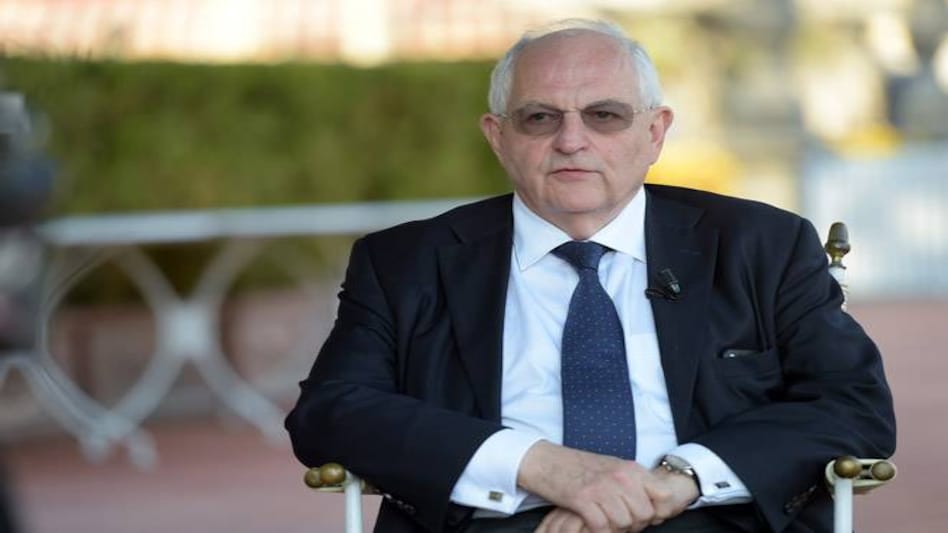
 Martin Wolf, Chief Economics Editor of the Financial Times / Image Source: Getty ImagesMartin Wolf, Chief Economics Editor of the Financial Times / Image Source: Getty Images
With the novel coronavirus pandemic taking the entire world hostage in less than four months and the global economy suffering the consequences due to the lockdown, noted expert on world economics Martin Wolf said that the governments must support citizens so that they don't venture out looking for help. Speaking at India Today's E-Conclave Corona series, Chief Economics Editor of the Financial Times shared some important tips on how India can protect its companies from coronavirus outbreak.
Martin Wolf suggested that the Indian government should make 'very large guarantees' to firms as they do not have the capacity to continue operations during the lockdown. The Indian government has imposed two lockdowns - Phase 1, from March 25 to April 14; and Phase 2, from April 14 to May 3.
"If people can't go out and work, they can't be expected to stay at home and starve to death. The first priority should be to support their living standards. The second focus of governments should be to support companies," he said. "My view is that governments should put a hold on all bankruptcy proceedings and encourage banks to support companies," Martin Wolf added.
Martin Wolf, while addressing the great economic crisis that companies across the globe are facing, said that governments must protect businesses. He said, "At the end of this, there will be some businesses that will be completely devastated and the government will have to look at those industries and see what sort of bailouts are appropriate."
Interestingly, India was not the first to put an entire nation under lockdown. China, Singapore, France, South Korea, Germany and the UK also implemented total confinement to stop the virus from spreading.
When asked about what measures India can consider under a lockdown of minimum 40 days, Wolf responded that India's focus should be on the maximum utilisation of its healthcare resources. "First, you have to use all medical resources you have and can create to deal with the medical side of the crisis. We know India has a relatively limited healthcare system so this is going to be quite a challenge," he said.
Wolf added, "Then, you have to protect people who are dramatically affected by the crisis. In the developed countries, we have rightly put in place systems to protect people's salaries. This is aimed at people's welfare. That's what you have to do but this is an enormously expensive process." Such measures will also escalate the fiscal deficit. "Public debt will rise. I think India needs to run a large fiscal deficit," he said.
Here are some important pointers from the expert on surviving shutdown:
How is the current crisis compared to previous ones?
On lockdown
What economic measures should we take?
On need to overhaul capitalism
On threat to globalisation
On global and Indian economic recovery
Race for new economic superpower
On trends for the future
(Edited by Vivek Dubey)
 'Enjoy the current gas prices while...': Iran warns as US blocks all ships at Iranian ports from April 13
 $115 oil in sight: Markets rattle as US-Iran tensions spike over Strait of Hormuz
 Trump considers bombing Iran again after peace talks in Islamabad fail: Report
 What is RBI's kill switch proposal? What it means for your UPI, cards, net banking access
 Stock market open or closed tomorrow for Ambedkar Jayanti 2026 gazetted holiday? Check NSE, BSE calendar
 Ground Report: Indian Workers In Tel Aviv Debunk Bunker Access Rumours Amid Missile Sirens
 What’s Next For INR? Expert Take On Rupee Vs Dollar
 NASA Unveils Stunning Artemis II Moon Voyage Footage As Astronauts Return From Historic Flyby
 Pakistan-Israel Row Erupts Ahead Of U.S.-Iran Talks As Khawaja Asif’s ‘Evil’ Remark Sparks Fury
 The Truth About IT Earnings: Why Low PEG & Management Quality Matter More Than Price
 Nifty, Sensex, Nifty Bank outlook for today: Gift Nifty down 355 pts; key levels to watch
 HDB Financial share price: 22% upside? HDFC Bank arm gets 'Long' rating ahead Q4 results on April 15Stock market open or closed tomorrow for Ambedkar Jayanti 2026 gazetted holiday? Check NSE, BSE calendar
 Top stocks in news: M&M, Adani Green, L&T, Swiggy, Lupin, Muthoot, ICICI Pru AMC, MGL
 Gift Nifty tanks as US-Iran peace talks collapse; oil jumps 7% on Trump threat; analyst views