








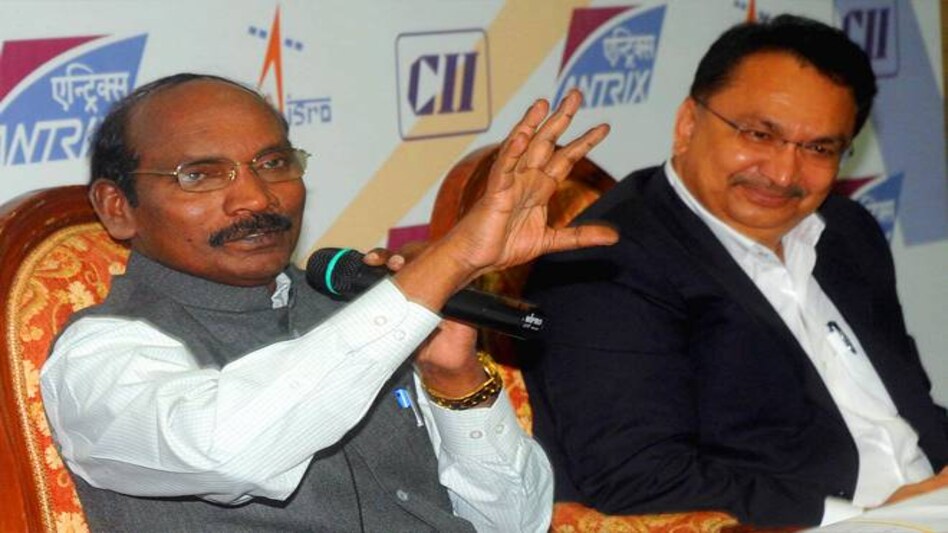
 ISRO Chief K SivanISRO Chief K Sivan
Indian Space Research Organisation Chief K Sivan on Wednesday said the Modi government has approved Chandrayaan-3, and that the project is going on smoothly. "The land acquisition for a second space port has been initiated and the port will be in Thoothukudi, Tamil Nadu," the ISRO chief said during a press conference, adding that the projecting costing about Rs 250 crore could be launched as early as next year.
ISRO chief K Sivan: We have made good progress on Chandrayan-2, even though we could not land successfully, the orbiter is still functioning, its going to function for the next 7 years to produce science data pic.twitter.com/6tw683HTnk
ANI (@ANI) January 1, 2020
Sivan said ISRO made some good progress on Chandrayan-2, and that its orbiter would function for the next seven years. He added that work on both Chandrayaan-3 and Gaganyaan was going on simultaneously.
The space agency will send astronauts for the Gaganyaan manned mission training scheduled to start in the third week of January in Russia, the ISRO chief informed.
Four astronauts have been identified for the mission, he said.
Also read: Chandrayaan 2: NASA fails to locate Vikram lander due to 'long shadows' over landing site
The ISRO chief also congratulated the Chennai based techie who recently located the Vikram lander of Chandrayaan-2 that hard-landed and maintained that it was the space agency's policy not to release picture of the crashed module. "We know where it crashed and where it is located," Sivan said.
To a question on what went wrong with Vikram lander, he said it was due to velocity reduction failure. "The velocity reduction failure was due to internal reasons," he said.
Also read: Chandrayaan 2: ISRO examines cause of communication failure with lander Vikram
Chandrayaan-2 mission was India's first attempt to land on lunar surface. The ISRO had planned the landing on the South Pole of the lunar surface. However, the lander Vikram hard-landed.
Also read: Chandrayaan 2: ISRO releases pictures of moon's surface
With PTI inputs
 NSE IPO may unlock mega gains for billionaire investors RK Damani, Premji
 India-US BTA: Harley Davidson bikes to get 0% duty, gradual tariff reduction on luxury cars
 India-US interim trade agreement: 'No GM modified product allowed, agri sector protected,' says Piyush Goyal
 'Decided to give 0% tariff on some cancer medications, neuro treatment': Piyush Goyal on what US got
 ‘How is this a win?’: Chidambaram slams India-US trade framework as opaque, US-tilted
 BT Golf 2025-26 Kochi, Kerala Awards Ceremony Marks A High-Energy, Successful Conclusion
 Golf Is An Addiction. We Eat And Sleep Golf!
 The Fairway Fixes Everything. Mindset, Life, Relationships
 BT Golf LIVE: Join AU Small Finance Bank Presents BT Golf 2025-26 For Its 4th Leg In Kochi, Kerala
 AI Will Change MBAs, Not Leadership: IMD President On India’s Global Education Rise
 RIL, SBI, Kotak Bank, Kalyan, HAL, BEML, BDL among stocks in focus next week; here’s whyNSE IPO may unlock mega gains for billionaire investors RK Damani, Premji
 SBI Q3 Results: Profit jumps 24% to Rs 21,028 crore; asset quality improves
 IDBI Bank stake sale: Kotak Mahindra Bank says ‘has not submitted a financial bid’
 BDL, Mazagon Dock, MRF, Hindustan Copper, RVNL, others to turn ex-dividend next week