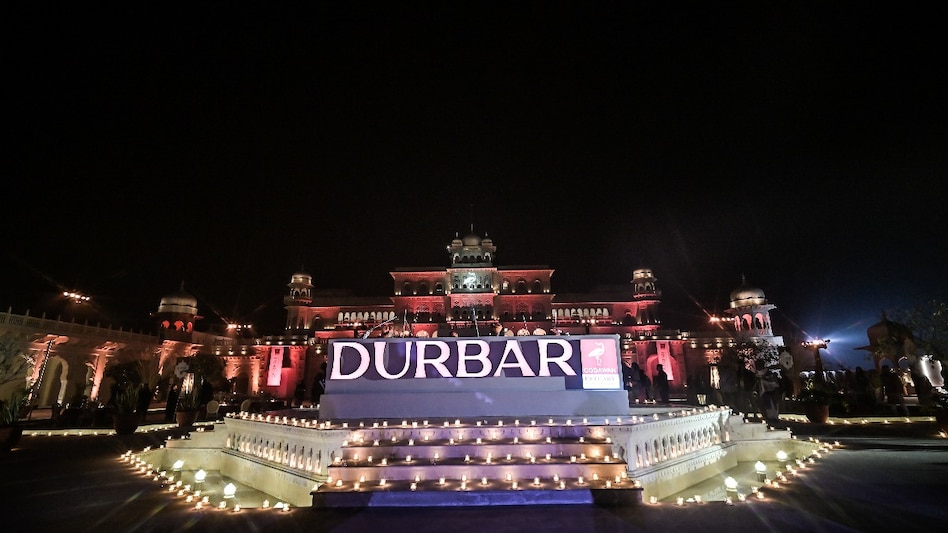
Unfolding from the Abheygarh hilltop palace at Khetri, the two-day extravaganza on January 9 and 10 was a master class in how to do mindful luxury right.
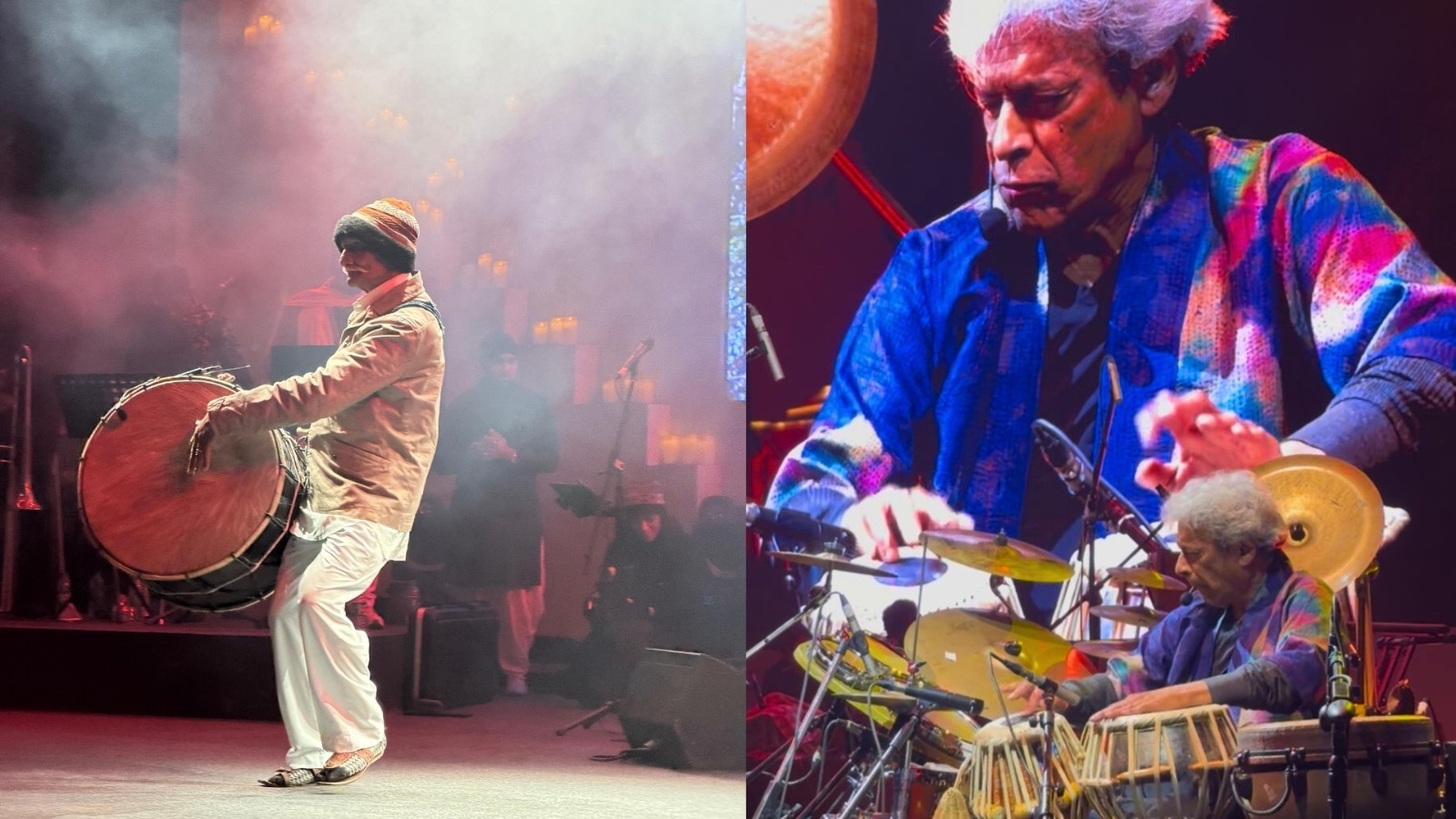
As the temperatures dipped on a cold night at the grandiose Abheygarh in Khetri, Rajasthan, Dhashrath Dada from NIMAD fired up the 100+ crowd with his dramatic beatings on the ‘chichli dhol’. The beats, increasing in its tenor, amplified the open stage experience. Goosebumps were guaranteed. This was just a small slice of Durbar by Godawan Estuary Water’s second edition, a curated immersive experience which brought together craft, conservation, culture and community.
Advertisement
Unfolding from the hilltop palace at Khetri, the two-day extravaganza on January 9 and 10 was a master class in how to do mindful luxury right. The tone was set immediately where the imposing grandiosity of the hilltop palace Abheygarh the passion project of Abhimanyu Alsisar over a decade in the making, the display of supercars Porsche 911 Carrera and Porsche Cayenne, was complemented by the warm hospitality that was sensory in manifold ways.
“Durbar is the celebration of everything Rajasthan — craftsmanship, community and culture coming together. Godawan stands for craftsmanship, celebration and community,” said Praveen Someshwar, CEO and MD, Diageo India.
Echoing a similar train of thought, Abhimanyu Alsisar said, "Durbar is our way of presenting Rajasthan’s living heritage in a contemporary, meaningful format. It brings together craft, music, storytelling, and conservation in spaces that carry centuries of history. The idea is to create experiences that are immersive, thoughtful, and rooted in the land.”
Advertisement
And immersive they were. From mindfully curated performances that blended folk with contemporary expression, to conversations that stayed close to the ground realities of conservation, to heartland music and plated delights that travelled across cuisines, the two-day sojourn became a sensory ode to Rajasthan’s spirit, and the power of community.
Conservation of Wildlife & Preservation of Culture
Durbar is built around the conservation legacy of the Great Indian Bustard, localled called Godawan, a bird listed as Critically Endangered on the IUCN Red List. Once widespread across the subcontinent, the species, a powerful symbol of the fragility of the grassland ecosystem, now survives against formidable odds, laying just one egg a year. Godawan’s conservation programme, implemented in partnership with wildlife experts, NGOs, and local village communities, has contributed to increasing the bustard population from 92 to 173 birds. “When the count of birds went from 92 to 173, it was gratifying but equally humbling. It’s just a start… This is a commitment you can’t make for the sake of a campaign — it’s a commitment you make hoping ecosystems come together to see an outcome that’s far away,” said Vikram Damodaran, Chief Innovation Officer, Diageo India.
While the numbers matter, Durbar’s ambition is broader where the aim is to translate conservation from data into dialogue, and awareness into accountability. It was this intent that came into sharp focus during The Last Dance, a documentary screening directed by Vinay Chittora that paid tribute to Radheshyam Bishnoi, a grassroots conservationist whose life was devoted to protecting the Great Indian Bustard and its habitat. The screening served as a testimony to reinforce that conservation is ultimately sustained by individual courage and community resolve.
Advertisement
Further anchoring this narrative were wildlife conversations led by conservationist Dr Dharmendra Khandal and ecologist Dr Ayan Sadhu in a session moderated by Oliver Sinclair, owner of Bijaipur Horse Safari. Titled ‘Hidden Forests, Hidden Predators’, the session explored the invisible ecosystems of Rajasthan and how these spaces are often overlooked in development narratives but remain vital to maintaining ecological balance.
Talking about the big challenge that conservation as a perception faces. Dr Khandal said, “If we want to conserve our wildlife, we want our grandchildren to see the wildlife, then we need to understand that only a handful of wildlife lives inside the protected forests. Indian wildlife lives outside (protected) area… That’s where the challenges come—when you need to give the momentum for conservation.” He further harped on how what was essential was for the national park core to stop where it is at a manageable number. He added, “What we want is that the rest of that landscape becomes a coexisting space.”
Meanwhile, a special premiere of ‘Puqaar Diaries II’, the second part in the folk music documentary series, produced by Abhimanyu Alsisar, showcased raw human emotions of folk artists from across Rajasthan. Their passion and life-long dedication to their art, the heritage of how it has been passed through generations and the soulful but equally haunting tunes, be it from the ‘Bhapang’ or the ‘Mashak’, and the ticking time bomb of their existence, were captured in the moving documentary.
Advertisement
Be it wildlife conservation or preserving the folk art and its languishing artists, the need for funding and R&D requires patronage. This was the sense of community that was also central to a curated event like Durbar, where potential patrons could know about the ground realities of conservation efforts in India.
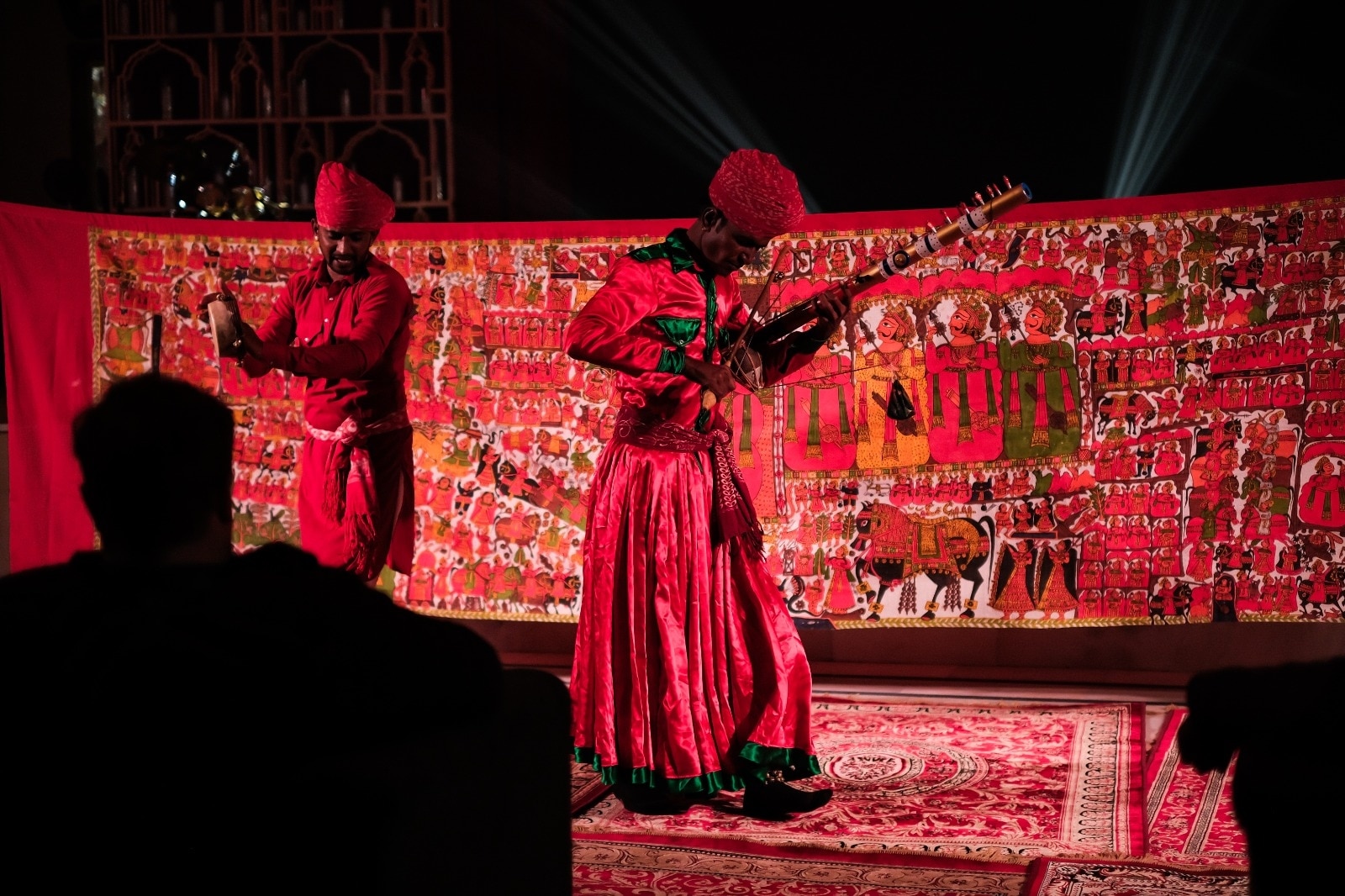
Phad Baachan: With a 700-year-old history, this Rajasthani tradition was made luminous for the present by Thorr Collective.
A Continuum of Culture and Craft
Through scroll, song, and storytelling, Durbar opened a window into Phad Baachan. With a 700-year-old history, this Rajasthani tradition was made luminous for the present by Thorr Collective. The form centres on a long painted scroll, the phad, whose vivid panels recount the legends of local deities. The recital, which was traditionally performed at night, brought together song, music, and dramatic narration, with a lamp used to illuminate different sections of the scroll as the story unfolded.
Amid the music and conversation, the art and craft at Durbar was presented as a living, immersive experience. The displays by Jaipur’s Nila House and Boito from Odisha allowed guests to slow down and engage with the stories embedded in material, memory and handwork. Nila House brought its revival of natural dyes, indigenous textiles and age-old techniques, reinterpreted through a contemporary lens that honoured origin and innovation. Their garments in varied hues of whites and blues, jute bags and accessories were a testament to how slow crafts take time.
Advertisement
Complementing this was Odisha-rooted design studio Boito, whose collaborative practice with artisan clusters translated native knowledge systems into installations, garments and objects that felt both intimate and forward-looking. The high-fashion brand’s electric blue Habaspuri silk trench coat was one example of bridging the gap and bringing the timeless craft of the Odia artisans to the contemporary luxury consumer. Together, their philosophy of mindful luxury allowed tradition to be experienced as something tactile, evolving and increasingly relevant to the present.
“Consumers are going back to their roots in a big way. You’re seeing a lot of artisanal, craft-driven products come through, which are niche, premium, authentic… This micro-community being created (at Durbar) will become very special over time,” said Diageo India’s Praveen Someshwar.
Dhashrath Dada from NIMAD on the 'chichli dhol' and legendary percussionist Trilok Gurtu
Music from the Heartland and Hinterland
Legendary percussionist Trilok Gurtu, a pioneer in fusing Indian rhythms with jazz and global improvisation, joined NIMAD’s main stage performance on Day 1 at Durbar, elevating the evening into one of the festival’s defining moments. In his electrifying performance, sounds came alive as almost tangible textures, marked by inventive use of drum textures, water-infused percussion and improvisational exchange. His set drew the crowd forward, turning the performance into a participatory spectacle.
Advertisement
Gurtu struck a reflective note on the global journey of Indian music and its reception at home. “It’s an eclipse (by Western music). We are doing it ourselves. It’s our fault. It’s not that they are pushing it; we are accepting it,” he said, pointing to what he sees as an under-recognition of India’s musical legacy domestically. At the same time, he expressed optimism about collaborations with new-age folk collectives such as NIMAD. He added, “When both sides understand each other, then it’s a meaningful collaboration… what NIMAD does is very unique.”
Created by Jayesh Malani and Bharat Chandore and directed by Warren de Sylva, NIMAD seeks to reinterpret the folk traditions of Madhya Pradesh’s Nimad region for contemporary audiences. Their performance moved between jazz-influenced passages and raw folk elements, including the region’s ‘harbolas’, akin to desi freestyle rappers. The set culminated in a multi-percussion sequence that had the audience visibly engaged, before transitioning into Kabir poetry and a jazz-inflected rendition of a traditional wedding song. "Durbar gives artists like us a rare platform to share our ancestral art with people who truly appreciate its depth. Our Dhol traditions have been passed down for generations, and through Durbar, we are able to keep this legacy alive while introducing it to a wider audience,” said Dhashrath Dada, NIMAD.
Also integral to NIMAD’s set were the visuals directed by Keerthi Raju, which added remarkable depth and atmosphere to the performance. During tracks such as ‘Baat Ghani’ and ‘Bichiya’, they transported the audience into the heartland the songs emerged from and made the performance truly come alive.
Shye Ben Tzur & The Rajasthan Express at the Durbar main stage
On day 2, Israeli musician Shye Ben Tzur who is a living testament to the profound impact of the soulful strains of India’s musical heritage, took to the main stage with the folk collective The Rajasthan Express. Tzur, who came to India and trained under Ustad Zia Fariddudin Dagar in the mid 90s, has never looked back since. “I’m working with people who are musicians from musician families for many, many generations… There’s always a line… to keep the respect of the musicians and the heritage… and another way to explore original music and creative work,” said Tzur. The collective features a diverse set of artists and instruments including the Siddha tradition, qawwals, Manganiyars, khartal, bhapang and the nagara drums among others.
Tzur and The Rajasthan Express’ experiments with Qawwali, bhajan, folk music and the fusion they achieve with global contemporary music, fused for a performance that was equal parts spiritual and equal parts bold and frenzied. With lyrics in Urdu, Hindi, and Hebrew, tracks like ‘Junun’, ‘Modeh’ and ‘Roked’, came alive with brassy parts, flute solos and . Their rendition of ‘Dama Dam Mast Kalandar’ got the crowd grooving and singing along.
Tzur and The Rajasthan Express delivered a set that sat at the crossroads of qawwali, bhajan and Rajasthani folk, while pulling in contemporary global music elements that made the performance feel both rooted and restlessly modern. The result was equal parts devotional and high-voltage with harmonium, handclaps and earthy vocals lifting into brassy punches, flute runs and driving percussion. Sung in Urdu, Hindi and Hebrew, tracks like ‘Junun’, ‘Modeh’ and ‘Roked’ built in tight, rhythmic waves, expanding with each chorus. Their rendition of ‘Dama Dam Mast Kalandar’ was the tipping point as the popular number turned the space into a shared chorus where the line between performer and audience dissolved.
The 2-day event though was replete with sound throughout. Tapi Project brought a blend of folk and contemporary music as folk, jazz and rock intertwined backed by the commanding vocal and presence of lead vocalist Swati Minaxi as she swayed and sang her way through songs like ‘Mehsoos’ and ‘Haiya Ho’. The Nuqta Project’s poetic rendition, infused with ghazals, brought a beautiful pause and serenity to another evening at Durbar. Rajasthani folk music was especially celebrated throughout as right from the first ‘Khambagai’ welcome to the luxury hotel as kalbelia folk dancers performed with grace to the sounds of the sarangi to every meal and high tea, the soulful strains of live music echoed throughout the culturally centred celebration.
A Sensory Journey Through Food
At Durbar, food was part of the storytelling, shaped as a series of curated meals that moved across regions and moods, much like the festival itself. The Ivory Feast, curated by Nikhil Merchant, reimagined Rajasthan’s culinary heritage in an understated and elegant all-white palette. Sky & Soul by Chef Jasleen Marwah brought Kashmir to the desert with a quiet intimacy with flavours that felt personal and poetic. Merchant’s Highland Picnic on Day 2 shifted the tone to something rustic and generous with a slow lunch meant for lingering and sharing. The evening turned warmer with Earth & Spirit, curated by Vernika Awal, which placed the flavours of the undivided Punjab alongside Rajasthan’s robust character, tasting like memory and home in the same bite. Together, the menus made the festival feel immersive at every level, from the stage to the table.
As the final notes faded into the desert night, Durbar felt less like an event and more like a proposition that luxury can be conscious, culture can be contemporary, and conservation can be made personal. As musician Shye Ben Tzur put it, “Be open to experience music… not through a screen, but through the vibration of presence. The more people can go out of their rooms, out of the screens, and… experience life—it’s very rewarding.” In a world increasingly mediated by devices, Durbar’s real triumph was reminding people of the value of showing up, be it for music, craft, community, and more importantly for the fragile ecosystems that hold it all together.
With a career that spans over a decade, Prashanti Moktan knows how to cut through the noise. A digital strategist by profession and a storyteller by passion, she has led the app teams at India Today, Aaj Tak, and now helms social media at Business Today. Other than being a digital ninja, she combines sharp insights with engaging narratives, whether it’s culture, fashion, politics, food, wellness or travel.
An alumna of IIMC, she’s equally at home debating politics over chai, as she is discovering culinary gems (street-side stalls, fine-dining experiences and everything in between!) or setting off on her next travel adventure.
















 Unfolding from the Abheygarh hilltop palace at Khetri, the two-day extravaganza on January 9 and 10 was a master class in how to do mindful luxury right.
 TCS to acquire Porsche’s IT consulting arm MHP for €320 million, signs five-year strategic deal
 Tata Sons board likely to meet on September 17, Chandrasekaran exit may take center stage
 'Our trade is growing again, thanks to PM Modi': Putin tells EAM Jaishankar
 Trade war escalates: Trump announces 50% tariffs on Canadian autos & steel from Jan 1
 Saudi attacked by Houthis, Turkey targeted by Israel: So what is the Mecca Pact doing?
 Market Masters | Aniruddha Sarkar On Top Sectors, Market Outlook & Where To Invest
 Daily Calls: Ask Your STOCK MARKET TODAY QUERIES | Market Update | Share Market News Today
 All About Debt Funds: Types Of Debt Funds & How To Invest | Mutual Fund Guide | Money Today
 “India Can Attract Global Space Talent Like A Magnet”: PM Modi To Startup CEOs
 CM Yogi Responds To Rahul Gandhi Over Manusmriti Remarks, India's Youth, And Heritage
 Tempsens Instruments IPO: Issue subscribed over 184 times on final day; check latest GMP
 Cupid's Aditya Kumar Halwasiya ups stake to 33.53%; buys 11 lakh shares
 Auto, auto ancillary stocks: Is it time to book profits? What Centrum's Nilesh Jain says
 This mid-cap metal stock zooms 15% on Rs 2,700 crore order announcement; do you own?
 RVNL shares a buy? Accumulate railway stock as valuations cool, says Kranthi Bathini
 This 25-year-old built ₹1.6 crore through meme pages and online content, now seeks advice on his money
 Bangkok, Tokyo, Barcelona are world’s top workcation destinations; only one Indian city make it to the list
 Punjab To Be Part of Electronics Supply Chains: Punjab’s Minister for Industries & Commerce Aman Arora
 Forget petrol bikes: Honda’s futuristic Outlier EV hints at a radical two-wheeler future
 Norton breaks superbike rules: Manx R wins rare global design honour