









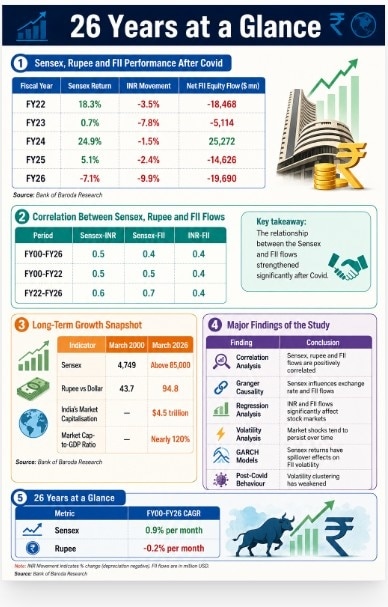



 Over this period, the benchmark Sensex delivered strong long-term growth. In contrast, the Indian rupee has steadily weakened over the years.
India's financial markets have undergone a dramatic transformation over the past quarter century. A new study by Bank of Baroda Research has traced the evolution of the Sensex, the rupee and foreign institutional investor (FII) flows over a 26-year period, revealing how increasingly interconnected these variables have become in shaping India's financial landscape.
The report analysed monthly data between FY2000 and FY2026 to understand the relationship between the BSE Sensex, the rupee-dollar exchange rate and FII equity flows. According to the study, India opened itself to global capital following the economic reforms of the 1990s, creating opportunities for foreign portfolio investors to play a major role in the country's capital markets.
Sensex's performance
Over this period, the benchmark Sensex delivered strong long-term growth. From around 4,749 in March 2000, the index scaled record highs above the 85,000 mark before witnessing some moderation. India's market capitalisation has expanded to nearly $4.5 trillion, equivalent to around 120% of GDP, underscoring the growing importance of equities in the country's economic development.
MUST READ: Sensex, Nifty tumble; weak Asian markets weigh on US futures: What's ahead?
Indian rupee's weakness
In contrast, the Indian rupee has steadily weakened over the years. The currency moved from 43.7 against the US dollar in March 2000 to about 94.8 by March 2026, reflecting a long-term depreciation trend. Despite this decline, the report notes that currency movements and stock market performance have remained closely linked, with several studies globally highlighting the interaction between exchange rates and equity markets.
MUST READ: As NSE prepares for IPO, Zerodha's Nithin Kamath says it’s a ‘cash machine’. Here's why
One of the most significant findings of the study is that the correlation between these variables has strengthened after the pandemic. During the period between April 2022 and March 2026, the correlation between the Sensex and FII flows rose to 0.7, while the correlation between the Sensex and the rupee increased to 0.6. In addition, the rupee and FII flows also showed a positive relationship.
The study also examined whether one variable could help predict another. Through Granger causality analysis, Bank of Baroda found evidence of causality between the Sensex and the exchange rate, as well as between the Sensex and FII flows. This suggests that stock market movements can influence future capital flows and currency trends.
FII activity
Regression analysis further showed that both exchange rate movements and FII activity significantly influence stock market performance across different time periods.
The report also highlighted the presence of volatility clustering in financial markets. In simple terms, periods of sharp movements tend to be followed by further bouts of volatility. Using GARCH models, researchers found that shocks to the Sensex and FII flows have persistent effects, with changes in one variable spilling over into the other.
Interestingly, the study found that post-pandemic data exhibited fewer signs of volatility clustering, suggesting that market behaviour may have changed in recent years.
The findings underline how deeply integrated India's stock market, foreign capital flows and currency have become. As the country attracts greater global capital and its markets continue to expand, understanding these relationships could become increasingly important for investors, policymakers and businesses navigating a rapidly evolving financial environment.
MUST READ: AI stocks among world's most valuable asset; top giants hold over $15 trillion mcap

 Behind the reduction in workforce in India’s top three private sector banks
  'Eye for an eye': Houthis declare naval blockade against Saudi Arabia
 No proposal to abolish LTCG on listed equities: Govt in Lok Sabha
 Blame it on the IndiGo fiasco? Air ticket refund complaints up 233% in 2025
 'No commitments made so far': CJP delegation meets JP Nadda, seeks Dharmendra Pradhan's removal
  Why Invesco Focused Fund Stands Out In The Focused Mutual Fund Category | Expert Explains
 Bandhan Large & Mid Cap Fund: Why Experts See It As A Top Mutual Fund Pick
 Tatva Up 20%; HDFC, Axis Bank Drop on Weak Q1
 Why Parliament Could Not Function on Day 1 of the Monsoon Session | Full Report
 Is Facial Recognition Actually Secure? | 1X Neo Robot & Ultraviolette X-47 Review | Tech Today
 Nifty, Sensex, Nifty Bank outlook for today: GIFT Nifty down 114 pts; key levels to watch
 Adani Green, Vodafone Idea, PNB: Stocks to trade — Key levels, target, stop loss & more
 SBI Funds IPO: Check the latest GMP before listing; should you expect a solid listing pop?
 Top stocks in news: SBI Funds, Paytm, IndiGo, Ather Energy, Sobha, Emcure, Canara HSBC Life
 JSW Steel Q1 earnings: Here's how the stellar show may impact the metal sector