


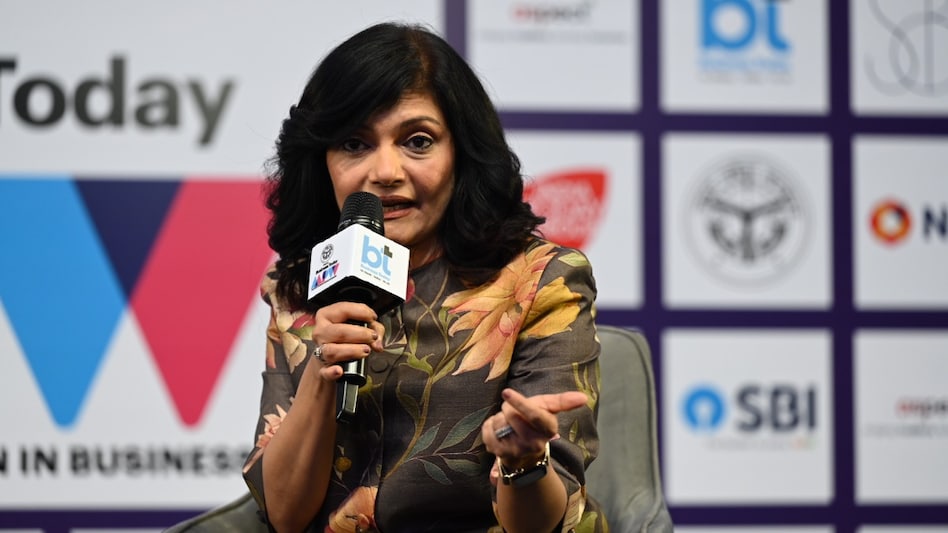
 Gangadharan is not just an accomplished tech leader — she is also the current chairperson of NASSCOM, India's apex body for the $250 billion technology sector.
At the Business Today Most Powerful Women (MPW) 2025 awards ceremony, Sindhu Gangadharan, Managing Director of SAP Labs India and Head of Customer Innovation Services at SAP, reflected on a remarkable career that has spanned decades in the tech industry — an industry that, just a few decades ago, offered few female role models. Today, Gangadharan’s achievements stand as a beacon for women striving to break through the industry's long-standing gender barriers.
In the late 1990s, when she first entered the tech world, Gangadharan encountered an industry devoid of visible female leaders. "There were very few women role models that you could look up to, especially in technology," Gangadharan recalled. Fast forward to the present, and her own career trajectory now mirrors the significant but incomplete changes in the sector. Gangadharan is not just an accomplished tech leader — she is also the current chairperson of NASSCOM, India's apex body for the $250 billion technology sector.

 How Tamil Nadu is continuing to lead in manufacturing with factories and factory workers
 Carney strikes back: Canada retaliates against US tariffs with duties on $20 billion of goods
 Get a lifetime membership at Delhi's iconic Roshanara Club; DDA opens 750 slots, check prices
 Did you know India’s cash demand is strong despite the digital payment boom?
 Xi Jinping likely to visit India after 7 years for BRICS summit, may bring 400-member delegation
 Trump Moves To Make H-1B Visa Fee Permanent And Higher: What It Means For Indians
 Market Rally Vs Geopolitical Risk: What Wins From Here? Aditya Agarwal
 Daily Calls: Ask Your STOCK MARKET TODAY QUERIES | Market Update | Share Market News Today
 Symbiotec Pharmalab IPO | Top Management On Growth Plans, Business Outlook & IPO Strategy
 Chennai Second Airport Halted: Parandur Project Faces Wetland Concerns & Political Storm
 Paytm shares up 33% in a month: Time to book profits or is there more upside left?
 Nykaa shares: Elara Capital hikes target price; sees 43% upside potential
 Crompton Greaves shares: Brokerage sees 67% upside potential; check target price
 Dixon Tech, Amber Enterprises: Will they benefit from MPMS? Kotak shares views
 Vodafone Idea, Paradeep Phosphates, Hindustan Copper shares: What expert says
 Health insurance waiting periods: Why switching policies mid-year may not solve the problem
 PPFAS GIFT cuts minimum investment in S&P 500, Nasdaq 100 funds from $5,000 to $500
 India’s gold derivatives market crosses ₹2.2 lakh crore in daily turnover; physical deliveries hit 175 tonnes
 Apple launches refreshed Mac Mini and Mac Studio with M6 and M5 Pro silicon in India
 'It is the feeling of being...': Suniel Shetty reveals what keeps him working at 65 despite financial success












