





Search
Advertisement
SBI Focused Fund gets ₹315 cr in Jio IPO anchor allocation: What investors should know about the scheme

SBI Focused Fund gets ₹315 cr in Jio IPO anchor allocation: What investors should know about the scheme

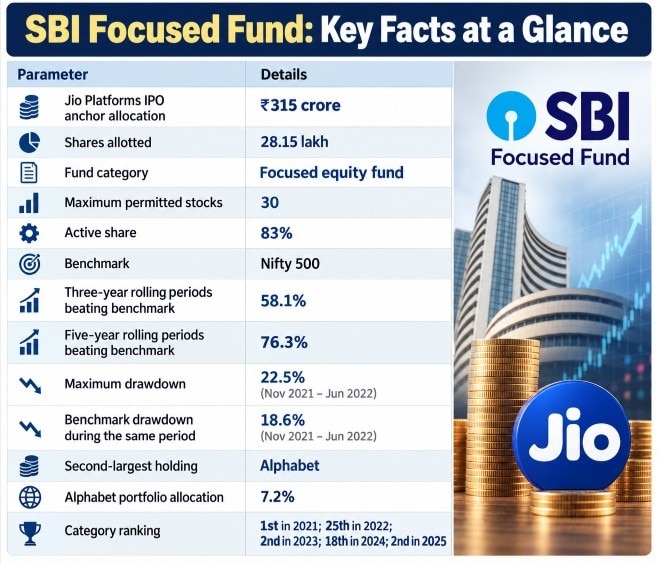
SBI Focused Fund received ₹315 crore in Jio Platforms’ anchor book, the largest allocation among individual mutual fund schemes. While the fund has beaten the Nifty 500 in 76.3% of five-year rolling periods, its concentrated portfolio has also exposed investors to sharper declines than the benchmark.

Business Today Desk
Business Today Desk
  • Updated Oct 23, 2026 5:35 AM IST
SBI Focused Fund gets ₹315 cr in Jio IPO anchor allocation: What investors should know about the schemeSBI Focused Fund received 28.15 lakh shares worth ₹315 crore under Jio Platforms IPO.

SBI Focused Fund received an allocation worth ₹315 crore in the anchor book of Reliance Industries-backed Jio Platforms’ ₹30,213-crore initial public offering (IPO), emerging as the largest recipient among individual mutual fund schemes. Beyond the investment in Jio, the fund’s concentrated portfolio, active stock selection and track record of benchmark outperformance offer investors several factors to consider when evaluating the scheme.

Advertisement

According to the anchor allocation report dated October 19, Jio Platforms allotted approximately 7.25 crore equity shares to anchor investors at ₹1,119 per share. Domestic mutual funds received around 2.49 crore shares, accounting for 34.34% of the total anchor allocation, through 95 schemes across 25 mutual funds.

SBI Focused Fund received 28.15 lakh shares worth ₹315 crore. HDFC Flexi Cap Fund followed with an allocation of ₹132.43 crore, while HDFC Large Cap Fund received ₹126.33 crore.

How does SBI Focused Fund invest?

SBI Focused Fund is a focused equity scheme, a category in which funds can invest in a maximum of 30 stocks. Unlike diversified equity funds that can spread investments across a larger number of companies, focused funds rely more heavily on the performance of a relatively small portfolio.

Advertisement

This strategy can help fund managers generate returns through high-conviction stock selection, but it can also amplify the impact of individual holdings performing poorly.

MUST READ: Jio IPO: Can Akash Ambani turn Reliance’s telecom giant into a technology powerhouse?

The fund’s reported active share stands at 83%, indicating that its portfolio differs substantially from its benchmark, the Nifty 500. A high active share reflects a greater degree of active portfolio positioning, although it does not, by itself, establish whether the fund will outperform its benchmark.

The scheme also has a large-cap tilt. Its portfolio includes overseas exposure through Alphabet, which accounts for 7.2% of holdings and is the fund’s second-largest stock position, according to the supplied fund snapshot.

Advertisement

How consistently has it beaten the benchmark?

The fund’s rolling-return data presents a more favourable picture over longer investment periods. It beat the Nifty 500 benchmark in 58.1% of three-year rolling periods and 76.3% of five-year rolling periods, according to the snapshot dated October 20, 2026.

The figures suggest that the fund has historically beaten its benchmark more frequently over five-year periods than over three-year periods. However, the data also shows that outperformance has not been consistent across every measurement period.

Investors should therefore assess returns across multiple market cycles rather than relying only on recent performance or a single calendar year.

ALSO READ: Jio IPO: Meta's ₹43,573-crore bet could yield ₹56,272 crore on paper, but what about dollar returns?

What about the downside risk?

The fund’s concentrated strategy has also exposed it to sharper declines. Its maximum drawdown was 22.5% between November 2021 and June 2022, compared with an 18.6% fall for the benchmark over the corresponding period.

Maximum drawdown measures the decline from a peak to a subsequent trough. The larger fall indicates that investors in the fund experienced a deeper decline than those tracking the benchmark during that period.

Advertisement

Its calendar-year category rankings have also fluctuated sharply, moving from first in 2021 to 25th in 2022, second in 2023, 18th in 2024 and second in 2025, as shown in the supplied snapshot. Such variation underlines the importance of evaluating performance over longer periods alongside risk.

For investors, SBI Focused Fund’s Jio IPO allocation is a notable development, but it should not be treated as a standalone investment signal. The scheme’s active stock selection and longer-term benchmark-beating record need to be weighed against its concentrated portfolio, ranking volatility and potential for deeper drawdowns. Investors should also consider their own risk tolerance, investment horizon and asset allocation before investing.

DO READ: Jio Platforms IPO: How early investors made 116% paper gains and what retail investors can learn

Disclaimer: Business Today provides market and personal news for informational purposes only and should not be construed as investment advice. All mutual fund investments are subject to market risks. Readers are encouraged to consult with a qualified financial advisor before making any investment decisions.

ABOUT THE AUTHOR

Business Today Desk
Business Today Desk

Business Today brings you the latest news, views and analysis from the world of finance, economy, markets, corporates, startups, tech, and the digital economy. You can find everything from breaking news to deep dives to immersive essays and more on a variety of subjects across all formats - online, magazine, television, data visualisation, et al.

Published on: Oct 23, 2026 5:35 AM IST