












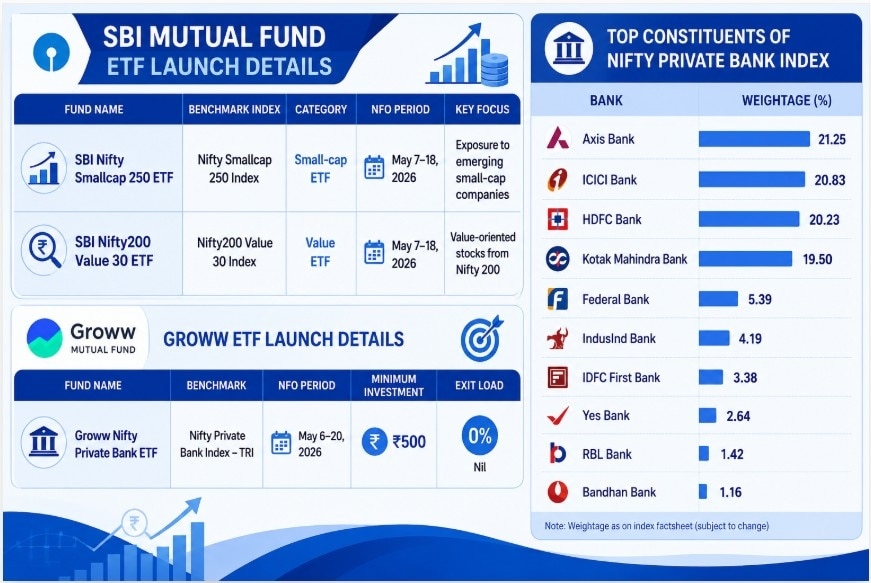



 The SBI Nifty Smallcap 250 ETF tracks the Nifty Smallcap 250 Index, while the Groww Nifty Private Bank ETF offers exposure to India’s private banking sector through the Nifty Private Bank Index – TRI.
India’s passive investing space is witnessing fresh activity, with SBI Mutual Fund and Groww Mutual Fund announcing new exchange-traded funds (ETFs) aimed at capitalising on growing investor interest in index-based investing strategies. The launches come at a time when passive fund assets continue to rise rapidly, driven by increasing awareness, lower costs, and broader participation from retail investors.
SBI Mutual Fund has launched two new ETFs — the SBI Nifty200 Value 30 ETF and the SBI Nifty Smallcap 250 ETF — with their new fund offer (NFO) scheduled to open on May 7 and close on May 18. Both are open-ended ETFs designed to track specific benchmark indices.

 ‘An Indian consumes 1/10th of an average American’: Amb Kwatra says energy security comes first
 Tata stock to buy: Nuvama bets on unique tech-telecom play, sees 28% upside
  NSE IPO, Hero Motors IPO, SS Retail IPO, Jindal Supreme IPO: GMP of four ongoing issues rises up to 32%
 UPI MDR: BharatPe distances itself from Ashneer Grover's remarks, says UPI to remain free for consumers
 IndiGo shares in focus as baggage, infant fee, priority boarding charges likely raised
 Corporate Health Insurance Vs Retail Policy: Why You Need Personal Health Cover Too
 How India Changed In 12 Years: PM Modi’s Journey From Economic Reforms To Viksit Bharat
 Modi @76: From Twitter To Instagram, How His Digital Outreach Has Evolved
 Stock Picks To Watch: Shibani Kurian Reveals Kotak AMC’s Market Bets
 Gold ETF vs Physical Gold: Know the Tax Rules, Charges and Key Differences
  NSE IPO, Hero Motors IPO, SS Retail IPO, Jindal Supreme IPO: GMP of four ongoing issues rises up to 32%
 Tata Chemicals, Tata Investment shares drop up to 8%: Why Tata stocks are falling today
 OnEMI Technology shares in focus as board clears fund raising via preferential route
  Adani Power, Adani Green, Adani Ports, Adani Energy: Jefferies shares target prices
 Kotak Bank, Auro Pharma, GE Vernova T&D: Top stocks to trade — Key levels, target price & stop loss
 What endures: The residential school in a changing worldUPI MDR: BharatPe distances itself from Ashneer Grover's remarks, says UPI to remain free for consumersNSE IPO, Hero Motors IPO, SS Retail IPO, Jindal Supreme IPO: GMP of four ongoing issues rises up to 32%Tata Chemicals, Tata Investment shares drop up to 8%: Why Tata stocks are falling today
 Only one Indian-American lawmaker voted in favour of Russia sanctions act: Who is Raja Krishnamoorthi?


