












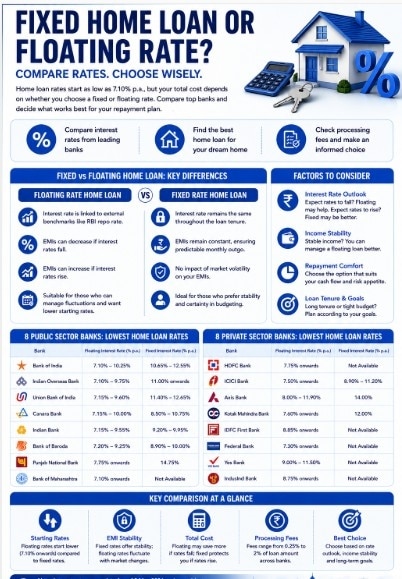



 Interest rates on floating-rate loans are generally linked to external benchmarks such as the Reserve Bank of India’s repo rate.
For most homebuyers, getting the lowest possible interest rate is one of the biggest priorities while taking a housing loan. But beyond finding the cheapest rate, another key question often arises: should borrowers choose a fixed-rate home loan or a floating-rate loan?
The decision can have a significant impact on total repayment costs, monthly EMIs and long-term financial planning. While both options have advantages and risks, the right choice often depends on market conditions, income stability and repayment preferences.

 RIL group to become India's largest conglomerate by m-cap after Jio IPO: Uday Kotak
 IDBI Bank sale to Fairfax faces union resistance, black-badge protest on October 16
 Supreme Court overturns Yes Bank’s ₹8,400 crore bond write-off, raising liability risks: Report
 India's trade with West Asia returns to near-normal levels
 India-US trade deal nearing finish line, but tariff clarity remains key
 Weekend OTT Releases: The Diplomat 4, Aasha, Sacrifice And More
 How Jio Transformed India From Data Scarce to Data Abundant! | Akash Ambani | Jio Platforms IPO
 Akash Ambani Decodes Jio's Financial Muscle | Reveals The 5 Key Business Drivers | Jio Platforms IPO
 From Dhirubhai’s 1977 IPO to Jio's Mega Launch | Uday Kotak Calls Jio IPO a ‘Moment in History’
 Where To Invest To Benefit From The RBI’s Rate Hike | Personal Finance | Money Today
 RIL group to become India's largest conglomerate by m-cap after Jio IPO: Uday Kotak
 Gold eyes sharp recovery; can MCX prices hit Rs 1.5 lakh? Vandana Bharti explains
 Tech Mahindra Q2 results: PAT rises 33% YoY to Rs 1,586 crore; recommends 1:1 bonus issue
 Jio Platforms IPO: How HFCL promoter Mahendra Nahata's investment could rise over 110 times
 South Indian Bank shares hit 52-week high on Q2 earnings, close higher
  'We are very close': US envoy Sergio Gor says India-US trade deal will happen
 'The question was when, not if': Sunil Mittal recalls 3 'Mahabharatas' that nearly sank Bharti Airtel
 India’s share of global metals revenue to rise to 12% by 2035 as China’s declines: McKinseyWeekend OTT Releases: The Diplomat 4, Aasha, Sacrifice And MoreHow Jio Transformed India From Data Scarce to Data Abundant! | Akash Ambani | Jio Platforms IPO


