












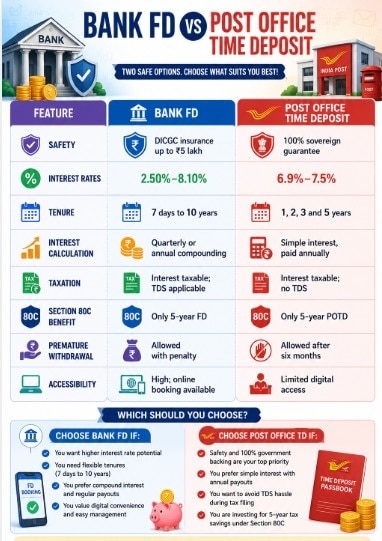



 POTDs suit long-term investors prioritising maximum safety, while bank FDs offer higher returns, flexible tenures and digital convenience.
For conservative investors looking for assured returns, Bank Fixed Deposits (FDs) and Post Office Time Deposits (POTDs) remain among the most popular options. While both offer capital protection and predictable returns, they differ in terms of safety, interest calculation, liquidity and convenience.
Post Office Time Deposits enjoy a sovereign guarantee from the Government of India, making them one of the safest fixed-income products available. Bank FDs, on the other hand, offer greater flexibility, wider tenure options and easier digital access. A comparison of the two can help investors determine which product suits their financial goals.

 Brent climbs past $100 as US-Iran clashes in Strait of Hormuz reignite global energy fears
 GOP midterms bid: Trump offers $5,000 payout to American adults if party wins
  SFIO recommends investigation into Xiaomi’s India business over alleged irregularities: Report
 The iPhone folds! Apple unveils its first-ever foldable ‘iPhone Duo’ at Rs 2,99,900
 Apple launches iPhone 18 Pro, iPhone 18 Pro Max: Brings upgraded performance, camera, and more
 Gold Or Silver? Expert Reveals Best Investment Route Ahead Of Festive Season
 ETF Explained: How Exchange-Traded Funds Work, Costs, SIPs, Trading & Tax
 Tata Curvv EV: First Look At The Tech-Packed Electric SUV
 IDBI Bank Stake Sale: Fairfax Bid, ₹53,000 Cr Valuation & Deal Delay Explained
 Adani Group Plans $2.5 Billion Offshore Loan To Refinance Cement Acquisition Deb
 HDFC AMC shares set for a 31% upside, MOFSL lists key catalysts
  Ather Energy shares climb 4% as Nomura raises target price; what foreign brokerage says
 Shakti Pumps shares jump 12% after Rs 236 crore Maharashtra solar pump empanelment
 SBI, IFCI, NIACL: Check fresh target prices for selling beneficiaries in NSE's mega IPO
 RIL stock: Three events that could drive a re-rating post 19% fall this year
  Apple enters the foldable game. Now everyone has to follow.HDFC AMC shares set for a 31% upside, MOFSL lists key catalysts Gold Or Silver? Expert Reveals Best Investment Route Ahead Of Festive Season
 iPhone 18 Pro, Pro Max, iPhone Duo price in India: Check all storage variants
 'Mirzapur The Movie' Box Office collection Day 6: Bhaukaal continues as it hits ₹190-cr worldwide mark in 6 days


