


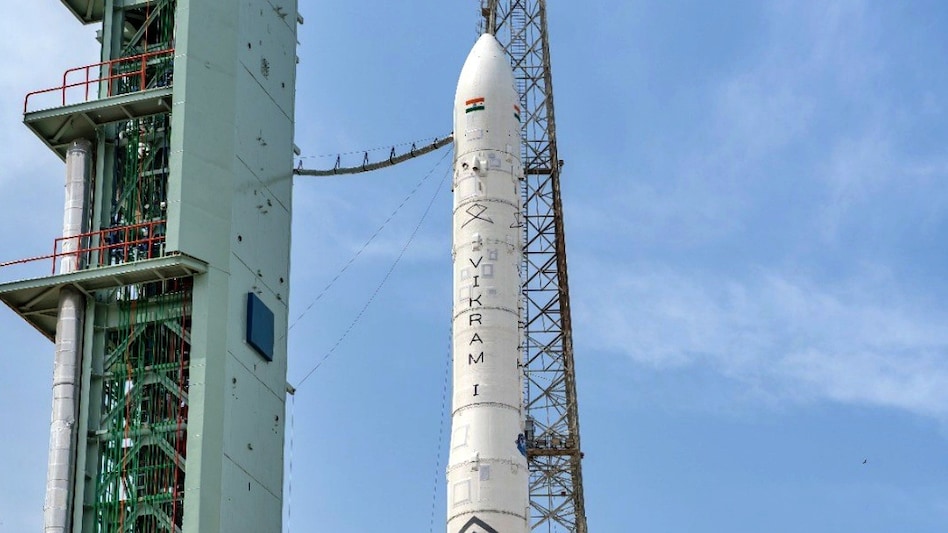
 Vikram-1 rocket on the launch pad.
India’s space sector is poised for another milestone as Skyroot Aerospace prepares to launch Vikram-1, the country’s first privately developed orbital rocket, under its maiden mission named Mission Aagaman. The launch is scheduled for July 18 at 11:30 am IST from the First Launch Pad at the Satish Dhawan Space Centre in Sriharikota, Andhra Pradesh.
DO CHECKOUT | 'Vikram-1 will prove our commercial product': Skyroot Aerospace CEO Pawan Kumar Chandana as start-up gears up for lift-off

 It's official: Xi Jinping will attend BRICS Summit in New Delhi
  Insolvency regulator sounds alarm over misuse of bankruptcy law; tells professionals to dig deeper
 Coforge after OP Bhatt: Advent’s growing influence puts board dynamics under spotlight
 Westinghouse plans 18 nuclear power plants in India by 2047
 BRICS Summit 2026: India to encourage use of central bank digital currencies for cross-border payments
 Nifty Outlook: Which Stocks & Sectors Can Outperform? Axis Bank, ICICI Bank, Defence & More
 Rupee Outlook: Why Crude Oil Is Key, USD/INR Range & Levels To Watch
 ED Raids 18 Locations Linked To Karnataka Minister Satish Jarkiholi In Bar Licence Probe
 HDFC Bank, TCS Stocks: Key Levels To Watch, Long-Term Outlook & Top I.T. Picks
 Delhi PG Horror: 22 Girls Left Without Food, Wi-Fi Or Warden After Satya Niketan Collapse
 MSCI India rebalancing went well under CAS: What SEBI Chair says
 HFCL share price: Why recent rally is a red flag; analyst says this on fresh entry
 Sell IRFC on rallies, railway stocks may stay subdued despite fresh orders, says analyst
 Waaree Energies, Astra Microwave, Texmaco Rail among stocks to turn ex-dividend on September 11
 Manipal Health share price target: What JPMorgan, UBS, BNP Paribas, others say Nifty Outlook: Which Stocks & Sectors Can Outperform? Axis Bank, ICICI Bank, Defence & MoreMSCI India rebalancing went well under CAS: What SEBI Chair saysRupee Outlook: Why Crude Oil Is Key, USD/INR Range & Levels To WatchED Raids 18 Locations Linked To Karnataka Minister Satish Jarkiholi In Bar Licence Probe
 China and India power BRICS trade expansion as intra-bloc commerce gains momentum: Report












