












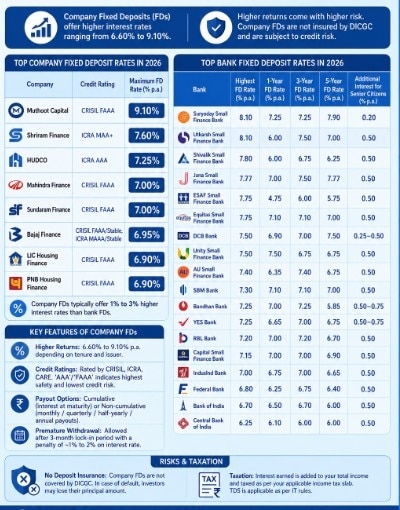



 Despite their attractive returns, company FDs carry higher risks than bank deposits.
Company FDs are term deposits issued by non-banking financial companies (NBFCs) and manufacturing firms to raise capital. These deposits typically offer interest rates that are 1-3 percentage points higher than those offered by banks, with returns currently ranging from 6.6% to 9.1% per annum.
Among the top-paying issuers, Muthoot Capital offers rates between 7.9% and 9.1%, making it the highest-yielding option among major company FDs. Shriram Finance offers up to 7.6%, while Housing and Urban Development Corporation (HUDCO) provides rates of up to 7.25%.
MUST READ: Senior Citizen FD rates go up to 8.10% - How bank deposits compare with SCSS, post office schemes
 India’s AI bet goes global: 93% of businesses trust AI with data, 87% eye new markets
 RBI forex swap facility draws $72.85 billion inflows, FCNR(B) deposits account for bulk
  Delhi H1N1 outbreak: 1,777 cases recorded. Symptoms, who are at risk & how to stay safe
 FII sentiment shows early signs of turnaround after months of selling: Report
 UPI should remain free: Expert on why MDR could push merchants and consumers back to cash
 Meta’s $200 Billion Trial: Did Instagram & Facebook Keep Kids Hooked?
 Motor Insurance Explained: Is Third-Party Car Insurance Enough? Know Before You Buy
 Retirement Tax Planning: 5 Ways Senior Citizens Can Reduce Their Tax Liability
 #IndiaAt100 : Adipen Bose Nandhiji On Conscious Capitalism- Can Profit & Purpose Coexist?
 #IndiaAt100 : Hisashi Takeuchi On Driving India’s Manufacturing Revolution
 Crompton Greaves says no plan to sell stake, expects revenue to double by FY31
 Gaja Alternative Assets IPO: 3 ways to check application status; allotment odds, GMP, listing dateFII sentiment shows early signs of turnaround after months of selling: Report
 ₹24,800 crore bill: How transaction costs are eating into retail derivatives trading
 Cupid, NTPC Green, NTPC, Raymond Realty, HAL shares: Key technical levels to watchRBI forex swap facility draws $72.85 billion inflows, FCNR(B) deposits account for bulk
  India’s forgotten soft drink: This Pune brand is 142-years-old and predates Coca-ColaCrompton Greaves says no plan to sell stake, expects revenue to double by FY31Delhi H1N1 outbreak: 1,777 cases recorded. Symptoms, who are at risk & how to stay safeIndia’s AI bet goes global: 93% of businesses trust AI with data, 87% eye new markets


