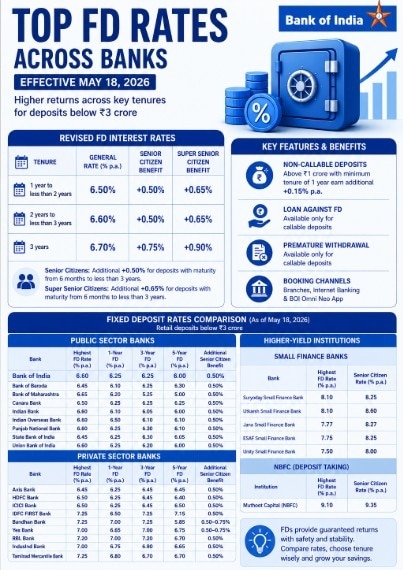



 Industry data shows scheduled bank FD rates currently range from 2.5% to 8% for regular depositors.
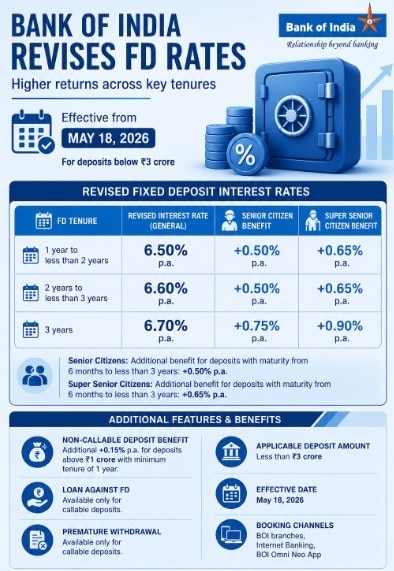
State-owned Bank of India (BOI) has revised fixed deposit (FD) interest rates on select medium- and long-term deposits, offering higher returns to customers seeking stable and guaranteed income options. The revised FD rates, applicable on retail fixed deposits below ₹3 crore, came into effect from May 18, 2026, and are expected to strengthen the bank’s competitiveness in an increasingly crowded deposit market.
The revision comes at a time when banks are actively adjusting deposit offerings to attract retail savings amid rising competition from private lenders, small finance banks, and non-banking financial companies (NBFCs), many of which continue to offer higher rates.

 Why Zerodha Fund House is bullish on life cycle funds
 Ex-IMF economist Surjit Bhalla backs 7.8% GDP number: 'No evidence of exaggeration'
 Air India sacks Phuket-Delhi pilot after psychoactive substance test comes back positive
 BT Explainer: Why Volkswagen Group plans to axe 12% of its workforce in India
 NSE IPO update: SEBI approval likely next week; Check expected dates of price band and listing
 #DemocraticNewsroom | '800 Million People On Subsidies': Siddharth Zarabi On India’s K-Shaped Economy
 #DemocraticNewsroom | India Inflation Data: Are Official Numbers Hiding The Real Economic Picture?
 GDP Real Or Fudged? Siddharth Zarabi Defends India’s Growth Numbers With Data
 Financial Planning For Couples: How To Build A Strong Financial Plan, Budget & Wealth Together
 “High Sugar, Salt, Fat”: FSSAI CEO On Proposed Red Warning Labels On Food Packs
 56% rally in TBZ stock: Upper circuit led to record high today; here's why
  Sensex, Nifty snap four sessions of losing streak; RIL, Tata Steel, Bajaj Finance boost sentiment
  Physicswallah shares jump 9% as Motilal Oswal sees 66% upside
 KEC International: At 52-week low, Geojit expects more downside in infra stockNSE IPO update: SEBI approval likely next week; Check expected dates of price band and listing
 BRICS Summit 2026: Patiala House Courts may function virtually amid security, traffic curbs
 WMO warns El Niño could intensify through February 2027: What it means for India? Check here
 GDP growth at 7.8%: Arvind Subramanian says India’s data needs more transparency, trust
 PM Modi congratulates ‘friend’ Meloni as she becomes Italy’s longest-serving PMEx-IMF economist Surjit Bhalla backs 7.8% GDP number: 'No evidence of exaggeration'