








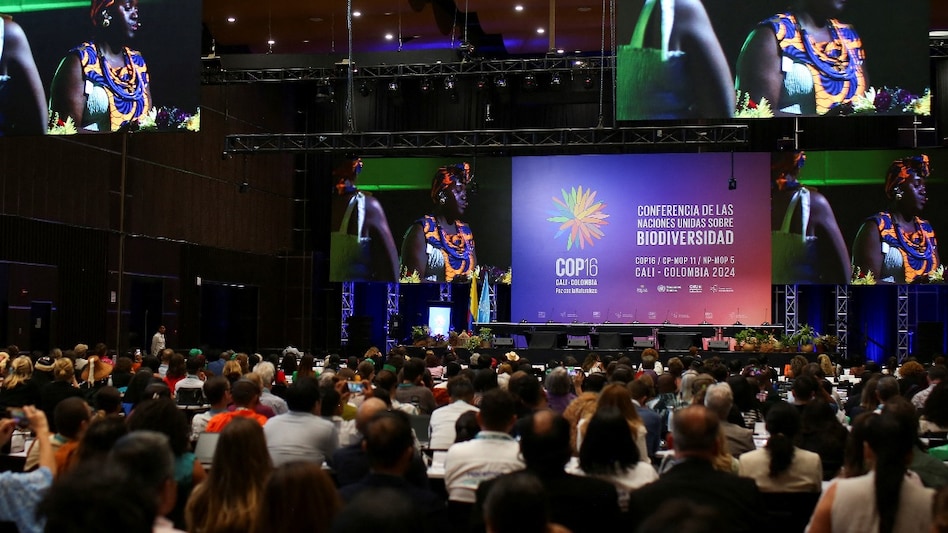
 People attend the 16th United Nations Biodiversity Summit (COP16) in Cali, Colombia October 20.
 People attend the 16th United Nations Biodiversity Summit (COP16) in Cali, Colombia October 20.
Environmental leaders from nearly 200 nations are convening in Colombia to evaluate historic pledges aimed at halting and reversing nature loss.
Delegates in Cali will discuss strategies to combat the rapid destruction of the environment and fulfil the commitments made in the 2022 accord.
The two-week United Nations Biodiversity Conference (COP16), starting today (October 21), follows the 2022 Montreal meetings where 196 countries signed the ambitious Kunming-Montreal Global Biodiversity Framework to protect biodiversity. The meeting will continue till November 1.
Here are some of the main agendas for COP16:
Plans for global goals
Two years after establishing the landmark framework, countries must now detail their plans to achieve over two dozen globally agreed goals. These goals include designating 30 percent of their land for conservation, cutting subsidies that harm nature, and requiring companies to disclose their environmental impact.
Countries were expected to submit their biodiversity strategies, known as NBSAPs, before the summit, which runs until November 1. As of October 18, only 31 out of 195 countries had submitted plans to the UN biodiversity secretariat.
Delegates will review these submissions to assess progress since COP15 in 2022 and identify future priorities.
Paying for genetic information
Traditionally, national laws and the 2010 Nagoya Protocol addressed compensation for sharing physical samples from countries of origin. However, with the rapid sequencing of genomes now possible, the volume of digital genetic information shared online has surged, often disconnected from original samples.
The summit aims to create a global multilateral system for compensating access to this digital sequence information (DSI). Negotiators have indicated they expect to reach an agreement during COP16, outlining when payments are necessary, who should make them, and how funds should be allocated. Companies hope this deal will clarify the legal landscape surrounding DNA sequences.
Focus on indigenous communities
As the host of COP16, Colombia has prioritised the inclusion of indigenous and traditional communities in its agenda. The UN office overseeing the Convention on Biodiversity has called for special protections for Indigenous groups in voluntary isolation, emphasising their crucial role in nature conservation.
COP16 aims to finalise a programme to integrate traditional knowledge into national conservation strategies and decisions. Negotiators will also discuss establishing a permanent body to ensure Indigenous representation in UN decision-making.
Financing issues
During COP15 in Montreal in 2022, wealthy nations pledged at least $20 billion annually starting in 2025 to assist developing countries in achieving their biodiversity objectives, with this target increasing to $30 billion by 2030.
However, biodiversity aid has not yet met these targets. According to the Organisation for Economic Co-operation and Development (OECD), governments contributed around $15.4 billion to biodiversity efforts in 2022, up from $11.4 billion in 2021.
At COP16, governments and companies are expected to announce additional funding initiatives and explore new mechanisms for financing nature conservation.
Climate change
Historically, discussions on climate change and biodiversity have been separate, but leaders are increasingly seeking ways to address both issues together. The two challenges are closely intertwined; protecting nature can mitigate climate change, while global warming threatens biodiversity and drives extinction.
Experts argue that COP16 must intensify pressure ahead of the COP29 climate summit in Baku, Azerbaijan, to better recognise the role of nature in combating climate change.
 NSE IPO may unlock mega gains for billionaire investors RK Damani, Premji
 India-US BTA: Harley Davidson bikes to get 0% duty, gradual tariff reduction on luxury cars
 India-US interim trade agreement: 'No GM modified product allowed, agri sector protected,' says Piyush Goyal
 'Decided to give 0% tariff on some cancer medications, neuro treatment': Piyush Goyal on what US got
 ‘How is this a win?’: Chidambaram slams India-US trade framework as opaque, US-tilted
 BT Golf 2025-26 Kochi, Kerala Awards Ceremony Marks A High-Energy, Successful Conclusion
 Golf Is An Addiction. We Eat And Sleep Golf!
 The Fairway Fixes Everything. Mindset, Life, Relationships
 BT Golf LIVE: Join AU Small Finance Bank Presents BT Golf 2025-26 For Its 4th Leg In Kochi, Kerala
 AI Will Change MBAs, Not Leadership: IMD President On India’s Global Education Rise
 RIL, SBI, Kotak Bank, Kalyan, HAL, BEML, BDL among stocks in focus next week; here’s whyNSE IPO may unlock mega gains for billionaire investors RK Damani, Premji
 SBI Q3 Results: Profit jumps 24% to Rs 21,028 crore; asset quality improves
 IDBI Bank stake sale: Kotak Mahindra Bank says ‘has not submitted a financial bid’
 BDL, Mazagon Dock, MRF, Hindustan Copper, RVNL, others to turn ex-dividend next week