


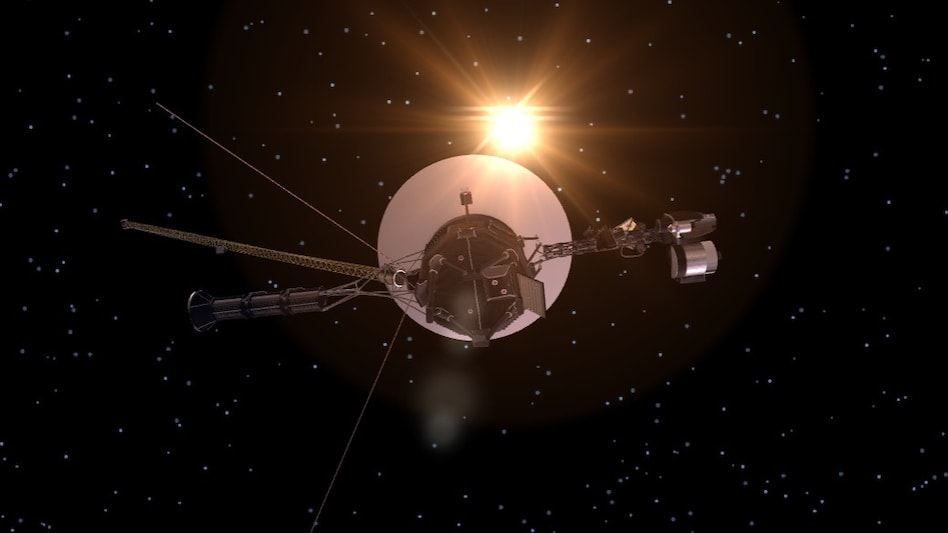
 Voyager 1 will not transmit forever. As its nuclear power source continues to decline, more instruments will eventually be shut down until the spacecraft falls silent.
 Nearly five decades after its launch, NASA's Voyager 1 is still doing what few thought possible — sending scientific data back to Earth from interstellar space.
The spacecraft is now so distant that a radio signal, traveling at the speed of light, takes more than 22 hours to reach it. Another 22 hours are needed for a reply, making even the simplest exchange between engineers and the spacecraft a nearly two-day process. Yet Voyager 1 continues to function, extending one of the most remarkable missions in the history of space exploration.

 'AI Jobocalypse': Raghuram Rajan proposes AI token tax to curb job losses, boost govt coffers
 Rays of Belief, parent of Mom's Belief, to launch IPO on September 1
 Core sector growth eases to 5.4% in July from 6% in June; iron ore, cement lead
 India’s digital shopping story is reversing: Bill payments move back offline, shows study
 Indian Oil close to signing LPG import deal with Algeria’s Sonatrach for 2027: Report
 #PROMO | Business Today Presents India@100: India’s Manufacturing Champions | Building Viksit Bharat
 Nifty Bounces Back After 7-Day Fall, Relief Rally Or Fresh Uptrend? Piyush Pandey Decodes
 Augmont Enterprises IPO Opens August 21: Price Band, Dates, & Should You Apply
 Top 5 Fixed Income Products To Invest | Investment Guide | Money Today
 These ETFs Are Quietly Taking The Lead As Global Markets, Gold And Metals Gain Momentum
 SEBI allows FPIs to use digitally signed power of attorney for faster onboarding; check detailsRays of Belief, parent of Mom's Belief, to launch IPO on September 1
 Large cap stocks may lead market recovery; Anand Rathi analyst cites key factors
  Sensex, Nifty rebound sharply; can the recovery sustain?
 Hold ITC, avoid averaging despite underperformance, says Ruchit Jain of MOFSLSEBI allows FPIs to use digitally signed power of attorney for faster onboarding; check details
 Student protest violence: SC forms 5-member panel with ex-CBI chief to investigate police action
 Real estate faces a private credit paradox: Biggest deployment, highest default risk, shows report
 Could it replace chemotherapy? Indian scientists develop ‘smart’ cancer drug that targets only tumour cells
 YES Bank’s latest push: A credit card just for women that goes beyond shopping












