


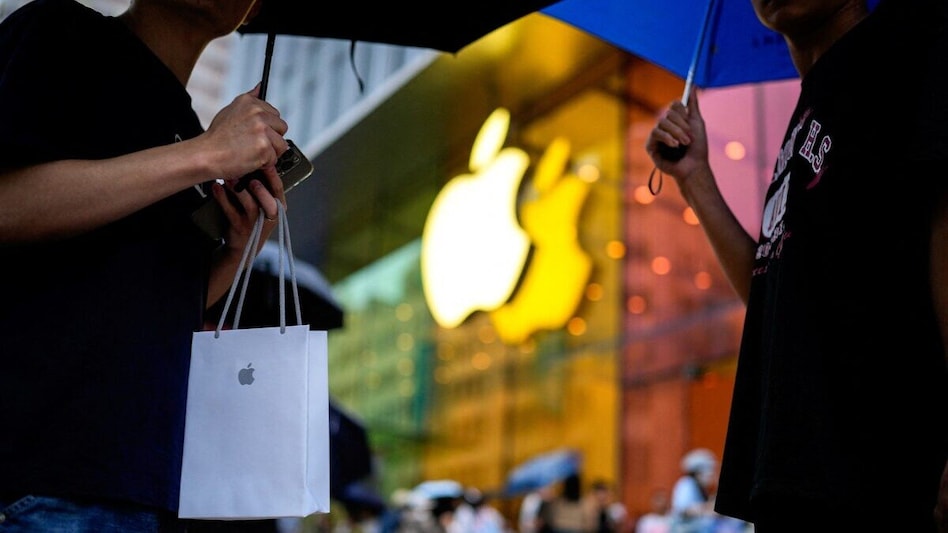
 In the quarter ending June, India emerged as the leading exporter of smartphones to the US for the first time, accounting for 44% of total shipments
Apple's shift in production strategy has led to the majority of iPhones sold in the United States being manufactured in India. This significant change marks a departure from past reliance on China for production aimed at the US market. CEO Tim Cook confirmed this development during a company earnings call, stating, "In terms of the country of origin, it's the same as I referenced last quarter. There hasn't been a change to that, which is the vast majority of the iPhones sold in the US or the majority, I should say, have a country of origin of India."
In the quarter ending June, India emerged as the leading exporter of smartphones to the US for the first time, accounting for 44% of total shipments, according to data from Canalys. Vietnam, a key hub for Samsung Electronics Co., ranked second. Meanwhile, China’s share plummeted from over 60% a year ago to just 25%, reflecting a major shift in global smartphone manufacturing dynamics.
While India now plays a crucial role in serving the US market, China continues to be a major manufacturing hub for Apple's products destined for other international markets. Cook noted, "... the products for other international countries, the vast majority of them are coming from China."
The transition comes amid US President Donald Trump's expressed concerns about Apple's manufacturing decisions. Trump, in addressing Cook, stated, "I had a little problem with Tim Cook… I said to him, my friend, I am treating you very good… but now I hear you are building all over India. I don’t want you building in India." Despite these remarks, Apple remains committed to its manufacturing plans in India.
India's role in Apple's global strategy is further underscored by the country's strong sales growth. Cook highlighted, "We saw an acceleration of growth around the world in the vast majority of markets we track, including greater China and many emerging markets, and we had June quarter revenue records in more than two dozen countries and regions, including the US, Canada, Latin America, Western Europe, the Middle East, India, and South Asia." This growth was particularly evident in iPhone sales.
The company's quarterly results showcased a global revenue increase, with India being a significant contributor. "We saw iPhone growth in every geographic segment and double-digit growth in emerging markets including India, the Middle East, South Asia, and Brazil," Cook commented. Apple's revenue for the quarter reached $94 billion, reflecting a 10% year-on-year growth.
The impact of US tariffs continues to be a challenge for Apple, even as electronic devices like smartphones are currently exempt. Cook elaborated, "… so let me provide some colour there. For the June quarter, we incurred approximately $800 million of tariff-related costs. For the September quarter, assuming the current global tariff rates, policies, and applications do not change for the balance of the quarter, and no new tariffs are added, we estimate the impact to add about $1.1 billion to our costs."
Despite these tariff-related cost implications, Apple's strategic positioning in India seems set to continue. With an expanding retail presence in the country, the company aims to capitalise on the burgeoning local market. As Cook stated, the "situation around tariffs is evolving," indicating that while cost pressures remain, Apple's operational focus remains steadfast.
India's rise as a manufacturing hub for Apple not only highlights the country's growing importance in the global supply chain but also underscores the strategic shifts in Apple's production dynamics amid evolving international trade landscapes.

 Did Cockroach Janta Party's 'Chalo Sansad' 2.0 threat trigger Dharmendra Pradhan's resignation? What we know so far
 'Will discharge my responsibilities with complete humility': Pralhad Joshi after being appointed Education Minister
 Curious about Pralhad Joshi's wealth? A closer look at his assets, investments and liabilities
 From NEET protests to politics? What CJP's Saurav Das and Ashutosh Ranka have now revealed
 Metal recycling stocks to buy: Gravita, Pondy Oxides, Jain Resource among top picks
 Best Healthcare Stocks: Gaurang Shah's Outlook On Apollo Hospitals, Fortis & The Manipal Health IPO
 Is Indo-MIM's IPO Valuation Justified? Here's Why The Company Sees Strong Growth Ahead
 Treasury Bills Explained: Why T-Bills Are One Of The Safest Short-Term Investment Options
 FDs vs Markets: Where Should You Keep Your Short-Term Money?
 Why Term Insurance Is Essential for Every Earning Member | Sum Assured & Coverage Explained
 Metal recycling stocks to buy: Gravita, Pondy Oxides, Jain Resource among top picks
 TRIL shares: Should you average the falling stock? Here's 'fixed and final' stop loss
 Adani Power: 45 GW target, Rs 2 lakh crore capex plan among conference call highlights
  ITC Hotels, Chalet, Ventive, IHCL, SAMHI: Hotel stocks to buy despite travel disruptions
 ITC shares: Rs 307 a key short-term level to watch; here's target price
 Bengaluru builder hires firm behind Supertech Twin Towers demolition to raze tilted 18-storey tower
 Caught on camera: Karunanidhi’s granddaughter slaps SBI manager over lift row, bookedBest Healthcare Stocks: Gaurang Shah's Outlook On Apollo Hospitals, Fortis & The Manipal Health IPO
 From 4 stoves To ₹75 crore empire: R Madhavan applauds Bihar mother-son duo’s Thekua success storyCurious about Pralhad Joshi's wealth? A closer look at his assets, investments and liabilities









