
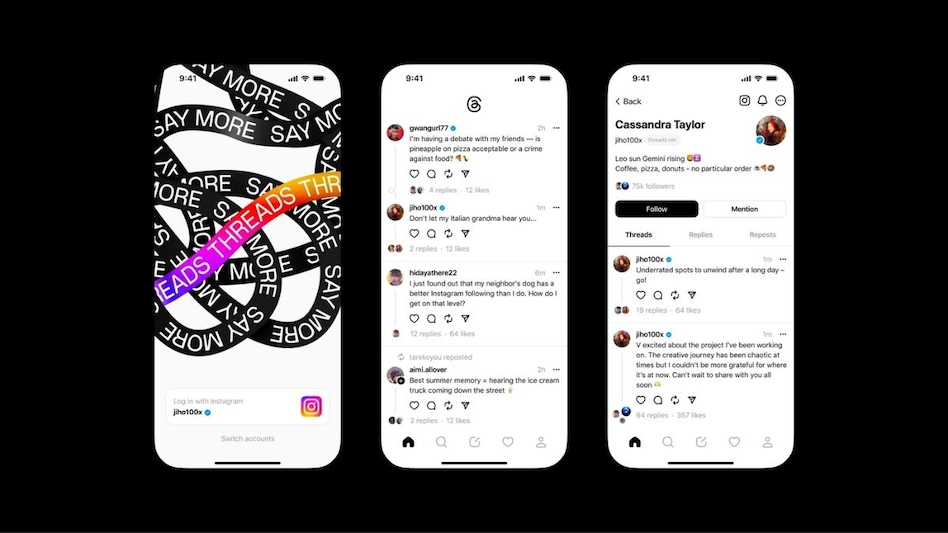
 Threads app has witnessed 5 million sign-ups in 4 hours
Mark Zuckerberg has finally launched Threads, a new app built by the Instagram team but which looks and feels a lot like Twitter. Threads aims to expand Instagram's capabilities to include text updates and conversations. Threads is now available for download on iOS and Android devices in over 100 countries.
To get started with Threads, users can simply log in using their Instagram account. This allows their Instagram username and verification to carry over seamlessly, although they also have the option to customize their profile specifically for Threads. Notably, users under the age of 16 (or 18 in certain countries) will be automatically defaulted into a private profile upon joining Threads.

 AI revenue is surging at Indian IT firms, but how much is adding to growth?
 Festive spending in urban India to drop 6% to ₹1.97 lakh crore amid inflation: Survey
 India to overtake Japan as world’s fourth-largest economy in 2027: IMF projections
 BT Explainer: What the SC verdict on Yes Bank’s AT-1 bonds means for the lender and will it alter AT1 bonds as such?
 Stock market: India back on investors’ radar as they warm to ‘non-AI stories’, says HSBC
 Jio IPO: Mukesh Ambani's Big ₹30,213 Crore Bet, Reliance Employees Asked To Invest?
 Flying Cars Are Here? Elon Musk Shows Tesla Roadster Flying Through Air In Stunning Demo
 Ramakrishna P, CEO, India Mobile Congress Talks To Us About India’s Next Digital Frontier
 Market Recovery: Gaurang Shah Picks Banking, Defence, Power And Cement Stocks For Fresh Bets
 Will IDBI Employees Lose Jobs? DIPAM Secretary Arunish Chawla Clears The Air On Pension & Benefit

 CCL Products shares fall 9% on Q2 results; brokerages see up to 30% upside
 PNB Q2 earnings: Net profit rises 13%, asset quality improves
 BT Explainer: What changes for investors post revision of new Closing Auction System
 PC Jeweller shares hit 52-week high; stock jumps 75% YTD; what analysts say
 Federal Bank Q2 earnings: Net profit at record high, asset quality improves
 Saif Ali Khan rents out two commercial units in Mumbai for ₹22.76 lakh per month
 How Mukesh Ambani Is Tapping Reliance’s 4.2 Lakh Workforce To Boost Jio's Record IPO
 Jailer 2 Box Office: Rajinikanth Scores ₹125 Crore Opening, But Coolie Still Rules
 Should India Reconsider LTCG Tax? NITI Aayog VC Ashok Lahiri Responds
 PC Jeweller Hits 52-Week High | 3 Reasons Behind The Rally