












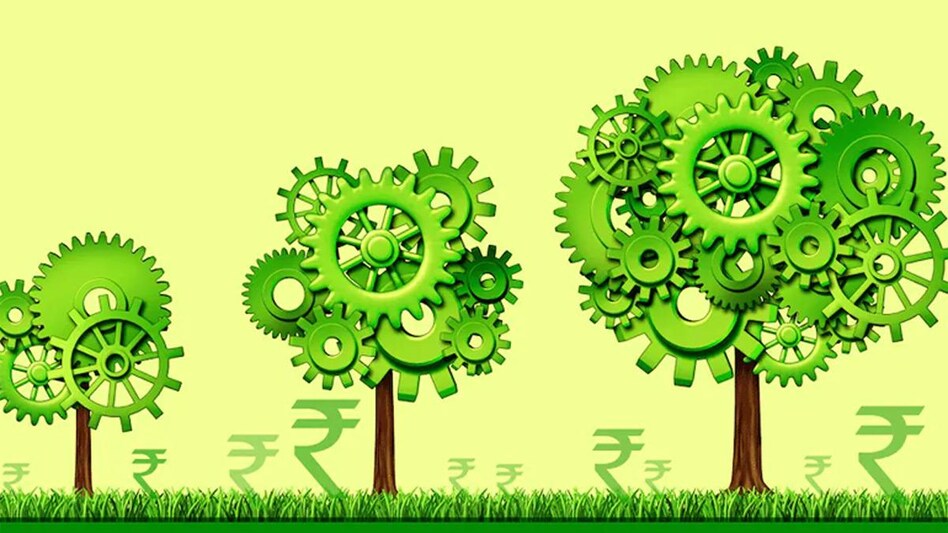
 A global campaign and strong collaboration between governments and the commercial sector essential for sustainable business operations.A global campaign and strong collaboration between governments and the commercial sector essential for sustainable business operations.
After a rebound in 2021, the global economy is expected to slow down this year. India, on the other hand, is a bright spot: the country's gross domestic product (GDP) is predicted to increase at a rate of 9 per cent or more this fiscal year and next.
That means a lot of eyes will be on India's Budget on February 1 to see how it creates a platform for the country to lead the global post-pandemic recovery.
Growth has become entwined with sustainability in today's world. In that regard, the framework for this year's Budget may have been established to some part on November 1, when Prime Minister Narendra Modi made international headlines by announcing India's resolve to achieve net-zero energy by 2070.
Also Read: India's transition to green economy to create 50 mn jobs, contribute $1 trn in economic impact: WEF
As India approaches its goal of achieving a GDP of between $8.5 trillion and $10 trillion by 2030, the interim Budgets may focus on 'green' shoots of growth in a variety of ways. Green energy growth, after all, is what will take India and the rest of the globe to a more sustainable future.
Gearing up for Green Growth
We anticipate that the Budget will pave the way for a significant reduction in carbon emissions, in line with Prime Minister Narendra Modi's announcement at COP26 in Glasgow that India would reduce its carbon intensity - carbon dioxide emissions per unit of GDP - by 45 per cent by 2030, surpassing the previous target of 35 per cent. Hence, the inclusion of the Hydrogen Mission announced by the Prime Minister is likely in the Budget 2022.
We have strong indications that this decarbonization path will place a heavy emphasis on hybrid plants to provide continuous renewable electricity and handle the trilemma of dependability, cost, and sustainability.
Smart grid balancing critical for renewable energy supply
Storage solutions must be added to the mix as we move forward. This draws attention to hydropower assets, which are well suited to pumped storage hybrid systems. The role of smart grid balancing becomes increasingly important in accommodating and controlling the growing supply of renewable energy. Data analytics and digital technologies will play a significant part in this.
Decarbonisation also has a societal and human component. The coal economy is directly or indirectly tied to the fortunes of many firms and the livelihoods of hundreds of thousands of people. As a result, there is a need for the energy transition to be managed sensibly.
We must acknowledge that India's shift to renewable energy will require natural gas power as a sturdy bridge to ensure a smooth transition. The gas turbine technology developed by GE can help to provide energy security by producing reliable, adaptable, and long-lasting energy.
Also Read: A global push towards green energy causing delay in BPCL disinvestment
With decades of experience running our fleet of gas turbines on various levels of hydrogen - and a plan to run on 100 per cent hydrogen - GE has considerable expertise in operating hydrogen safely.
Additionally, India already has a coal-fired power plant fleet of 200 GW. We can reduce hazardous emissions and improve these plants by using technologies such as GE's flue gas desulfurization.
SAF rewriting the future of flight
To deal with and dispose of carbon and other pollutants, we have prioritised Carbon Capture, Utilisation, and Storage (CCUS) and other technologies.
Sustainable Aviation Fuel, we believe, will play a significant part in the future of aviation, which will be determined by how the aviation sector innovates to reduce emissions and enhance fuel economy.
Collaborations and Partnerships - Key to Transition
As shown in a new estimate provided by McKinsey & Co on January 25, the global economy will need to spend $9.2 trillion per year on average on physical assets to achieve net zero by 2050. This is $3.5 trillion more than what is being spent today.
In 2020, the difference will be equal to half of the worldwide corporate profits and a quarter of the total tax collection.
According to research released in November by the Council on Energy, Environment, and Water, India will need $10 trillion in cumulative investments to achieve net-zero energy by 2070.
A collective global campaign and strong collaboration between governments and the commercial sector is the need of the hour. Through technological advancements, the private sector could make a significant contribution to solutions.
(The author is President, GE South Asia.)
 BT Exclusive: What are the views of the next Chief Naval Staff of the Indian Navy on the West Asia crisis? Here’s more
 Rs 229 per share dividend! Bumper amount by most expensive Indian stock; check payout history
 'Ami Suvendu Adhikari...': Senior BJP leader takes oath as West Bengal CM in mega ceremony
 Same property, different tax Bills: Why an NRI brother paid Rs 5.25 lakh, resident paid Rs 0 tax
 ‘Interesting data; how out of favour India currently is with global investors’ - Sandip Sabharwal
 "India Rose To The Occasion": EAM Recalls How Vaccine Maitri Saved The Global South
 Killer On Board: Rare Hantavirus Leaves 3 Dead On Atlantic Luxury Cruise
 Muridke To Bahawalpur: How India Systematically Dismantled Pakistan's Terror Hubs
 Mother’s Day: How To Secure Your Mother’s Financial Future | SIPs, Insurance & Retirement
 Resort Politics Returns: 25+ AIADMK MLAs Move To Puducherry To Push For TVK Alliance
 Rs 229 per share dividend! Bumper amount by most expensive Indian stock; check payout history
 Digital platforms are democratising investing; BSE CEO explains how markets changed‘Interesting data; how out of favour India currently is with global investors’ - Sandip Sabharwal
 Know why Nifty is down 8% from Sept 2024 high but global markets rallied up to 150%
 These are top PSU dividend paying stocks in Q4 2026 - List | Do you own any?