












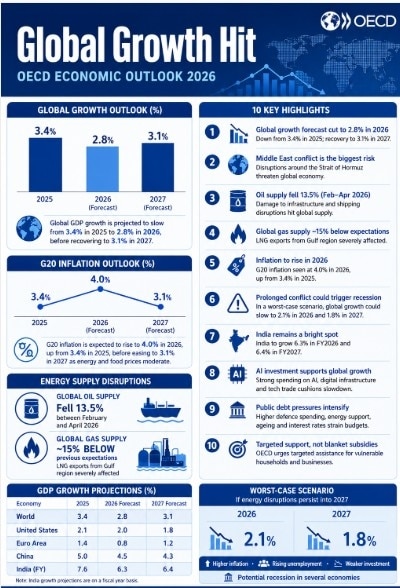



 OECD stated continued disruptions to shipping through the Strait of Hormuz and damage to energy infrastructure have significantly curtailed global energy supplies.
The Organisation for Economic Co-operation and Development (OECD) has lowered its global growth outlook for 2026, warning that disruptions to oil and gas supplies caused by the escalating Middle East conflict are weighing heavily on the world economy and reviving inflation risks.
In its latest OECD Economic Outlook 2026, titled Under Pressure, the Paris-based institution projected global GDP growth to slow from 3.4% in 2025 to 2.8% in 2026, before recovering modestly to 3.1% in 2027. The downgrade reflects rising energy costs, supply chain disruptions, weaker business confidence and growing uncertainty linked to the conflict in the Persian Gulf region.

 India is an important US ally, can't pivot from Russian oil overnight: Marco Rubio ahead of Mumbai visit
 Noel Tata evokes founding principles to guide Tata Trusts' new strategic shift
  No data needed? Airtel rolls out 3 new prepaid voice and SMS packs after TRAI directive
  'More patients than we want to count. It's a disaster': Canada military base fire overwhelms hospitals
 From storage to transport, FSSAI tightens checks on how paneer, meat, fish and khoa reach consumers
 Gold Vs Silver: Which Could Deliver Better Returns Over The Next 3–5 Years? Expert Shares Targets
 Gold, Silver ETF Purchases Halted: Why Mutual Funds Have Restricted Fresh Investments Before Diwali
 SIR Explained: Forms 6, 7 And 8—What Voters Must Know | Akshita Nandagopal Explains
 Gold Investment Options: ETFs, EGR And MCX Explained | How To Invest In Gold Beyond Physical Buying
 Redmi Note 17 Pro Max Review , Vivo V80, Vivo Vision | Tech Gear EP 20 | Business Today
 Markets Next Week: Jio Platforms IPO, high crude oil prices and Q2 earnings in focus
 10 investing mistakes retail investors should avoid, from overpaying to panic selling
 YES Bank Q2 profit rises 65% to Rs 1,080 cr; proforma impact of restatement of AT-I bonds revealed
 ICICI Bank Q2 results: Net profit jumps 20% to Rs 14,843 crore; NIM contracts
 IDBI Bank Q2 net profit falls 39% to Rs 2,205 crore on year-ago's one-off gain
  Advertising veteran blasts LIC's cancer insurance ad: 'Most horrific thing I've seen'
 'I hope Rishikesh holds on to its soul': Anand Mahindra reacts to spiritual town's makeoverNo data needed? Airtel rolls out 3 new prepaid voice and SMS packs after TRAI directive
  'A boon for people like me': LLB student turns Blinkit delivery partner, shares first-day earnings'More patients than we want to count. It's a disaster': Canada military base fire overwhelms hospitals


