












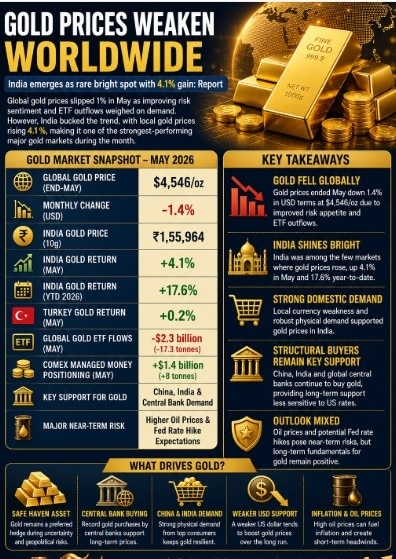



 According to the WGC, on a year-to-date basis, Indian gold prices have gained 17.6%, significantly outperforming several developed-market counterparts.
Gold prices slipped in May despite persistent geopolitical tensions and economic uncertainty, but India emerged as one of the few major markets where local gold prices continued to rise, according to the World Gold Council's (WGC) latest Gold Market Commentary.
The precious metal ended May at $4,546 per ounce, down 1.4% in US dollar terms, as improving investor risk appetite and modest outflows from gold exchange-traded funds (ETFs) weighed on prices. The decline came even as global investors continued to grapple with concerns over inflation, interest rates, and geopolitical tensions in West Asia and Eastern Europe.

 AI revenue is surging at Indian IT firms, but how much is adding to growth?
 Festive spending in urban India to drop 6% to ₹1.97 lakh crore amid inflation: Survey
 India to overtake Japan as world’s fourth-largest economy in 2027: IMF projections
 BT Explainer: What the SC verdict on Yes Bank’s AT-1 bonds means for the lender and will it alter AT1 bonds as such?
 Stock market: India back on investors’ radar as they warm to ‘non-AI stories’, says HSBC
 Jio IPO: Mukesh Ambani's Big ₹30,213 Crore Bet, Reliance Employees Asked To Invest?
 Flying Cars Are Here? Elon Musk Shows Tesla Roadster Flying Through Air In Stunning Demo
 Ramakrishna P, CEO, India Mobile Congress Talks To Us About India’s Next Digital Frontier
 Market Recovery: Gaurang Shah Picks Banking, Defence, Power And Cement Stocks For Fresh Bets
 Will IDBI Employees Lose Jobs? DIPAM Secretary Arunish Chawla Clears The Air On Pension & Benefit
 CCL Products shares fall 9% on Q2 results; brokerages see up to 30% upside
 PNB Q2 earnings: Net profit rises 13%, asset quality improves
  BT Explainer: What changes for investors post revision of new Closing Auction System
  PC Jeweller shares hit 52-week high; stock jumps 75% YTD; what analysts say
 Federal Bank Q2 earnings: Net profit at record high, asset quality improves
  From colonial lines to protected zones: Why Indian citizens need permits to visit parts of India
 Financial Horoscope Today, October 17, 2026: Scorpio Will Gain Wealth, Know the Financial Horoscope from Aries to Pisces
 Planning to buy a Maruti Suzuki car this festive season? Check October discounts on these models
 Can Electronic Gold Receipts overcome GST and liquidity hurdles to unlock India's gold market?
 Thailand’s 'Casio connection': How a $60 watch became a symbol of political power


