


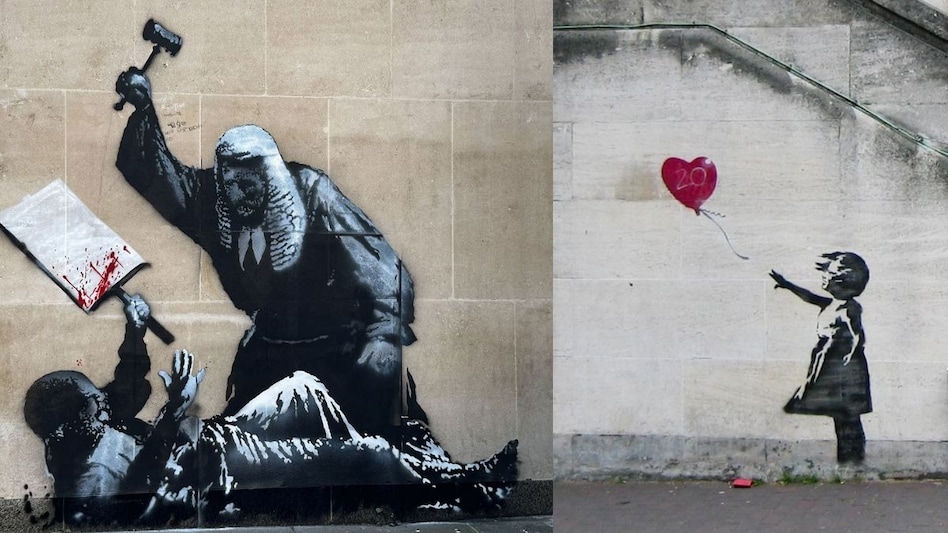
 Banksy identity revealed
The identity of the elusive street artist, political activist and film director Banksy may finally have been uncovered, with a Reuters investigation linking the globally famous graffiti artist to Robin Gunningham, a Bristol-born man who later reportedly used the name David Jones.
For decades, Banksy has remained one of the art world's biggest mysteries, a figure whose work is instantly recognisable, yet whose face has never been officially confirmed. Now, after years of speculation, journalists claim to have pieced together evidence pointing to Gunningham as the man behind the pseudonym.
Banksy first emerged from the underground art scene in Bristol in the 1990s, gaining attention for his distinctive stencil-based graffiti that often carries sharp political and social commentary. His works appearing overnight on public walls across cities tackle themes ranging from war and capitalism to surveillance and authority. Despite their rebellious nature, many of his pieces have become highly valuable, blurring the line between street art and fine art.
"I don't know why people are so keen to put the details of their private life in public; they forget that invisibility is a superpower."
That philosophy has defined his public image as an anonymous provocateur whose identity has been part of the art itself.
Reuters' investigation draws on years of reporting, documents and on-ground tracking. One key lead came from a 2000 arrest in New York, where a handwritten confession reportedly carried the name Robin Gunningham. The publication also traced movements and appearances, including a trip to Ukraine where Banksy's work surfaced during the war, as well as earlier sightings and photographs that align with Gunningham.
Additional clues emerged from the art world itself. During the now-iconic 2018 Sotheby's auction, where Banksy's Girl With Balloon shredded itself moments after being sold, a man believed to resemble Gunningham was reportedly present, observing the reaction. The stunt, later turning the artwork into Love Is in the Bin, only added to Banksy's mythos as both artist and disruptor.
The investigation also dismissed long-standing theories linking Banksy to Massive Attack's Robert Del Naja, reinforcing the Gunningham connection instead.
However, the claim has not gone unchallenged. Banksy's lawyer has rejected several aspects of the findings, arguing that revealing the artist's identity could threaten his safety and undermine the very purpose of anonymity in creative expression.

 Shipping at Hormuz nearly comes to a halt, Iran issues new warnings: Report
  TCS CEO dismisses AI job cut fears, says workforce will continue to grow
 War-proof stocks: Do US-Iran missile attacks warrant portfolio changes? Stocks to track
 Australia assures no cut in opportunities for genuine Indian students, MEA tells visa-worried applicants
 Why can't you choose between pure petrol, E10, E20? Here's what every vehicle owner should know
 Beyond Cost-Cutting: How India Is Becoming The World’s New Innovation Engine!
 CM Vijay Visits Karur, Meets Stampede Victims' Families Amid Political Row
 PM Modi's Australia Visit: Uranium Pact, CEO Forum & Mega Indian Diaspora Event
 Dubai Real Estate Outlook 2026: Why Rizwan Sajan Says Prices Could Surge After September
 Delhi-NCR Monsoon Misery Returns: Why Does Every Spell Of Rain Bring The Same Crisis?
 Why Elecon Engineering shares slipped 6% after Q1 FY27 results
 Bloomberg launches global trade in Indian bonds
  Infosys, TCS, HCL Tech, Tech Mahindra: Two factors why IT sector shares are rising todayWar-proof stocks: Do US-Iran missile attacks warrant portfolio changes? Stocks to track
 Rs 24 dividend per share: Bharti Airtel fixes record date for payment — Check details









