


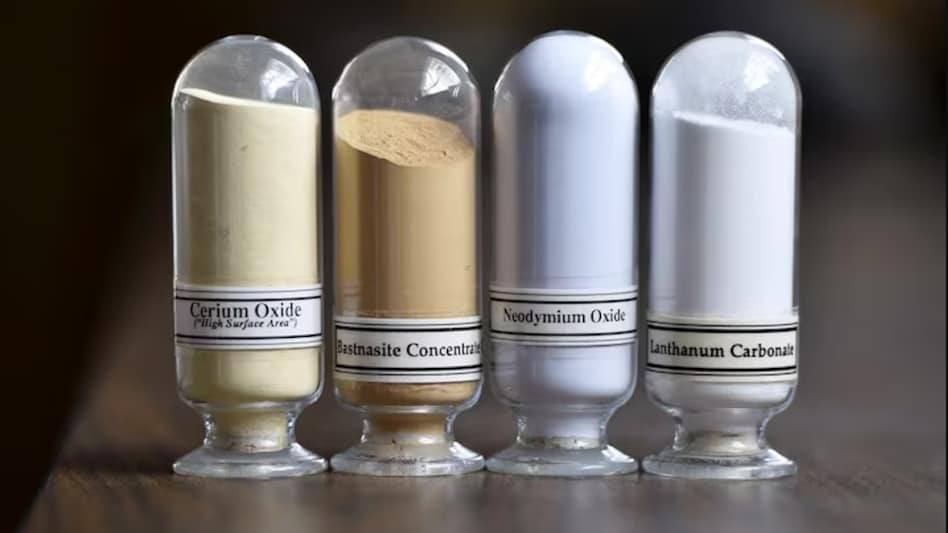
 Trump tariffs: What are rare earths whose export China has restricted?
China, in a manoeuvre to get back at the US for their tariffs that it deems ‘bullying’, has put restrictions on the exports of rare earths. This has come after the US imposed 145 per cent tariffs on Chinese goods, and China imposed 125 per cent tariff on American goods, escalating the trade war among the two nations.
Meanwhile, the US is planning to stockpile deep-sea metals to counter China’s dominance in battery minerals and rare earths supply. The US, concerned about a probable conflict with China, where the Asian country might constrain imports of metals and rare earths, plans to stockpile deep-sea metals available on US territory. According to a report in Financial Times, stockpiling is being considered as part of a broader push to fast-track deep-sea mining applications.

 LPG rate changes from August 1: Commercial LPG cylinder rates slashed by around ₹200,14-kg cylinder rates unchanged
 'I want to forgive them': PM Modi's message to 'misguided children' after Jantar Mantar abuse
 GMDC, IDFC First Bank: Expert shares outlook, key levels to watch
 'It happened before the paper left NTA': IIT Madras director V Kamakoti's big claim on NEET paper leak
 August 2026 and your finances: ITR deadline, CKYC 2.0 rollout, RBI policy, LPG prices and other key financial changes to watch
 Active Vs Passive Mutual Funds: Which Investment Strategy Is Right For You?
 Data Centres, Space & A Stable Rupee: India's Blueprint For The Next Growth Cycle
 Red Sea Crisis: How Global Shipping Lines Are Navigating Another Major Disruption
 Why EV Trucks Are Still Missing From India's Highways | BT Infrastructure Summit 2026
 #BTInfrastructureSummit: Powering India's New Growth Spurt With Infra, Investment & Innovation
 GMDC, IDFC First Bank: Expert shares outlook, key levels to watch
 Maruti Suzuki Q1 results: Profit slips 9% YoY to Rs 3,447 crore; revenue climbs 36%
 ITC Q1 results: Profit slips 16% to Rs 4,394 crore YoY; revenue climbs 28%
 BTTV Exclusive: M&M CEO Rajesh Jejurikar on Q1 earnings, business outlook, order book and more
  Nifty IT stocks rebound in July as semiconductor shares falter; reverse AI trade at play?
 Petrol, diesel prices today, August 1: Check latest rates in Delhi, Mumbai, Chennai, Kolkata & more
 LPG, CNG, PNG rates today (August 1): Commercial LPG cylinder rates hiked, others stable. Check latest prices in Delhi, Mumbai and other citiesGMDC, IDFC First Bank: Expert shares outlook, key levels to watch
 'Hamari company sirf ₹10 leti hai': Security guard shows balanced meal given at workplace, netizens reactActive Vs Passive Mutual Funds: Which Investment Strategy Is Right For You?










