








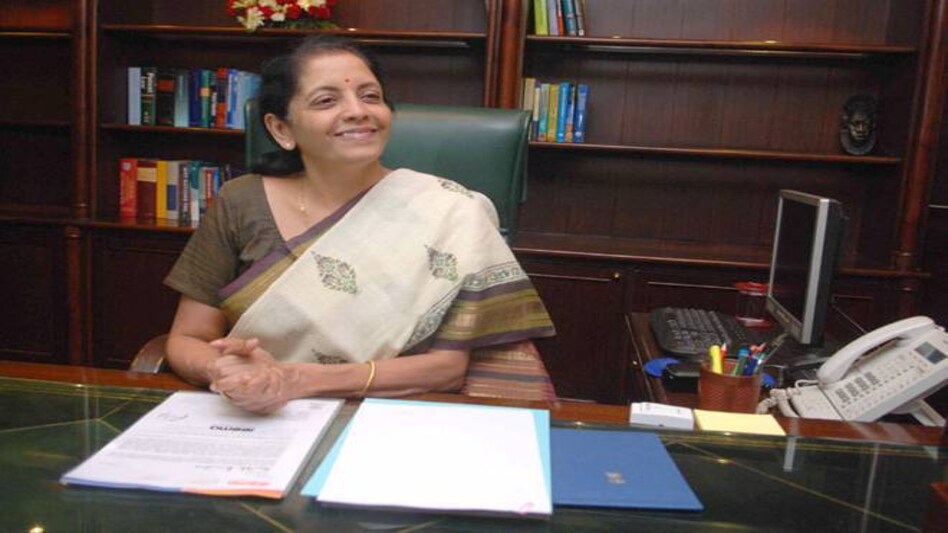
Nirmala Sitharaman, Minister of State for Commerce and Industry (Independent Charge), has made a candid statement - India needs a new manufacturing policy.
In an interview-based report published by the business daily Economic Times, Sitharaman talks about a comprehensive review of the six-year-old National Manufacturing Policy launched by the previous government. She points out that for the government's flagship programmes such as the 'Make in India' campaign to succeed, the policy cannot be a 2011 vintage.
Technically, the minister is correct. The Ministry of Commerce and Industry has not come out with a new policy since the Narendra Modi-led National Democratic Alliance (NDA) government took over in 2014. While the Modi government has adopted several policies and programmes of the previous UPA government, including the use of the 12-digit unique identification number Aadhaar and its biometric authentication, as its own, it might have found fault with the UPA government's manufacturing policy. Going by what Sitharaman said, one could assume that either the Modi government's 'Make in India' initiative was driven by a faulty UPA's 2011 policy or it has been moving ahead without an umbrella policy.
It is perfectly normal for ruling political parties to blame its predecessors for any shortcoming. But to link the Modi government's 'Make in India' campaign with the UPA's policy or policy vacuum may not be entirely correct. That is because a revision of the existing manufacturing policy was one of the first measures planned by the Modi government after it came to power.
The idea of a National Capital Goods Policy was first presented by the Department of Heavy Industries to the Prime Minister during the 'Make in India' workshop held in December 2014.
The Commerce Ministry's policy might have remained a UPA vintage, but the Ministry of Heavy Industries and Public Enterprises formulated a National Capital Goods Policy to promote manufacturing in India. It was approved by the Modi Cabinet on May 25, 2016.
In an official statement, the government called this as the "first ever policy for capital goods sector with a clear objective of increasing production of capital goods from Rs 2,30,000 crore in 2014/15 to Rs 7,50,000 crore in 2025 and raising direct and indirect employment from the current 8.4 million to 30 million".
According to the government, the policy envisages increasing exports from the current 27 per cent to 40 per cent of production. "It will increase the share of domestic production in India's demand from 60 per cent to 80 per cent, thus making India a net exporter of capital goods. The policy also aims to facilitate improvement in technology depth across sub-sectors, increase skill availability, ensure mandatory standards and promote growth and capacity building of MSMEs," it said.
The press release goes on to claim that the policy will help realise the vision of building India as the world-class hub for capital goods and play a pivotal role in overall manufacturing as the pillar of strength to the vision of 'Make in India'.
The National Capital Goods Policy, apparently, was finalised after extensive stakeholder consultations with the industries, academia and different ministries etc. Availability of finance, raw material, innovation and technology, productivity, quality and environment-friendly manufacturing practices, exports promotion and creation of domestic demand were supposed to be some of the key issues that were addressed by the policy.
If energising Indian manufacturing is the objective, the Commerce Ministry should not be looking at a revision of a UPA policy, which it considers irrelevant. It should look at the Modi government's own manufacturing policy of 2016 and try to plug the gaps to produce a comprehensive policy to promote manufacturing in India.
 NSE IPO may unlock mega gains for billionaire investors RK Damani, Premji
 'The real sting is the monitoring': Brahma Chellaney flags risk for India in Trump's Russian oil order
 Moltbook hype unravels: Viral posts were human-written, not AI, finds MIT Technology Review
 India-US BTA: Harley Davidson bikes to get 0% duty, gradual tariff reduction on luxury cars
 India-US interim trade agreement: 'No GM modified product allowed, agri sector protected,' says Piyush Goyal
 BT Golf 2025-26 Kochi, Kerala Awards Ceremony Marks A High-Energy, Successful Conclusion
 Golf Is An Addiction. We Eat And Sleep Golf!
 The Fairway Fixes Everything. Mindset, Life, Relationships
 BT Golf LIVE: Join AU Small Finance Bank Presents BT Golf 2025-26 For Its 4th Leg In Kochi, Kerala
 AI Will Change MBAs, Not Leadership: IMD President On India’s Global Education Rise
 RIL, SBI, Kotak Bank, Kalyan, HAL, BEML, BDL among stocks in focus next week; here’s whyNSE IPO may unlock mega gains for billionaire investors RK Damani, Premji
 SBI Q3 Results: Profit jumps 24% to Rs 21,028 crore; asset quality improves
 IDBI Bank stake sale: Kotak Mahindra Bank says ‘has not submitted a financial bid’
 BDL, Mazagon Dock, MRF, Hindustan Copper, RVNL, others to turn ex-dividend next week