









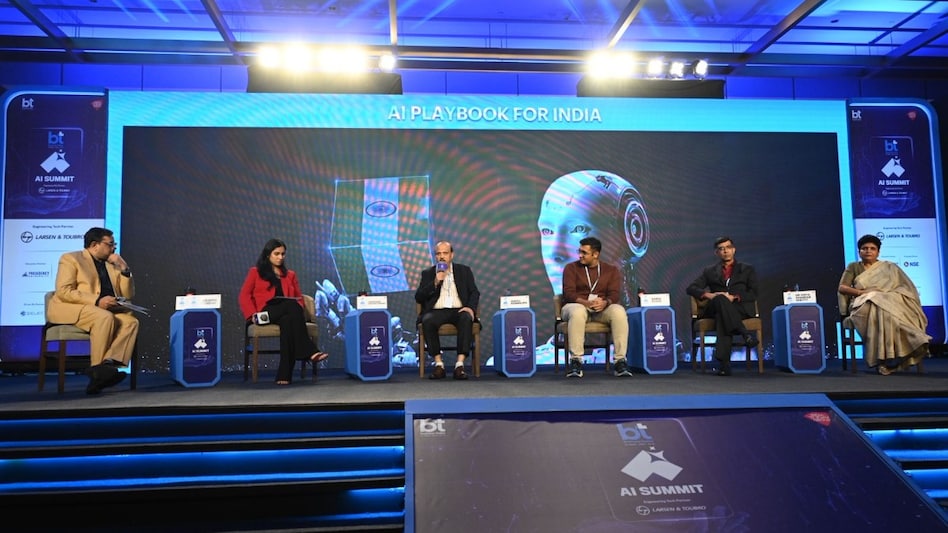
 Speakers at the 'AI Playbook for India: CTO Insights & Strategies' session highlighted infrastructure, innovation, and inclusion as the key drivers of India’s AI decade.

 Speakers at the 'AI Playbook for India: CTO Insights & Strategies' session highlighted infrastructure, innovation, and inclusion as the key drivers of India’s AI decade.
India’s AI revolution is gathering pace, driven by bold investments, deep-tech startups, and a young talent base ready to innovate. At the Business Today AI Summit 2025, industry leaders and educators discussed how the country can turn its AI promise into practical success.
The panel featured Shashidhar Ramakrishnaiah (CTO, Fractal), Harsh Dhand (Global Product Partnerships, Google Research), Kshitij Khandelwal (CTO, Pixxel), and Dr. Vidya Shankar Shetty (Pro Vice Chancellor, Presidency University, Bengaluru). Together, they explored the key enablers, such as infrastructure, innovation, and inclusion, that will shape India’s AI decade.
AI Playbook for India: From Labs to Real-World Impact
For most enterprises, AI adoption remains more talk than action. Shashidhar Ramakrishnaiah of Fractal explained why. “Many organizations get stuck in the experimentation phase and fail to scale,” he said.
Fractal’s approach lies in combining analytics, engineering, data foundations, and behavioural design. “We call it a decision-backward approach,” he added, “where we start from the business problem and work backward to build the right AI solution.”
Ramakrishnaiah believes startups play a crucial role in driving real adoption. “The energy and risk-taking ability of startups inspire large enterprises to reimagine what’s possible. If we blend that startup spirit into traditional organizations, the possibilities are limitless.”
Google’s $15 Billion Push for AI Leadership
Google is betting big on India’s AI potential. Harsh Dhand from Google Research highlighted the tech giant’s recent $15 billion investment to set up one of its largest AI innovation hubs in the country.
“This will create the foundational infrastructure, data sets, compute power, and models to empower thousands of researchers and hundreds of startups,” he said.
Google’s AI journey in India began in 2019 with a research lab focused on language, healthcare, and education. “We’re not just investing money,” Dhand emphasized. “We’re building solutions in India, for India, and in many cases, for the world.”
AI Beyond Earth: Satellites, Crops, and Rare Minerals
Space-tech startup Pixxel is redefining how AI is applied to Earth observation. “Our hyperspectral satellites look beyond images — they study the surface chemistry of the Earth,” said CTO Kshitij Khandelwal.
The technology helps predict crop yields, monitor soil health, and even identify rare earth minerals in regions like Rajasthan. “The potential impact over the next five years is tremendous,” Khandelwal said. “AI will help improve agricultural productivity, resource management, and sustainability at a national scale.”
Skilling the AI Generation
Dr. Vidya Shankar Shetty of Presidency University highlighted the transformation underway in education. “Students today are far more aware, adaptive, and curious,” she said. Encouragingly, more women are enrolling in AI and tech courses than ever before.
“The next leap will come from partnerships between academia and industry,” she added. “That’s how we turn curiosity into capability,” Shetty said.
As India builds its AI playbook, the path ahead is clear: scale innovation, invest in talent, and collaborate across ecosystems. The AI opportunity is not just about technology; it’s about shaping a smarter, more inclusive future.
 'Never seen so many tankers': India's Russian crude imports may hit record high in June
 Delhi EV policy approved: Road tax exempted for cars over ₹30 lakh; ₹50,000 subsidies for EV buyers
 9 shares may enter AMFI largecap list: BSE, Vodafone Idea, Groww, BHEL among probables
 Qatar Emir’s $500 million superyacht Al Lusail returns after luxury refit worth $35 million
 GIFT Nifty logs record open interest, contracts on June 25
 Delhi Unveils ₹15,000 Crore EV Policy: What It Means For Auto Companies And Consumers
 Gold, Silver Or Crude? Where Should Investors Bet Now? | Vandana Bharti
 How India Strategically Managed LPG & Crude Oil Supplies During West Asia War | K. Surana Explains
 Delhi’s Green Revolution: CM Rekha Gupta Unveils Massive ₹15,000 Crore EV Policy To Combat Pollution
 Why Crude Oil Prices Could Stay Under Pressure As China's Demand Weakens And Supply Improves
 Where should investors put their money? PL Wealth CEO has some tips
  Axis Bank CFO Puneet Sharma steps down; stock likely in focus on Tuesday
 Apollo Hospitals, Medanta, Healthcare Global, Max Healthcare, Artemis Medicare: Check target prices, outlook
 Polycab: Amid record FII buying, shares at all-time high but brokerages expect more upside
 Sensex, Nifty close in the red: Why markets fell and what to expect next