


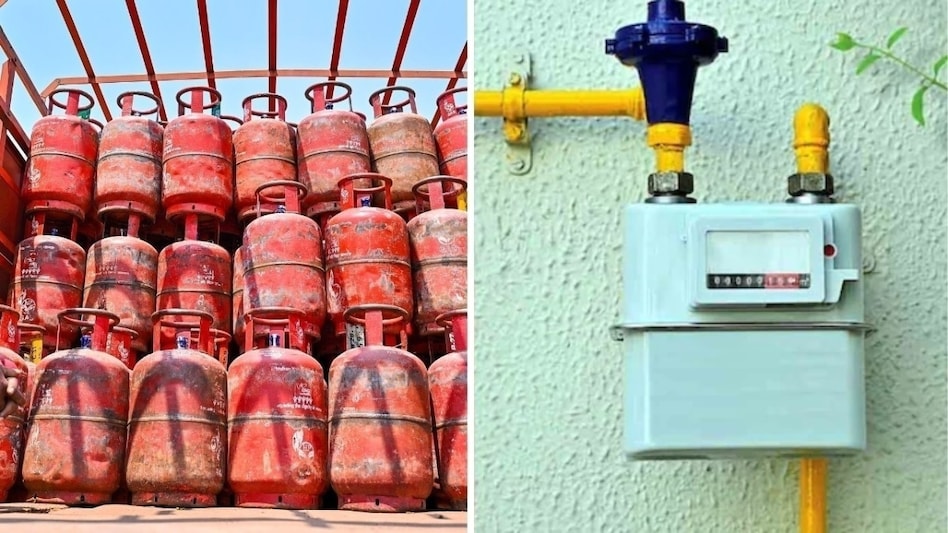
 What new LPG and PNG rules mean for households
Amid the Strait of Hormuz crisis and disruptions to energy supplies from West Asia, the government has moved to shift households towards piped natural gas (PNG) while tightening rules on liquefied petroleum gas (LPG).
Must Read: Can you apply for multiple PNG connections? Key rules consumers must know
India relies heavily on imports for cooking fuel, with a large share of LPG sourced from the Gulf region, making supplies vulnerable to geopolitical shocks.
The Centre has amended rules to prevent households from using both PNG and subsidised LPG at the same time, while also mandating a transition to piped gas in areas where infrastructure already exists.
Must Read: LPG or PNG connection? Your complete guide to gas connection problem
The push is aimed at easing pressure on LPG supply chains, prioritising cylinder availability for regions without pipeline access, and reducing dependence on a single fuel during a period of global uncertainty.
Must Read: LPG delays push households to black market: Prices soar up to ₹4000 per cylinder
What the March 14 order says on PNG and LPG
A notification issued on March 14 by the Ministry of Petroleum and Natural Gas amended the Liquefied Petroleum Gas (Regulation of Supply and Distribution) Order, 2000, making it mandatory for consumers with PNG connections to surrender their domestic LPG cylinders.
"No person having a piped natural gas (PNG) connection and also having a domestic LPG connection shall retain a domestic LPG connection, or take refills of domestic LPG cylinders from any Government oil company, or through their distributors. Such persons will be required to immediately surrender their domestic LPG connection," the order said.
The amendment also prohibits government oil companies and their distributors from issuing new LPG connections or refilling cylinders for households that already have a PNG supply.
Those with PNG connections have also been barred from applying for a domestic LPG connection, effectively ending the possibility of dual access to both fuels in areas where piped gas is available.
What happens if you don't switch
A second order issued on March 24 further tightened the framework. It mandates that LPG supply will be discontinued if households do not switch to PNG, where such connectivity exists.
The order states that LPG supply “shall cease after three months” if a household does not opt for PNG despite availability. An exception is allowed only in cases where PNG is “technically infeasible,” subject to a no-objection certificate.
At a media briefing, Sujata Sharma, Joint Secretary in the Ministry of Petroleum and Natural Gas, said the entity authorised or holding a license to retail CNG and PNG in a geographical area will notify LPG users in areas where piped gas is available.
Why the rules have been tightened
The changes are aimed at prioritising LPG supplies for households without access to piped gas and reducing pressure on supply chains at a time of disruption.
India imports about 88 per cent of its crude oil, 50 per cent of its natural gas, and 60 per cent of its LPG requirements. Before the escalation of conflict in West Asia, more than half of India’s crude imports, around 30 per cent of gas, and 85–90 per cent of LPG imports came from the region.
The conflict has disrupted flows through the Strait of Hormuz, a key transit route for Gulf energy supplies. While India has partly offset crude shortages by sourcing oil from countries including Russia, gas supplies have been curtailed to industrial users, and LPG availability has tightened for commercial consumers such as hotels and restaurants.
Push for PNG rollout
In parallel, the Petroleum and Natural Gas Regulatory Board (PNGRB) has asked city gas distribution companies to accelerate PNG connections to households, particularly in areas where pipeline infrastructure already exists.
India's total natural gas consumption stands at around 189 million metric standard cubic metres per day, of which about 97.5 mmscmd is produced domestically. Of the 13.94 mmscmd of administered price mechanism gas allocated to the city gas sector, only about 3.63 mmscmd is used in household PNG, with the rest going to compressed natural gas for vehicles.

 Who is Pralhad Joshi? Modi names veteran Karnataka BJP leader to lead Education Ministry after Pradhan's exit
 Third round of talks: CJP ends 49-day-long protest, says govt accepted 'key demands'
 Dharmendra Pradhan resigns, says decision taken to protect students' future amid NEET row
 All about Dharmendra Pradhan's educational qualification, wealth, assets and more
 India's first REIT mutual fund is here. Can it change how Indians invest in real estate?
  FDs vs Markets: Where Should You Keep Your Short-Term Money?
 Why Term Insurance Is Essential for Every Earning Member | Sum Assured & Coverage Explained
 Pakistan's Alleged Terror-Politics Nexus: Lashkar Links Spark Questions Over Fazlur Rehman
 Think Life Insurance Is Optional? Here's Why Every Indian Family Needs It Today
 FD Vs Arbitrage Fund: Which Is Better For High Taxpayers?
 Adani Power: 45 GW target, Rs 2 lakh crore capex plan among conference call highlights
  ITC Hotels, Chalet, Ventive, IHCL, SAMHI: Hotel stocks to buy despite travel disruptions
 ITC shares: Rs 307 a key short-term level to watch; here's target price
 Mphasis shares: FY27 guidance maintained; brokerages keep 'Buy' after Q1; check target price
 Should you buy every IPO? Research suggests patience may be the smarter strategy
 A game-changer for East Delhi? How the Delhi-Shahdara-Baraut Namo Bharat corridor could redefine NCR travel
 New York's $400 million climate bet: How a million trees are cooling a city the city from extreme heat Who is Pralhad Joshi? Modi names veteran Karnataka BJP leader to lead Education Ministry after Pradhan's exit
 Houthis target Saudi Aramco sites in Jizan and Yanbu as Red Sea tensions take a new turn
  Lifestyle inflation, delayed investing, high-interest debt: 3 biggest money mistakes young professionals make









