









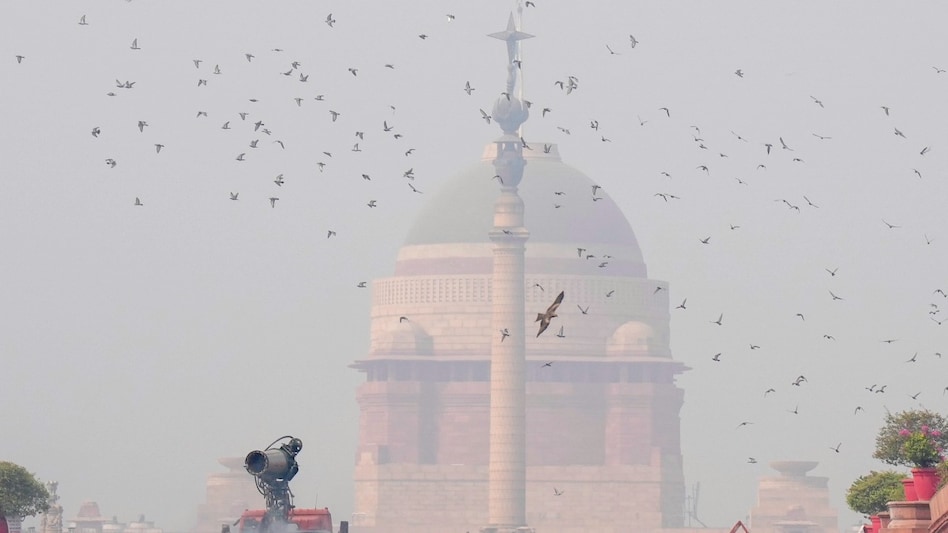
 Delhi air quality remains in the severe category on Friday

 Delhi air quality remains in the severe category on Friday
Delhi air pollution: The air quality index (AQI) continues to remain severe in the national capital on Friday. Even though the strictest Stage-4 curbs under the Graded Response Action Plan (GRAP) are under implementation, the air quality has remained in the ‘severe’ category. On Friday, the AQI of Delhi was recorded at 430, a slight improvement from Thursday’s 448.
According to SAFAR-India, Alipur station has recorded an AQI of 427, Anand Vihar station of 458, Bawana 468, Burari Crossing 442, Dwarka Sector 8 460, IGI Airport 397, ITO 455, Jahangirpuri 450, Jawaharlal Nehru Stadium 422, Lodhi Road 390, Mandir Marg 265, Mundka 465, Najafgarh 435, Nehru Nagar 459, North Campus DU 420, Okhla Phase 2 458, Patparganj 447, Pusa 396, RK Puram 450, Rohini 454, Shadipur 437, Siri Fort 453, Vivek Vihar 452, and Wazirpur 463 among others.
GRAP restrictions are put in place when the air quality deteriorates drastically. When the air quality is in the poor category (201-300), the first stage is implemented. When it deteriorates to ‘very poor’ (301-400), the second stage is implemented, third is implemented when the air quality becomes severe at 401-450, and stage four when the air quality hits severe plus at over 450.
DELHI AIR POLLUTION: STUBBLE BURNING, FIRECRACKERS
The government has blamed a combination of factors including stubble burning and firecrackers for Delhi’s worsening air quality. In a response to a question in Rajya Sabha, Minister of State for Environment Kirti Vardhan Singh said stubble burning contributed an average of 10.6 per cent to Delhi's PM2.5 pollution from October 8 to December 7.
Singh said that the air pollution in North India during the winter period is a culmination of multiple factors, including high levels of anthropogenic activities in the densely populated region.
Lower temperature, lower mixing heights, inversion conditions and stagnant winds, along with a combination of other factors such as stubble burning, firecrackers result in high pollution in the region.
The minister said that according to the Decision Support System of the Indian Institute of Tropical Meteorology, Pune, the average and maximum contribution of stubble burning to PM2.5 pollution in Delhi stood at 10.6 per cent and 35 per cent during the period from October 8 to December 7.
 Break silos, focus on results: PM Modi's message at key meeting with secretaries
 Indian economy resilient despite global shocks; NPAs to remain low: RBI report
 Why a weak monsoon may not hurt India's economy as much as before, Finance Ministry report explains
 Visa-on-arrival for select countries, simpler hotel rules: NITI Aayog proposes tourism overhaul
 First-time ITR filer? Why experts say you should enable the Income Tax Department's e-Filing Vault
 Rajnath Singh’s Big Vision: Why Gujarat Is Set To Become India’s Next Defence Manufacturing Hub!
 WhatsApp's Biggest Transformation Begins! No Phone Number, Ads & Premium Plans
 PM Modi Meets Top Secretaries | Watch To Know The Full Agenda
 100% Road Tax Waiver For Clean Vehicles! Centre's Big Push For EVs & Green Transport
 IPhone 18 Pro Secrets Leaked? Tata Electronics Cyberattack Raises Major Security Concerns
 Calcutta Stock Exchange shares rally in unlisted market; details here
 YES Bank gets rating upgrade for infrastructure, tier II bonds; key details
 Tata Communications shares: Two factors that may move the Tata Group stock in short term
  Sensex, Nifty extend slide: IT stocks drag markets lower; what to expect next
 Bharti Airtel deserves to trade at a valuation premium against global peers, says Nomura