








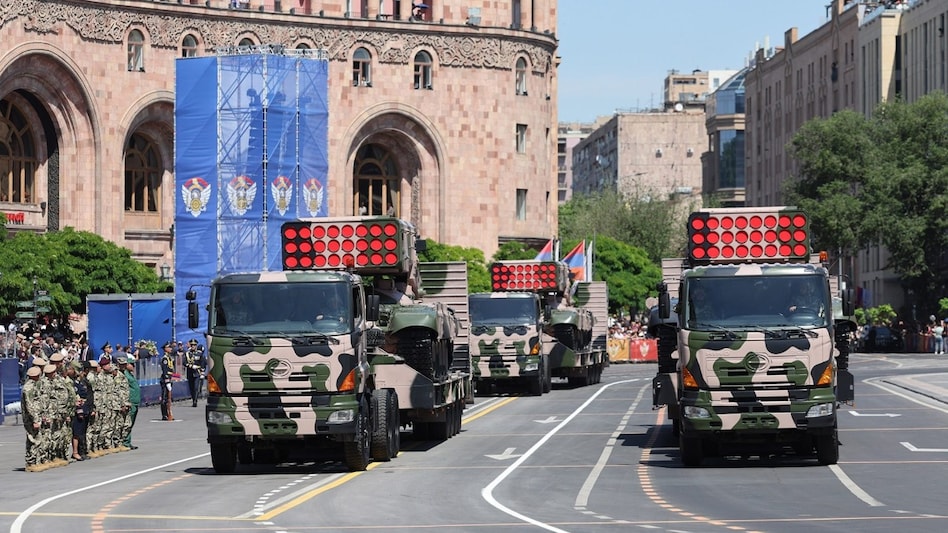
 For India, it was a public demonstration that its defence industry is beginning to compete in the global arms market.
 For India, it was a public demonstration that its defence industry is beginning to compete in the global arms market.
 Armenia’s latest military parade offered more than a display of hardware — it showcased India’s growing arrival as a serious defence exporter. During the Armenian Military Parade held on May 28, 2026, a wide range of Indian-origin systems rolled through the capital, underlining how New Delhi has emerged as one of Yerevan’s most important defence partners in a remarkably short span.
The display was strategically significant for both countries. For Armenia, it signalled a rapid military modernisation drive amid tensions in the South Caucasus. For India, it was a public demonstration that its defence industry is beginning to compete in the global arms market.
What Indian weapons did Armenia showcase?
The parade featured a broad mix of Indian-made offensive and defensive systems:
Akash Air Defence System: Developed by India’s DRDO and produced by Bharat Dynamics Limited (BDL), the Akash system is a medium-range surface-to-air missile platform designed to intercept aircraft, drones, and cruise missiles. Its appearance in Armenia indicates Yerevan’s push to strengthen air defence capabilities after vulnerabilities exposed during recent regional conflicts.
ATAGS 155mm Artillery Guns: The Advanced Towed Artillery Gun System (ATAGS), jointly developed by DRDO and Kalyani Group, is among India’s most ambitious indigenous artillery projects. The 155mm gun has a long firing range, automated systems, and high mobility — making it a modern replacement for legacy Soviet-era artillery.
Pinaka Multi-Barrel Rocket Launcher: Pinaka is India’s indigenous answer to systems like Russia’s Grad and Smerch rocket launchers. Designed for saturation strikes over large areas, Pinaka gives armies the ability to hit enemy positions rapidly and at long distances. Its deployment abroad marks a major milestone for India’s rocket artillery exports.
Swathi Weapon Locating Radar: This radar system detects and tracks incoming artillery shells, rockets, and mortars, helping armies identify enemy firing positions. For Armenia, such systems are crucial in mountainous conflict zones where artillery duels remain central to warfare.
ALS-50 Loitering Munitions: Often described as “suicide drones”, loitering munitions hover over a battlefield before striking targets with precision. The inclusion of the ALS-50 reflects how India is increasingly entering the fast-growing global drone warfare market.
Why is Armenia buying Indian weapons?
Armenia’s shift toward Indian defence systems is driven by several strategic realities. For decades, Armenia relied heavily on Russian weapons. But the Ukraine war, sanctions, supply chain disruptions, and Moscow’s changing geopolitical priorities have weakened Russia’s ability to supply arms consistently.
That forced Armenia to diversify suppliers.
India emerged as an attractive alternative because it offers:
Lessons from recent conflicts
The 2020 Nagorno-Karabakh conflict transformed military thinking in the region. Azerbaijan’s use of drones, precision artillery, and missile systems exposed major weaknesses in Armenia’s air defence and battlefield awareness.
Indian systems such as Akash, Swathi radar, and loitering munitions directly address many of those gaps.
Why this matters strategically for India
India is becoming a defence exporter. For decades, India was among the world’s largest arms importers. Now, New Delhi is trying to transform itself into a defence manufacturing and export hub under the “Make in India” initiative. Armenia has become one of the clear examples of that strategy succeeding.
Indian firms and state-backed defence companies are no longer just producing for domestic use — they are entering active geopolitical markets.
Expanding influence in the South Caucasus
The Armenia relationship gives India a strategic foothold in the South Caucasus, a region historically influenced by Russia, Turkey, Iran, and Western powers.
This matters because:
Defence cooperation therefore carries geopolitical weight beyond simple arms sales.
The Turkey-Pakistan factor
One of the most important strategic dimensions behind India-Armenia defence ties is the emerging Turkey-Azerbaijan-Pakistan alignment.
Turkey supplied drones and military support to Azerbaijan during the Nagorno-Karabakh conflict. Pakistan openly backed Azerbaijan diplomatically and remains one of the few countries that does not recognise Armenia formally.
India’s growing defence relationship with Armenia is therefore viewed by many analysts as part of a broader balancing strategy against hostile regional alignments involving Pakistan. If Indian systems perform effectively in operational environments, more countries in Asia, Africa, and Eastern Europe may begin considering Indian alternatives to Russian, Chinese, or Western weapons.
 Adani, Tata, Mahindra, Godrej double down on NCR real estate market
 'It is time to ride this wave': Ex-Infosys CEO Vishal Sikka launches AI startup Hang Ten Systems
 'Remarkable achievement': Vizhinjam welcomes 1,000th vessel, joins world's fastest-growing ports club
 Gold falls to 12-week low; Robert Kiyosaki says he is waiting to buy more
 Now, govt to bring out a monthly Index of Services Production from July 14
 A Dream Wedding Turned Tragedy: Inside The Ketan Agarwal Murder Investigation
 Keralam's Low-Alcohol Tax Cut Sparks Political Row, Congress Faces Backlash
 Adani Unveils AI And Infrastructure Vision For India's Future Growth
 NSA Ajit Doval Hosts 16th BRICS NSA Meet, Focus On Emerging Global Security Threats
 Will AI Destroy Indian IT Stocks? Experts Warn Investors On Crucial Pivot
 IRFC OFS oversubscribed 1.86 times on Day 1; government exercises green shoe option
 Vedanta Iron shares surge nearly 51% from listing-day intraday low: What analysts are saying
 Rs 17,000 salary for MD, 40% stock mismatch: ED's explosive findings after raids on Rajesh Exports
 Sensex, Nifty rebound: What's driving the recovery and what investors should watch next
 Adani Power shares: Why Morgan Stanley ups target price by 60% on it?