


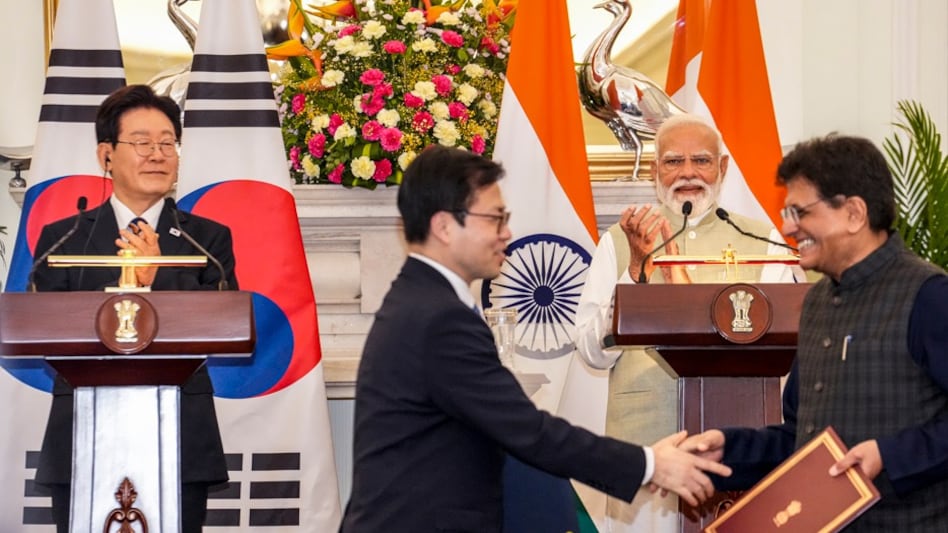
 India-Korea pledged to double their annual trade
Union Minister of Commerce and Industry Piyush Goyal while addressing a session at the India-Korea Business Forum that India will set up a Korea enclave to invite more investments as well as companies into the Indian market.
“I am also happy to report to you that Prime Minister Modi and President Lee have today discussed setting up a large industrial township – a Korea enclave in India with plug-and-play infrastructure to encourage greater investments and invite more Korean companies to come an leverage the large India demand as well as the open doors of preferential access that India today enjoys in almost two-thirds of global trade or two-third of the global GDP given the nine free trade agreements that we have finalised in the last three and a half years,” said Goyal.

 Pilots’ body urges govt to set up Civil Aviation Authority, replace DGCA with autonomous regulator
  6th-gen fighter tech: India turns to French-led European consortium to ensure air force doesn't lag
 EV boom could trigger a new commodity supercycle: Why copper, lithium, graphite matter
 Air India, Air India Express hike pilot salaries by up to 17% amid poaching battle: Report
 India vs Taiwan, South Korea: Where is global capital heading next?
 I.T. Stocks Rebound After Sharp Rally: Is The Worst Over Or Is Caution Still Needed?
 Income Tax Notices Explained: Common ITR Mistakes That Can Trigger A Tax Department Notice In India
 Reasons Why Your Health Insurance Claim Gets Rejected | Experts Share How To Avoid Them
 Deductibles Vs Co-pay In Health Insurance: What They Mean & How They Affect Your Premium | Health Insurance
 How To Choose Mutual Funds And Avoid Costly Investing Mistakes
 Poonawalla Fincorp: Planning to buy the NBFC stock? Here's what expert says
  Adani Green shares down 16% from July high; is it time to buy this Adani stock? Targets
 Short-term buy ideas: 2 stocks that Pradip Halder is betting on
 India’s realty IPO market evolves: Why workspaces, managed assets are next big theme
 PPFAS MF's Rajeev Thakkar explains why the fund isn't chasing OpenAI-like AI stocks
 Hormuz standoff deepens: Iran issues sweeping demands to US for strait access amid missile strikes
 No, your UPI transactions aren't getting charged: Government refutes fee rumors claimsPilots’ body urges govt to set up Civil Aviation Authority, replace DGCA with autonomous regulator
  Hope to register all urban cooperative banks with umbrella body in current financial year: NUCFDC CEO
 ‘Want guaranteed returns... make a Bank FD’: PPFAS’ Rajeev Thakkar on equity volatility










