'One hell of a problem for India': Taiwan crisis will be bigger than Hormuz
'One hell of a problem for India': Taiwan crisis will be bigger than Hormuz
'We seem to think that Taiwan is not our concern because it's 5,000 kilometers away. Let me tell you that we are grossly underestimating the impact of a crisis in the Taiwan Strait on our country,' warns Vijay Gokhale, former Foreign Secretary
China has been preparing, for years, to take control of Taiwan (AI generated)
The Hormuz crisis appears to be winding down, but India will have to prepare for another one that may be even bigger.
Till a few months ago, the chances of a crisis in the Strait of Hormuz looked almost negligible. The Hormuz closure was war-gamed by experts, but it did not seem that Tehran would actually go down that path.
Advertisement
There were two factors behind this reasoning. First, Iran had never, in its history, closed Hormuz. Second, it too relied on the strait to export its own oil, a lifeline for Tehran.
Pushed to the wall by Israeli and US strikes and elimination of top leaders, Tehran threatened to blow up any ships crossing the Hormuz. The strait was effectively shut, and it worked for Iran.
The Hormuz closure created the "largest supply disruption in the history of the global oil market," according to the International Energy Agency (IEA).
About 25 per cent of the world's seaborne oil passed through Hormuz in 2025. At one point, 55 per cent of India's total imports came through Hormuz. This figure stands at 90 per cent for CNG.
Advertisement
The shutdown of Hormuz pushed oil over $100 a barrel, creating anxiety not only in Asia - which relies heavily on supply through the strait - but also in Europe and the US. Fearing serious economic impact, Washington softened the blow - and preferred to negotiate a deal with Iran.
US President Donald Trump has announced the deal would be signed on Friday, June 19.
Once Hormuz is reopened, it is natural to think that the worst is behind us. But India's vulnerabilities do not end in West Asia.
If you are done with Hormuz, turn your gaze to the East - the Taiwan Strait. And if you think that's too far and won't bother us - think again.
Advertisement
The impact of the Hormuz shutdown is a fraction of what could happen once the crisis erupts in the Taiwan Strait.
"We seem to think that Taiwan is not our concern because it's 5,000 kilometers away. Let me tell you that we are grossly underestimating the impact of a crisis in the Taiwan Strait on our country," says Vijay Gokhale, former Foreign Secretary, during a discussion with ThePrint on his new book, China's War.
He says he is not talking about war because if that happens, then it would be World War III. "Because the United States will be involved." He warns that if the Hormuz playbook - which involves blockade, missile, and cyber attack - is applied in the Taiwan Strait, the trade in the Malacca Strait will immediately stop. And India will be heavily impacted.
The Malacca Strait is a narrow stretch of water between the Malay Peninsula and the Indonesian island of Sumatra. It connects the Andaman Sea to the South China Sea, making it one of the world's most important maritime chokepoints. A large share of oil and gas imports for countries such as China, Japan, and South Korea transit through it. More than 80,000 ships use the strait annually.
Advertisement
'India's 40% of trade goes through Malacca'
"Forty per cent of India's trade goes through the Malacca Strait. So, any Indian exporter exporting through the Malacca Strait is going to take a hit. Supply chains will collapse because 30% of all global supply chains originate in China. And that means not only the Indian exporter but the Indian importer importing from China is going to suffer," Gokhale points out.
The crisis will not be limited to exporters sending goods to the East; those exporting to the West will also be hit. "All supply chains globally will be disrupted. And therefore, the West won't purchase your stuff even if you're not exporting east of the Malacca Strait. So you're going to have a problem with that," the former secretary says.
Even worse, he continues, 90% of all (advanced) semiconductors come from that region - Taiwan, Japan, Korea, and China. "You are a heavily service-dependent economy. Your e-commerce will collapse. Your e-logistics will collapse. Your entertainment industry will collapse. Your education industry will collapse. The unemployment implications will be massive and socially destabilising for this country. You won't be able to order pizza. You will not be able to buy a car."
Advertisement
'IT-enabled services will be crippled'
The crisis in the Taiwan Strait will also cripple India's IT industry, warns Gokhale, who has also served as Ambassador to China from January 2016 to October 2017.
The former ambassador further states that 15 submarine cables from India to Silicon Valley are anchored in Taiwan. And in the last two years, he adds, China has cut three cables and demonstrated its capacity to do so.
"Your IT-enabled services will be crippled. The impact on India's economy will be massive. We have done no study in this regard. We do not understand the implications of this. We are totally unprepared for a crisis in the Taiwan Strait."
"We should not think Taiwan is too far or that it's not my problem if China invades Taiwan. It is one hell of a problem for us," the former diplomat warns.
Taiwan Strait crisis - inevitable?
China has been preparing, for years, to take control of Taiwan.
In 2023, former CIA Director William Burns said US intelligence believed Xi Jinping had instructed the People's Liberation Army to be ready by 2027 to conduct a successful invasion of Taiwan.
And if that happens, a crisis will erupt in the Taiwan Strait.
Advertisement
In March this year, the US intelligence agencies concluded that Beijing does not currently plan to invade Taiwan in 2027. "China, despite its threat to use force to compel unification if necessary and to counter what it sees as a US attempt to use Taiwan to undermine China's rise, prefers to achieve unification without the use of force, if possible," the US intel agencies said in the 2026 Annual Threat Assessment.
However, the same report also acknowledges: "China has never abandoned the use of force against Taiwan."
In his book Prisoners of Geography, British author Tim Marshall argues that there is a weakness in Western thinking when it comes to geopolitics and the threat of war. "Too many policymakers overestimate logic and underestimate emotion."
For Xi Jinping, Taiwan is not just a piece of land - it is an emotion.
Saurabh Sharma is Senior Assistant Editor at Business Today Digital. He writes on the economy, policy, business, and politics. With over a decade in journalism, he has worked with The Financial Express, Mint, and Times Now.
At BT, he tracks Indian politics, global affairs, and the strategic rivalries shaping Washington, Moscow, and Beijing, with a focus on China, Pakistan, the Middle East, and Southeast Asia.
Away from the newsroom, he enjoys non-fiction, especially books on geopolitics, intelligence, and international relations.



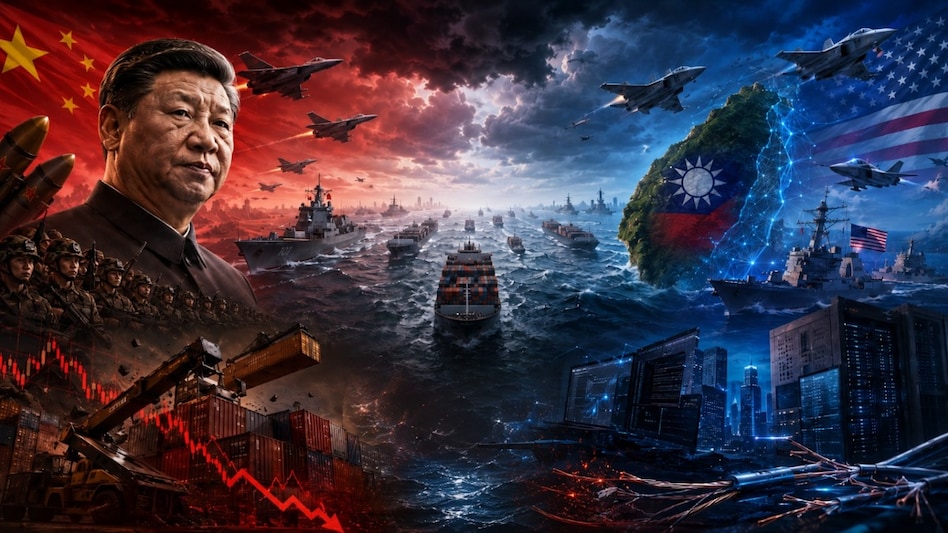 China has been preparing, for years, to take control of Taiwan (AI generated)
 'ISRO will neither be privatised, nor...': Space agency clarifies its future role amid private-sector push
 India becomes key diesel supplier to Europe via Bab-el-Mandeb
 SBI plans to hire 12,000 employees, up to 250 more branches in FY27
 Clash with BRICS Leaders’ Summit: GST Council meeting likely to be rescheduled
 West Bengal has Rs 8 lakh crore debt. Then why is it giving Rs 3,000 cash? FM Swapan Dasgupta explains
 Equity, FDs, Gold & More: How Couples Should Plan Their Investments Together
 How Couples Can Balance Shared Goals With Individual Dreams And Financial Needs
 FSSAI CEO On Misleading Food Ads, Brand Crackdowns And Pressure From Industry Lobby
 Couples & Tax Planning: How Smart Expense Planning Can Help Reduce Family Tax Outgo
 Mutual Fund Allocation: How Much Should Investors Allocate To Large, Mid & Small Cap Funds?
 APL Apollo, GNFC, Apar, Force Motors among stocks to turn ex-dividend next week; big payouts in focus
 LIC weighs NSE IPO strategy: CEO says market conditions, valuation to decide final move
 IHCL, LemonTree, Chalet among 5 hotel stocks to buy; analysts see up to 49% upside
 FCNR(B) windfall lifts NBFCs, small private banks: Why these stocks may be the bigger winners
 20 Asia-Pacific stocks with up to 145% upside: Full ‘Going For Glory’ list, no Indian stock included
 Global trade runs on the oceans: 10 maritime chokepoints that could disrupt the world economy
 484 silver coins, including 134 with archaeological significance, seized at Delhi's IGI Airport
 Ganga crosses highest flood level in Patna: Over 22 lakh affected as Bihar floods worsen












