This coercive behaviour by Beijing is unlikely to change anytime soon, suggests Vijay Gokhale, former foreign secretary, in his latest book - China's Wars.
Beijing has engaged in coercion or 'grey zone' conflicts with Taiwan in 1958, India in 1962, then Soviet Union in 1969, and Vietnam in 1979.
While Beijing has so far maintained that the 1962 war was a result of New Delhi's Forward Policy, Gokhale shreds that argument and makes the case that it was China that started the war.
Gokhale writes that as the PRC (People's Republic of China) does not regard India as a peer competitor, New Delhi's interests are unlikely to receive equal consideration to its own. "Nor will India's readiness to resolve the boundary question be likely to alter the calculus of Chinese thinking."
According to him, India needs to prepare to live with a "persistent Chinese overhang on national security for the foreseeable future until its comprehensive national strength reaches the levels of development that compels China to deal with it on an equal footing."
Don't Miss: Drones v/s Jets: Is it financially prudent to spend billions on manned platforms?
The foreign secretary, however, notes that the progress that India has made over the past three decades and its more confident stance on national security matters are being taken notice of in Beijing.
But given China's current perception about the vast gap between the two nations, he adds, Beijing continues to assess the threat from India as being "relatively low." "This likely implies that on key concerns for India's national security, including the disputed boundary with China, there is no compelling cause for the PRC to settle," he argues in the book.
India must, therefore, prepare for a prolonged period of armed coexistence, writes Gokhale, who has served as India's ambassador to China from January 2016 to October 2017. "The era of peaceful coexistence is at an end. It (India) should build the necessary military, economic and diplomatic deterrence on its own in order to prevent the PRC from altering the status quo on the boundary."
Will China go to war with India again?
Gokhale doesn't think so.
He presents multiple reasons why Beijing may not go for a large-scale conflict with India.
Ever since the PRC was founded, the former ambassador writes, Beijing's policy towards India was to neutralise what it perceived as a pro-Western tilt.
"If India could not be friendly towards China, it should not be allowed to become so friendly with the US as to endanger China's national security," so went the thought.
Steering India towards keeping a neutral stance in superpower competition so that it did not take sides with other major powers against Chinese interests became the overriding political objective of the PRC's India policy - "and this remains so even now."
For China, the two red lines or core national security concerns are: survival and continuance of the Communist Party of China in power for the very long-term, and the prevention of attempts by Western 'anti-China forces' led by the US to block, suppress and contain China through sabotage.
The former ambassador warns Beijing's threat perception about India could sharply escalate if it sees New Delhi siding with the US to increase its efforts to interfere in China's peripheral affairs, or joining the West in subverting the Chinese Communist Party's grip on power.
Gokhale, therefore, writes that it is necessary for New Delhi to continually monitor how Beijing views its relationships with Washington and Moscow.
Even in 1962, China was uncomfortable with New Delhi's growing proximity to Washington. Sino-Indian tensions on the border and India's activities in Tibet were, therefore, seen by Beijing as part of a much broader security challenge. "It (Beijing) was, and it remains, concerned that India's proximity to other great powers could upset the delicate global balance of power to the detriment of China's national security."
PLA's military coercion is principally driven by political goals and less by purely military objectives, Gokhale writes. It looks at territorial disputes not just in military terms but as part of the broader political question of whether the adversary poses a geopolitical challenge or threat to the PRC.
Despite a disputed boundary with India, thus far, there are few reasons to conclude that Beijing sees a broader or fundamental threat from India, the former diplomat says. "The PRC has become anxious at India's growing proximity to Washington, but is unlikely to have conclusively determined that this has become a geopolitical problem that needs to be dealt with through the application of coercive means."
If this assessment holds, Gokhale argues, "then there is no good rationale for China at present to make a military grab for wide swathes of Indian territory over which it has laid claim."
In the 1960s, former Foreign Secretary Jagat Mehta assessed that in Beijing, there was no anxiety that India might take military action to recover the occupied area of Ladakh.
That assessment holds even today, the former diplomat says. "In such circumstances, by weighing the benefits of pushing India against a wall through military coercion for territorial gains against the overall political damage that this might do to China's larger strategic objective of keeping India in a neutral posture within the context of the Sino–US rivalry, the PRC will likely avoid a local or general war with India over territory."
He, however, warns that the Chinese calculus would significantly alter if India were viewed as pursuing a deliberate policy of hostility either singly or with a major power that threatens China's 'core interests'.
"Since there is no indication of this happening, Beijing would likely prioritise ensuring continued Indian neutrality as its geopolitical contest with the US sharpens."
Must Watch: How The New Quad Summit In Delhi Just Created China's Worst Nightmare
'China knows a total victory is not likely'
There are two other considerations that might also persuade Beijing against pursuing wider conflict with India. First, when Beijing thinks its superior capacity is adequate enough to deter the adversary, it will not resort to the actual use of force. And second, the PRC prefers not to initiate a conflict unless absolute victory is assured.
The second was, in fact, Mao Zedong's principle.
When China was preparing for an attack in the Taiwan Strait in 1958, Mao had told the PRC: "We must persist in the principle of fighting no battle we are not sure of winning."
If Xi Jinping's China continues to follow that principle, it may avoid a war with India.
Gokhale writes that the India of 2025 is not what it was in 1962 - and "China knows a total victory is not likely." He says the communist regime in Beijing "runs the risk of losing prestige and of the leadership forfeiting credibility" if it launches a large-scale military attack on India without being certain that it will result in a decisive victory.
A large-scale conflict might also, potentially, tip India from a posture of neutrality to one of alliance with China's principal adversary.
The PRC also risks a potential reputational damage in the region if it goes to war with India, the former ambassador says, adding that others might no longer see the PRC as a benign actor and push some of China's neighbours to bandwagon with the US in an effort to balance the PRC.
If we agree that the PRC is a rational actor, the veteran diplomat writes, then weighing all these factors in the balance of risk versus gain, Beijing will, possibly, conclude that open war with India might not be a wise political option.
Despite this, Gokhale cautions that there is no circumstance under which large-scale conflict between India and China should be ruled out entirely.
"China is an opportunistic power," he writes, citing some case studies. "Should a geopolitical opportunity present itself for China to make quick and politically safe territorial gains that simultaneously deliver a strong political-psychological shock to India, it might not hesitate to take such an opportunity."



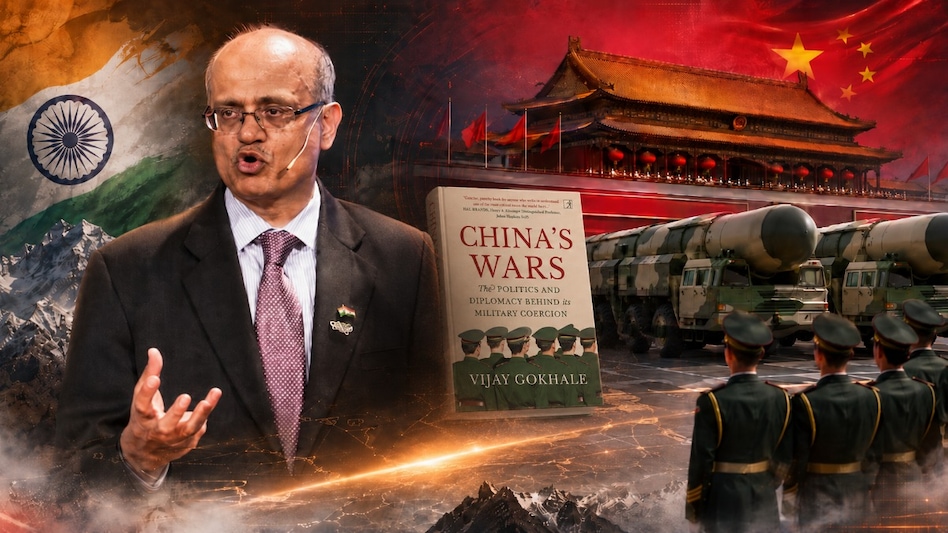 Vijay Gokhale, former foreign secretary, has come up with a new book - China's Wars (AI generated)
 ‘An Indian consumes 1/10th of an average American’: Amb Kwatra says energy security comes first
 Tata stock to buy: Nuvama bets on unique tech-telecom play, sees 28% upside
  NSE IPO, Hero Motors IPO, SS Retail IPO, Jindal Supreme IPO: GMP of four ongoing issues rises up to 32%
 UPI MDR: BharatPe distances itself from Ashneer Grover's remarks, says UPI to remain free for consumers
 IndiGo shares in focus as baggage, infant fee, priority boarding charges likely raised
 Corporate Health Insurance Vs Retail Policy: Why You Need Personal Health Cover Too
 How India Changed In 12 Years: PM Modi’s Journey From Economic Reforms To Viksit Bharat
 Modi @76: From Twitter To Instagram, How His Digital Outreach Has Evolved
 Stock Picks To Watch: Shibani Kurian Reveals Kotak AMC’s Market Bets
 Gold ETF vs Physical Gold: Know the Tax Rules, Charges and Key Differences
 Tata Chemicals, Tata Investment shares drop up to 8%: Why Tata stocks are falling today
 OnEMI Technology shares in focus as board clears fund raising via preferential route
  Adani Power, Adani Green, Adani Ports, Adani Energy: Jefferies shares target prices
 Kotak Bank, Auro Pharma, GE Vernova T&D: Top stocks to trade — Key levels, target price & stop loss
 What endures: The residential school in a changing world
 Only one Indian-American lawmaker voted in favour of Russia sanctions act: Who is Raja Krishnamoorthi?












